Published by HALOX Co.
2026 Ford Maverick Trims and Powertrains: Hybrid, EcoBoost, Lobo, and Tremor
What Ford publishes for the 2026 Maverick's five trims, the hybrid and the EcoBoost, and FWD, AWD, and Advanced 4WD, set next to Hyundai's 2026 Santa Cruz sheet.
The yellow truck on the blue carpet is a 2026 Ford Maverick, photographed January 16, 2026, at the Montreal International Auto Show. The file does not name a trim. What it shows is the shape Ford’s spec sheet still calls a unibody SuperCrew pickup: four doors, a short bed, a black honeycomb grille with the oval in the middle, and a lamp that wraps the lens in a bright C. Final assembly on that sheet is the Hermosillo plant in Sonora, Mexico. The body panels are steel. The hood is aluminum.
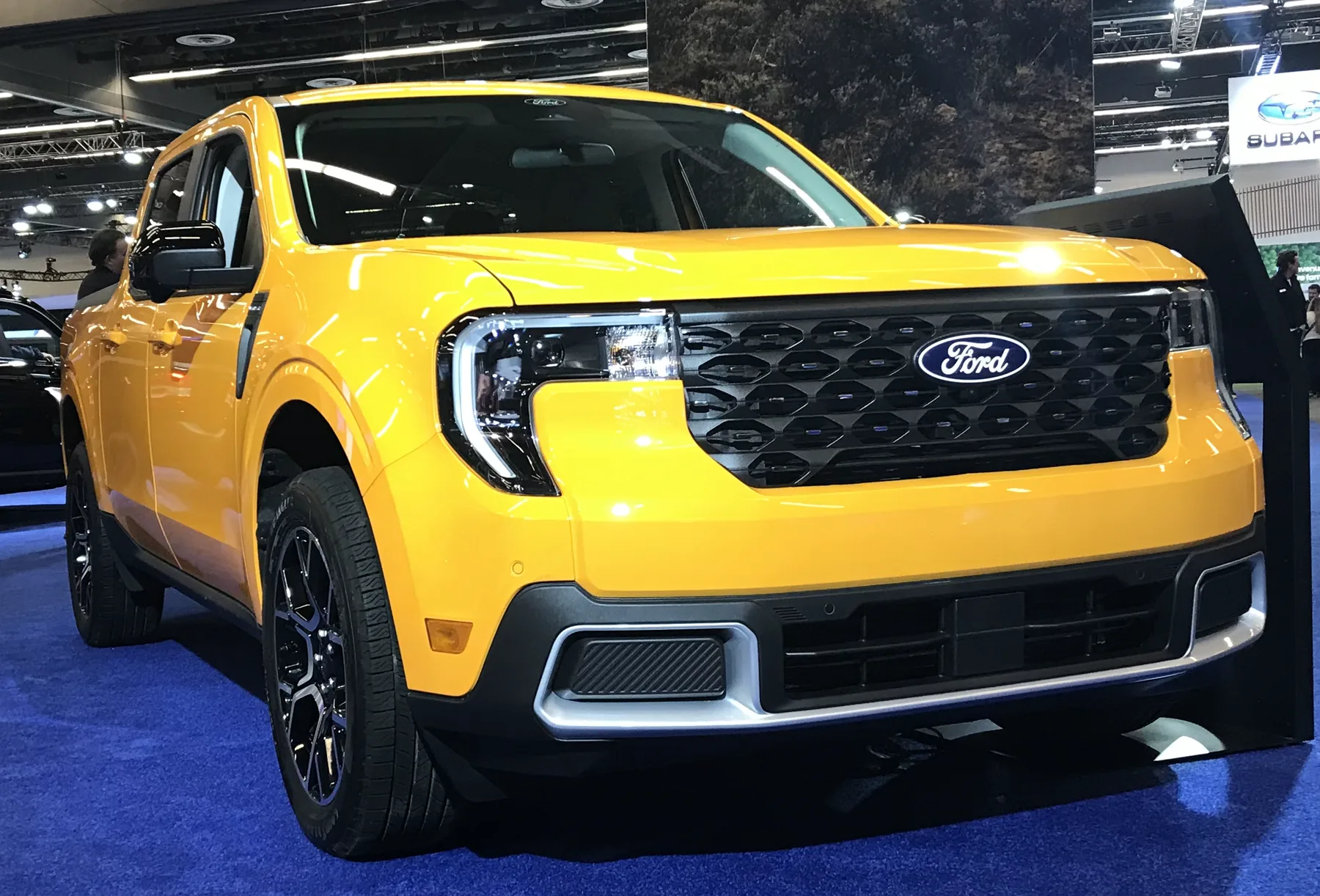

Ford’s August 27, 2025 note is the company’s list of what changed, and the list is short. The 2.0-liter EcoBoost in front-wheel drive is back. On XL and XLT, that front-drive EcoBoost is priced $1,000 under the standard hybrid front-drive truck. The EcoBoost with all-wheel drive is a no-charge upgrade against that same hybrid. Two paints are new: Marsh Gray, and Orange Fury Metallic Tri-Coat. A power-sliding rear window, which the note calls realigned, is optional on Lariat and Tremor, and the option reaches XLT and Lobo later. Every 2026 Maverick gets the Ford Connectivity Package, one year included and seven years optional. A conventional spare is offered on its own, with what the note calls increased availability. The XLT Luxury package, code 54L, no longer includes a six-way passenger seat. The four-way passenger seat stays. SiriusXM with 360L, on a three-year plan, is optional. The note prints a starting MSRP of $28,145. That sentence does not itemize a destination charge.
The spec sheet, dated July 20, 2026, version 1.2, names five trims: XL, XLT, Lobo, Lariat, and Tremor. Ford’s model page says the hybrid is standard on XL, XLT, and Lariat. The sheet’s standard drivetrain line is that hybrid, front-wheel drive, with the PowerSplit continuously variable transmission. All-wheel drive is available. The model page says it is standard on Lariat and available on XL and XLT, and that Lobo and Tremor come with Advanced 4WD. Those are Ford’s labels on this truck. They are not a finding that Advanced 4WD has a low range. A separate note here is about how Ford manuals treat AWD and the 4H and 4L positions on trucks that have those positions.
Wheels on the sheet sort the trims the Montreal photo does not. XL’s standard wheel is a 17-inch Sparkle Silver-painted steel wheel, on a 225/65R17 all-season tire. XLT’s is a 17-inch Carbonized Gray-painted aluminum, on the same tire size. Lariat’s is a 19-inch painted aluminum, on a 225/55R19. The black wheel on the yellow show truck is none of those three lines by itself. The file still does not say which trim was on the stand.
Lobo keeps the seven-speed. Tremor does not get the hybrid.
The gray truck is a 2025 Lobo, photographed April 25, 2025, at the New York auto show. The badge on the front fender reads LOBO. The grille is a run of vertical slats, not the honeycomb on the yellow truck. The roof and the mirror caps are black.
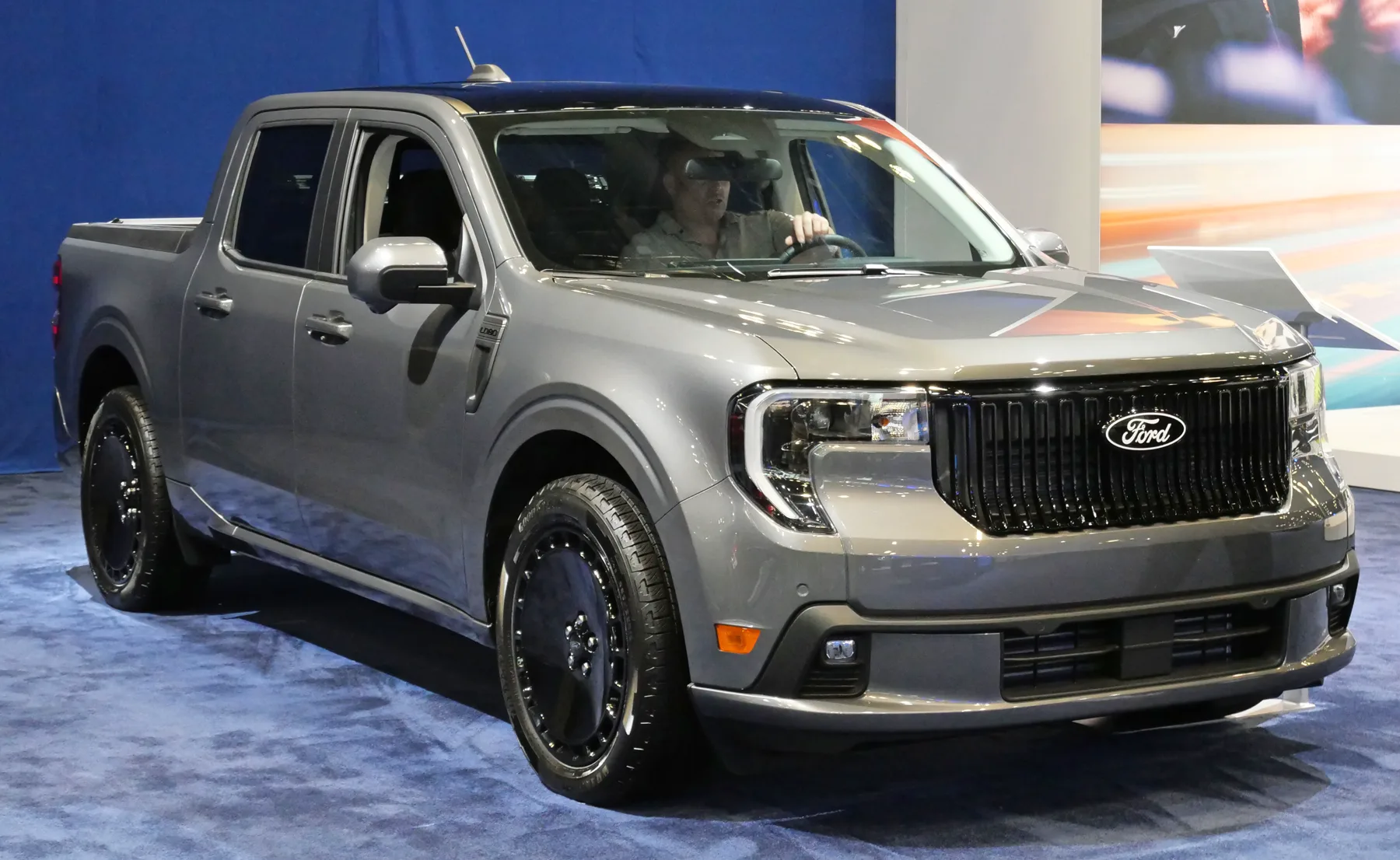

Ford’s 2026 Lobo page lists one engine: a 250-horsepower 2.0-liter EcoBoost, Advanced 4WD, and a seven-speed quick-shift transmission. Towing is 2,000 pounds when properly equipped. Payload is 1,045 pounds with that powertrain. The spec sheet’s standard Lobo wheel is a 19-inch black-painted turbofan-style aluminum, and a 19-inch black-painted aluminum is optional. The wheels in the photograph are black and multi-spoke. The picture does not establish that they are the turbofan wheel, and a 2025 show truck is not a 2026 build sheet.
Tremor is the other EcoBoost-only line. The 2026 Tremor page answers its hybrid question with no. The standard powertrain it lists is a 250-horsepower 2.0-liter EcoBoost, Advanced 4WD, and an eight-speed automatic, with a 16.5-gallon tank. The page uses two phrases for the rear hardware: “electronic-locking rear drive unit” in one block, and “Twin Clutch Rear Drive Unit” in the feature list. It does not say how those phrases relate. Towing is 2,000 pounds when properly equipped. Payload is 1,140 pounds with that EcoBoost, Advanced 4WD, and eight-speed.
The spec sheet’s Tremor column puts minimum running ground clearance at 9.1 inches and the approach angle at 30.8 degrees. Lobo’s column is 7.4 inches and 19.0 degrees. The hybrid front-drive column is 8.1 inches and 20.3 degrees. Those are published geometry figures. They are not a trail report, and they are not a statement that the higher number tows more. Tremor’s towing line is the 2,000-pound one.
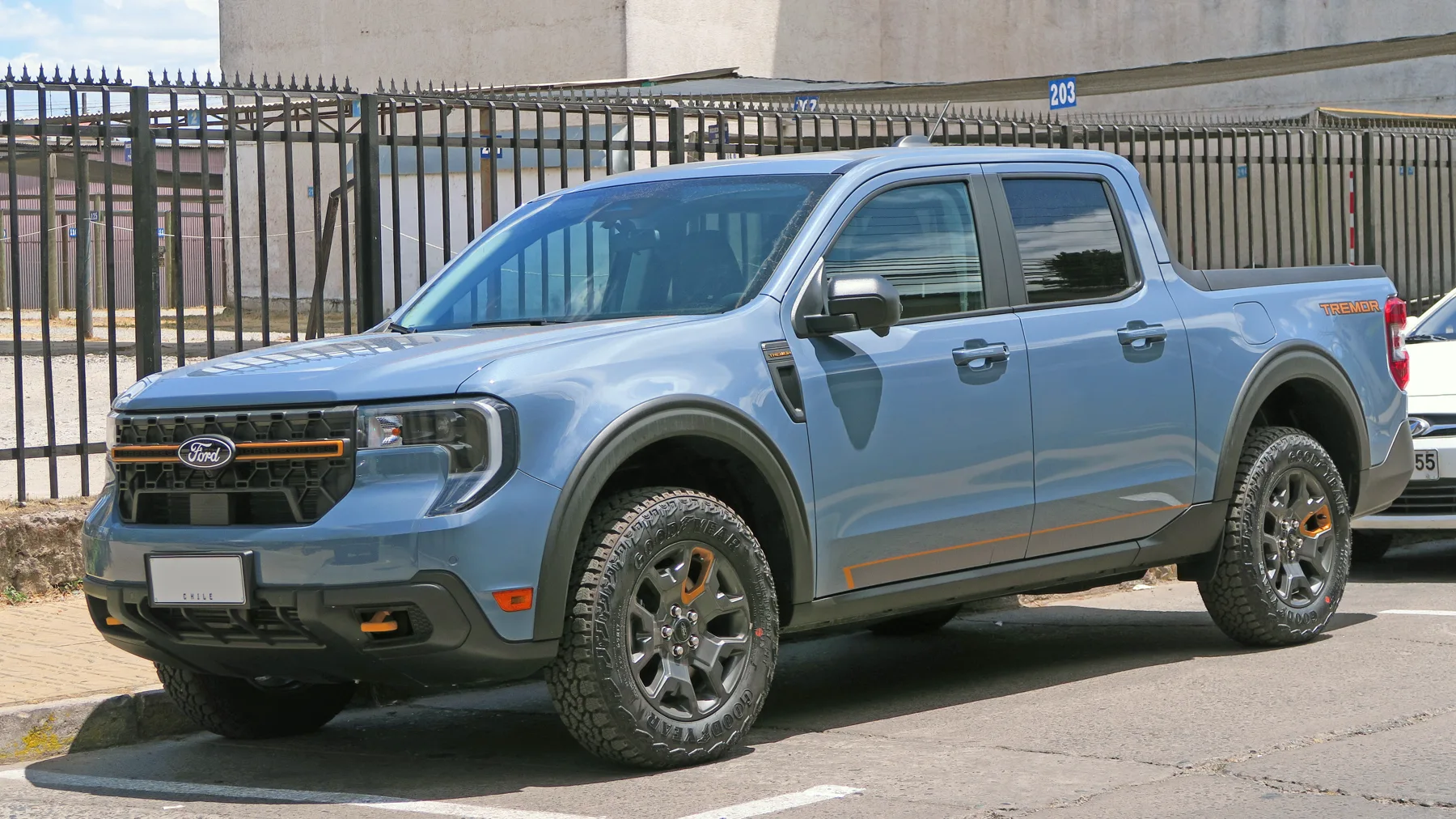

The file titles this photograph Ford Maverick Tremor 2026. Orange letters on the bed side read TREMOR, an orange bar crosses the grille, and the wheel pockets are orange. The front plate area reads CHILE. Ford’s U.S. Tremor page describes a unique grille with Tremor orange accents and 17-inch machined-face wheels with orange-painted pockets, on 235/65R17 all-terrain tires. The photograph shows those marks. It does not show a U.S. window sticker, and the plate says the truck in the frame is not sitting in a U.S. dealer row.
Two engines, and the fuel each sheet names
The hybrid column is a 2.5-liter Atkinson-cycle inline-four, naturally aspirated, compression 13.0:1, with sequential multiport injection. Recommended fuel is regular, 87 octane minimum. Combined output is printed as 184 horsepower. The footnote says that number is calculated from the engine and the electric motor with peak battery power, using SAE J1349 engine results and Ford electric-motor dyno testing, and that results may vary. The sheet does not print a separate gasoline-only horsepower on that line. The transmission is the PowerSplit electronic continuously variable transmission. Ford’s model page calls the same gearbox a Power-Split Electric CVT and the powertrain a 2.5-liter full hybrid. The hybrid-system block names a permanent-magnet traction motor, liquid cooling for the battery, and a battery on the passenger side under the cabin. The hybrid tank is 13.8 gallons.
The EcoBoost column is a 2.0-liter inline-four with one twin-scroll turbo, port and direct injection, compression 10.8:1. Horsepower is 250 at 5,500 rpm. Torque is 280 pound-feet at 3,000 rpm. The footnote bases both ratings on premium fuel under SAE J1349. Recommended fuel is premium, 91 octane or higher. The tank is 16.5 gallons. The gearbox is an eight-speed automatic, and a seven-speed with paddle shifters on Lobo only. Lobo’s seven-speed is not a shortened copy of the eight-speed. First gear matches, at 4.69:1. Second is 3.01 rather than 3.31, and there is no eighth gear. The eight-speed’s final drive is 3.63, or 3.81 with the 4K tow package. Lobo’s final drive is 3.63. The hybrid’s PowerSplit column has no stepped ratios at all.
EPA’s 2026 Maverick list, checked November 4, 2026, matches the city, highway, and combined figures on Ford’s sheet, and it marks every row regular gasoline.
- Hybrid, front-wheel drive: 42 city, 35 highway, 38 combined.
- Hybrid, all-wheel drive: 40, 34, 37.
- Lariat hybrid, all-wheel drive: 39, 32, 36.
- EcoBoost eight-speed, front-wheel drive: 23, 32, 26.
- EcoBoost eight-speed, all-wheel drive: 22, 30, 25.
- Lobo: 21, 30, 24.
- Tremor: 21, 27, 23.
Ford’s sheet attaches the Lobo figures to a line it names “7-speed automatic (Lobo 4WD)” and the Tremor figures to “8-speed automatic (Tremor 4WD).” EPA names both of those rows Automatic (S8). The miles per gallon agree. The transmission names do not, and neither page says what S8 means. The Lariat hybrid all-wheel-drive row sits two miles per gallon under the other hybrid all-wheel-drive row in the city, and one mile under it on the highway. The sheet does not say why. A separate row is not proof that the 19-inch wheel, or the curb weight, is the cause.
Ford’s economy footnote is the usual one: actual mileage will vary. A different footnote says horsepower, torque, payload, towing, and the EPA estimates are independent attributes and may not be achieved at the same time. The 42-city figure is the hybrid front-drive rating. It is not the Tremor’s rating, and it is not a number the sheet claims while the truck is towing its maximum.
What the 2,000-pound and 4,000-pound lines are tied to
Ford’s Maverick page prints a standard towing capacity of 2,000 pounds and a maximum of 4,000 with the optional 4K Tow Package. The spec sheet’s weight table is stricter than that sentence. Hybrid front-wheel drive prints 2,000. Hybrid all-wheel drive prints 2,000 and 4,000, and the 4,000 carries the footnote that it requires the extra-cost 4K package, code 53Q. EcoBoost front-wheel drive prints 2,000. EcoBoost all-wheel drive prints 2,000 and 4,000, with the same package footnote. Tremor and Lobo print 2,000. Maximum towing, the footnotes say, varies with cargo, configuration, accessories, and the number of passengers, and it applies when the truck is properly equipped.
Payload on that table is 1,500 pounds for hybrid front-wheel drive, EcoBoost front-wheel drive, and EcoBoost all-wheel drive. Hybrid all-wheel drive is 1,400. Tremor is 1,140. Lobo is 1,045. The footnote says the maximum varies with accessories and configuration, and it points to the label on the doorjamb for a specific truck. Base curb weight and gross vehicle weight rating sit in the rows above. Subtracting one from the other does not reproduce the payload line. The hybrid front-drive row prints 3,667 pounds at the curb and a 5,230-pound GVWR, a gap of 1,563 pounds, next to a 1,500-pound maximum payload. The other rows miss in the same direction. Curb weight and GVWR are different ratings. The gap on this sheet is a reminder of that, not a load you can put in the bed.
The box is one size on the hybrid, EcoBoost, Tremor, and Lobo columns. Floor length is 54.4 inches. Length at the top of the body is 53.1. Height is 20.3. Width between the wheelhouses is 42.6. Exposed width is 53.3. Volume is 33.3 cubic feet. Ford’s cargo-bed answer calls that a single bed 4 feet 5 inches long. Four feet five inches is 53 inches, which sits with the top-of-body length, not with the 54.4-inch floor. The Tremor equipment list puts eight bed tie-downs, locking rails with two locking brackets, a passenger-side cubby, and the FLEXBED storage system on that model. The model page’s FLEXBED line says the system lets you secure gear, and that accessories and a multi-position tailgate add utility. The spec sheet does not publish a weight rating for the tie-downs.
Wheelbase is 121.1 inches on every column. Overall length is 199.8 inches, except 200.6 on Tremor and 200.9 on Lobo. Rear suspension changes with the drivetrain. Front-wheel drive gets an independent twist-beam with what Ford calls force-vectoring springs. All-wheel drive gets a multi-link trailing arm. Lobo and Tremor get that multi-link layout with monotube shocks and a hydraulic rebound stop. Brakes are four-wheel discs. The hybrid block adds regenerative braking. The brake block lists upgraded front brakes, two-piston calipers, a larger rotor, and larger pads, and it marks that line Lobo only. None of those lines is a stopping-distance test.
Hyundai’s 2026 Santa Cruz, on its own sheet
The other compact unibody pickup Ford’s truck gets compared with is the Santa Cruz, and the model year has to stay 2026 if the numbers do. The photograph is not that model year. The Commons file is a 2025 Santa Cruz XRT, and the file description places it at a Hyundai store in Gilbert, Arizona. Dark cladding, a light bar across the nose, and a red hook at the bumper are what the frame shows. The 2026 figures below are Hyundai’s U.S. sheet, not a claim that this truck’s sticker matches them.
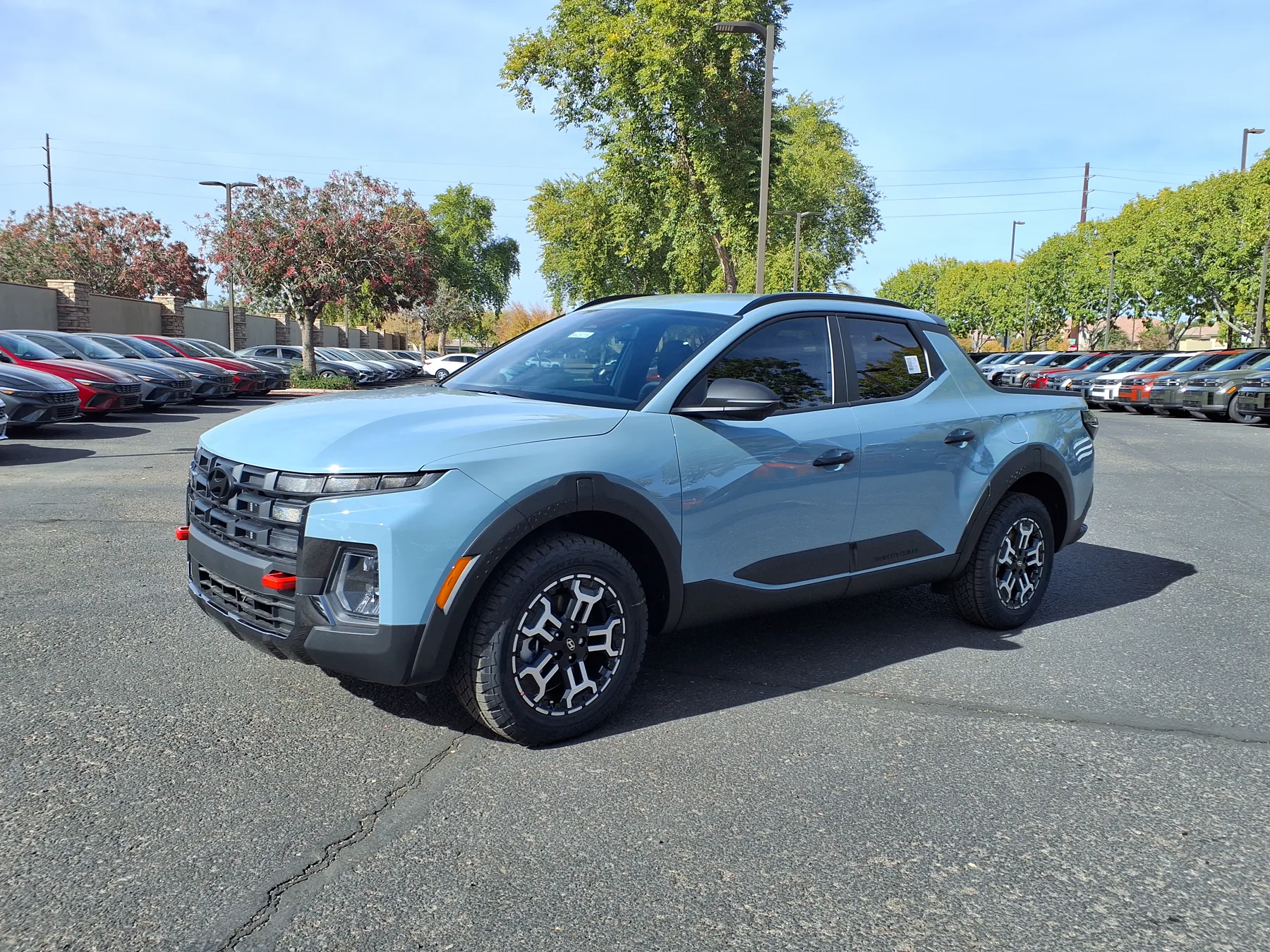

The compare-specs table has five columns: SE, SEL, SEL Activity, XRT, and Limited. SE, SEL, and SEL Activity use a 2.5-liter inline-four, 191 horsepower at 6,100 rpm and 181 pound-feet at 4,000. Front-wheel drive is standard. HTRAC all-wheel drive is available. XRT and Limited use a turbocharged 2.5-liter, 281 horsepower at 5,800 rpm and 311 pound-feet from 1,700 to 4,000 rpm, and HTRAC is standard. Front-wheel drive is marked not available on those two. Every column is an eight-speed automatic with SHIFTRONIC. There is no hybrid column.
EPA’s 2026 Santa Cruz list, checked the same day, agrees with Hyundai’s miles-per-gallon lines and also says regular gasoline. Front-drive 2.5-liter: 22 city, 30 highway, 25 combined. All-wheel drive, that engine: 21, 29, 24. The turbo all-wheel-drive rows, including a row named XRT: 18, 25, 20. The tank is 17.7 gallons on every trim. The highest city number on that sheet is 22. The Maverick hybrid front-drive city number is 42, from a different powertrain and a 13.8-gallon tank. The Maverick EcoBoost front-drive row, 23 city and 32 highway, is the closer gasoline-to-gasoline pair, and Ford still recommends premium for that engine’s power ratings while EPA lists the mileage rows on regular. Neither agency turns those two facts into a fuel-cost ranking.
The beds are close in width and not in volume. Santa Cruz bed length is 52.1 inches, depth 19.2, width 53.9 inches at the maximum and 42.7 between the wheelwells, volume 27.0 cubic feet. Hyundai calls the bed sheet-molded composite and lists a lockable under-bed compartment as standard. Maverick’s published volume is 33.3 cubic feet, with the longer floor. Neither figure says what fits once a cover, a spare, or a passenger is aboard.
Towing is where Hyundai’s own pages do not match. The compare-specs table prints capacity with trailer brakes as up to 3,500 pounds for SE, SEL, and SEL Activity, and up to 5,000 for XRT and Limited. The model page’s embedded table prints the SEL Activity cell as up to 3,500 in front-wheel drive and up to 5,000 with available all-wheel drive. A disclaimer on that page says the 5,000-pound maximum requires an XRT or a Limited and installation of aftermarket towing equipment, and another line says those trailers have to carry their own brakes. Ford’s 4,000-pound line requires the 4K package and, on the weight table, all-wheel drive, and the Lobo and Tremor rows do not get it. Setting 4,000 beside 5,000 without those sentences is how a spec sheet gets misread.
Hyundai prints one maximum load limit, called vehicle capacity weight, of 1,411 pounds in every column. That includes XRT and Limited, whose curb weights on the page are 4,140 and 4,191 pounds. SE is 3,779 front-drive and 3,922 all-wheel drive. The capacity-weight line does not step down as curb weight steps up. Ford’s payload line does change by configuration, and Ford sends you to the doorjamb for the truck in the driveway. The labels are not the same measurement. The starting prices are not the same kind of number either. Hyundai says the 2026 Santa Cruz starts at $29,750 and that the MSRP excludes freight, tax, title, and license. Ford’s August 2025 note prints $28,145 and does not, in that sentence, say the same thing about freight.
Wheelbase on the Santa Cruz sheet is 118.3 inches. Length is 195.7, or 195.9 on XRT. The Maverick’s wheelbase is 121.1, and the length runs from 199.8 to 200.9. Both are crew-cab unibody pickups with a bed a little over four feet. The rest of the comparison is the powertrain menu: a hybrid Ford still leads with, an EcoBoost Ford put back into front-wheel drive for 2026, and a Hyundai pair of 2.5-liter gas engines with no hybrid on the sheet. A road test would have to load them, tow with them, and fill the tanks the ratings assume. These pages do not do that.
Sources
- Ford: What's New, 2026 Maverick — Ford HQ note dated 27.08.25. EcoBoost front-wheel drive returns. On XL and XLT it is a $1,000 discount versus the standard hybrid front-wheel drive. EcoBoost all-wheel drive is a no-charge upgrade versus that hybrid. EPA-estimated 42 mpg city for the standard hybrid. New paints Marsh Gray and Orange Fury Metallic Tri-Coat. Realigned power-sliding rear window optional on Lariat and Tremor, and later on XLT and Lobo. Ford Connectivity Package standard with one year included and seven years optional. XLT Luxury package 54L drops the six-way passenger seat. Conventional spare offered on its own. SiriusXM with 360L, three-year plan, optional. Starting MSRP printed as $28,145.
- Ford: 2026 Maverick technical specifications, July 20, 2026, v1.2 — Unibody SuperCrew, steel panels, aluminum hood, trims XL, XLT, Lobo, Lariat, Tremor, assembled in Hermosillo. Hybrid 2.5-liter Atkinson, 184 combined horsepower under the calculation footnote, regular fuel, PowerSplit eCVT, 13.8-gallon tank. EcoBoost 2.0-liter, 250 horsepower at 5,500 rpm and 280 pound-feet at 3,000 rpm on premium, eight-speed, seven-speed on Lobo, 16.5-gallon tank. EPA rows. Weights, towing, payload, bed dimensions, wheels, suspension, and the note that horsepower, torque, payload, towing, and EPA estimates may not be achieved together.
- Ford: 2026 Maverick — Hybrid standard on XL, XLT, and Lariat. EPA-estimated 42 mpg city on front-wheel-drive hybrid models, 30 mpg highway on Lobo, 27 mpg highway on Tremor. 2.0-liter EcoBoost rated 250 horsepower and 280 pound-feet. Standard towing 2,000 pounds and 4,000 with the 4K Tow Package. AWD available, standard on Lariat, available on XL and XLT. Lobo and Tremor equipped with Advanced 4WD. Cargo bed described as 4 feet 5 inches, 33.3 cubic feet, 42.6 inches between the wheel wells, 53.3 inches overall. FLEXBED storage system. Power-Split Electric CVT on the hybrid spec block.
- Ford: 2026 Maverick Lobo — One engine, the 250-horsepower 2.0-liter EcoBoost with Advanced 4WD and a seven-speed quick-shift transmission. Maximum towing 2,000 pounds when properly equipped. Maximum payload 1,045 pounds with that powertrain. EPA estimates 21 city and 30 highway.
- Ford: 2026 Maverick Tremor — No hybrid. Standard 250-horsepower 2.0-liter EcoBoost, Advanced 4WD, eight-speed automatic, 16.5-gallon tank. Towing 2,000 pounds when properly equipped. Payload 1,140 pounds with that powertrain. Electronic-locking rear drive unit and, in the feature list, Twin Clutch Rear Drive Unit. Orange-accent grille, 17-inch wheels with orange-painted pockets, 235/65R17 all-terrain tires. FLEXBED, eight bed tie-downs, locking rails, passenger-side bed cubby. EPA estimates 21 city and 27 highway.
- EPA: 2026 Ford Maverick — Checked November 4, 2026. Seven rows, each on regular gasoline. Hybrid front-wheel drive 42/35/38. Hybrid all-wheel drive 40/34/37. Lariat hybrid all-wheel drive 39/32/36. EcoBoost eight-speed front-wheel drive 23/32/26. EcoBoost eight-speed all-wheel drive 22/30/25. Lobo, named Automatic (S8), 21/30/24. Tremor, named Automatic (S8), 21/27/23.
- Hyundai USA: 2026 Santa Cruz — U.S. model page. Starting MSRP $29,750, excluding freight, tax, title, and license. 191 horsepower on SE, SEL, and SEL Activity. 281 horsepower on XRT and Limited. EPA lines for those trims. Disclaimer that 5,000 pounds of towing requires XRT or Limited and aftermarket towing equipment, and that those trailers need their own brakes. Embedded spec table prints SEL Activity towing as up to 3,500 pounds front-wheel drive and up to 5,000 with available all-wheel drive.
- Hyundai USA: 2026 Santa Cruz specifications — Trim columns SE, SEL, SEL Activity, XRT, and Limited. Engines, HTRAC, eight-speed automatic, towing with trailer brakes, bed dimensions, curb weights, and a 1,411-pound vehicle capacity weight on every column. Specifications apply to U.S. vehicles. Starting MSRPs printed on the page.
- EPA: 2026 Hyundai Santa Cruz — Checked November 4, 2026. Four rows, each on regular gasoline. Front-wheel drive 2.5-liter 22/30/25. All-wheel drive 2.5-liter 21/29/24. Turbo all-wheel drive 18/25/20. A row named XRT all-wheel drive 18/25/20.
References checked .