Published by HALOX Co.
Cam Phaser vs Timing Chain: What a Cold Rattle Does and Doesn't Show
How an oil-controlled cam phaser advances or retards the cam without lengthening the chain, why a few seconds of cold rattle is not one diagnosis, and what a VVT code, a cam-to-crank code, and an oil-pressure reading each settle.
The two round parts under the clear cover are vane phasers, and the chain still crosses the tops of both sprockets, then runs down the sides under the cover. The file describes the photograph as vane-type phasers for continuous variable valve timing, on a cutaway model of a Hyundai T-GDI engine. The cover is clear because the engine is a display cutaway. A production timing cover is not a window. What the cutaway is for is the arrangement: a toothed ring on the outside of each phaser, vanes inside it, and a chain that did not have to come off for the vanes to be there.
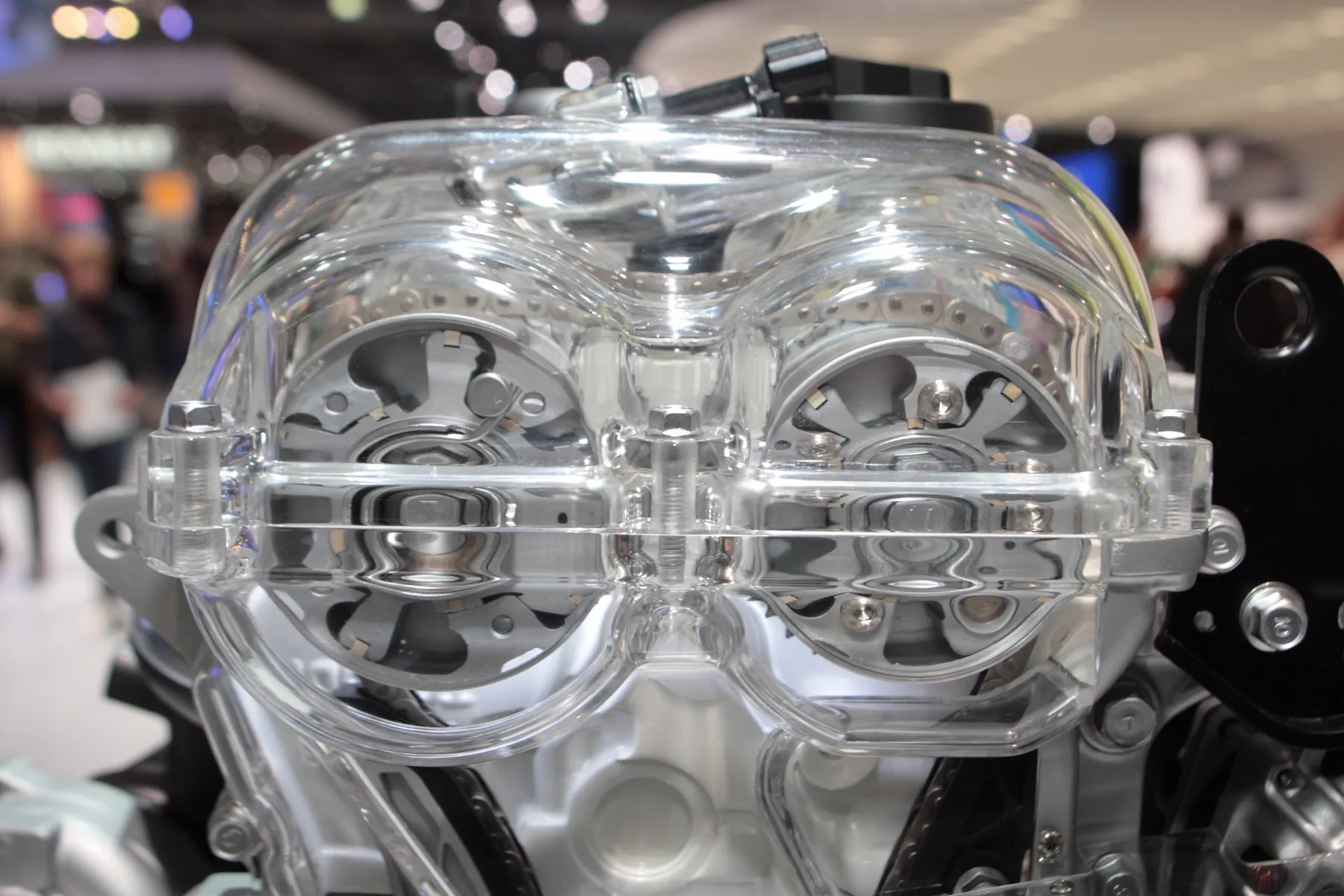

A timing chain, or a belt on the engines that use one, ties the crankshaft to those teeth. The phaser is the part that can change the camshaft’s angle relative to the teeth while that chain stays the length it is. The cam moves inside the sprocket. The chain does not have to grow for that to happen.
Oil, then the valve, then the vane
Toyota’s June 19, 1995 announcement of VVT-i names three pieces and no extra pump. An electronic control unit calculates intake-valve timing from how the engine is operating. An oil control valve controls hydraulic pressure on that unit’s instruction. A pulley changes the intake timing with the pressure, and Toyota says the pulley uses the engine’s existing oil pump. In the design that page describes, a piston with a helical spline slides along the camshaft and turns the cam by the amount the oil moves the piston. Toyota puts the range at up to 60 degrees of crankshaft angle, and says the valve controls the pressure both for advancing and for retarding. Toyota’s VVT-i announcement. That helical piston is a different part from the vanes in the Hyundai cutaway. Both take oil from the pump the engine already has, and both move intake timing.
Nissan’s engine-mechanical training text draws the split the other way. Every Nissan and Infiniti engine in that text can vary intake-valve timing relative to the crankshaft, and some, the VK50VE among them, vary the exhaust as well. The mechanisms may be hydraulic or electromechanical. The hydraulic system, C-VTC, uses oil under pressure to rotate the camshafts. The ECM reads cam position from PHASE sensors that pick up notches at the back of the cam, and it commands oil-control solenoids. The actuators may be the vane type or a splined shaft. The overview lists the ECM’s inputs as crankshaft position, camshaft position, engine speed, and engine-oil temperature. Nissan training text.
The vane layout in mechanical detail is BorgWarner’s U.S. patent 6,481,402. A rotor fixed to the camshaft sits inside a housing that turns around it. A vane on the rotor reaches into a recess in the housing. Pressurized oil goes to the advance side of that recess or the retard side, and comes out of the other, by way of a spool valve. A lock pin is pushed toward its locked seat by a spring and pushed back out of the lock by oil pressure. U.S. patent 6,481,402. That is the patented device. Nissan’s text already allows a production actuator to be a vane or a splined shaft, and Toyota’s 1995 pulley is the helical piston. The patent is one architecture. A cover with a VVT badge is not a promise that this rotor is what is bolted on.
HELLA’s note on the control valve is the piece between the pump and the phaser. The valve is an electromagnetic actuator, mounted on the cylinder head in the camshaft area. It sends oil pressure through different channels to the camshaft phaser, following the engine-management command, and that changes the camshaft’s position and the valve timing. The control unit regulates the valve electrically. An engine may have one valve or several. The illustration on that page separates the phaser, the oil lines, oil pressure from the engine, the control valve, and the electrical connection. HELLA control-valve note.
BorgWarner’s sheet for its dual-park hydraulic phaser, the one aimed at stop-start engines, maps an approximate solenoid duty cycle onto four results: a mid lock, retard into an end lock, holding, and advancing. The mid lock is labeled for a cold or conventional start. The end lock is labeled for a hot restart. The duty-cycle figures are marked approximate, and they belong to that sheet. BorgWarner dual-park sheet.
The Nissan VQ35HR in the next photograph is the case where oil is only half the story. The file titles the cutaway CVTC on the intake and eVTC on the exhaust. A roller chain runs across the upper left onto a toothed sprocket. The sectioned housing beside it shows internal passages. On the right, a round unit has copper-colored windings and a hex in the center. Nissan’s training text says this engine varies the exhaust cam with an electromagnet retarder, on a duty-cycle signal from the ECM, and it says never to disassemble that retarder. The intake on the same engine is the hydraulic C-VTC. Two black caps sit on the timing case, one toward the lower left and one below the round unit. The photograph does not label them. A black belt crosses the bottom of the frame. That belt is the accessory drive, outside the timing case. The chain at the upper left is the cam drive. Nissan training text.
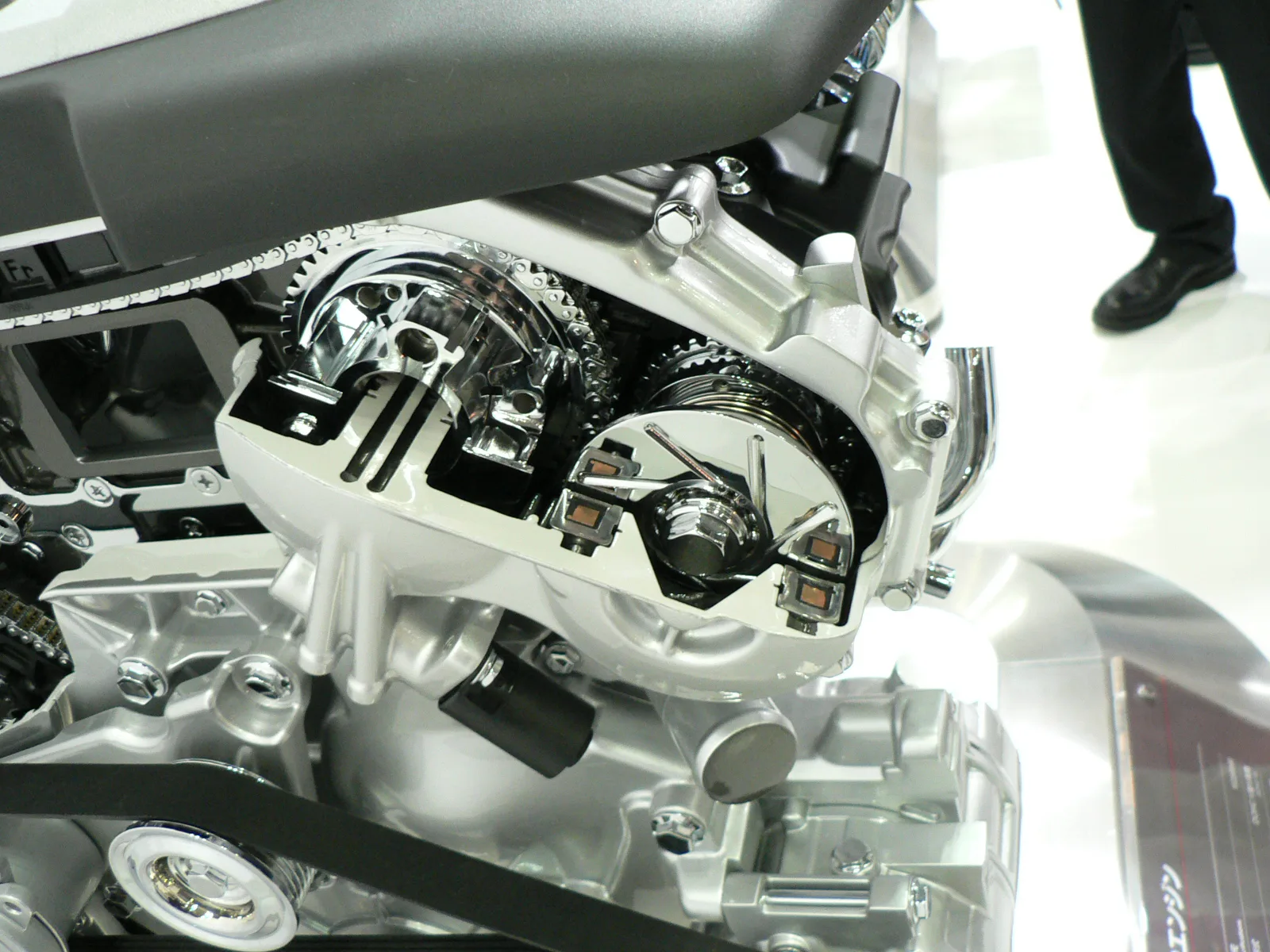

What any of these move, when they move, is the cam’s phase. Lift, duration, and phase are different measurements. Turning the cam relative to the crank moves the opening and closing events together. It leaves the lobe the shape it was ground. Toyota’s 1995 note uses the intake move for overlap at part load, which that page ties to pumping loss, NOx, and hydrocarbons, and for a later intake closing as engine speed rises. At idle, the same page says, the valves do not overlap. Toyota. Nissan’s text keeps variable valve event lift as a separate system, the one that changes how far the intake valve opens. A phaser that only turns the cam is the timing half of that pair.
The same few seconds
A rattle for a few seconds after start is a sentence several makers have published. They did not publish it about the same part, and none of the documents is a test you can run by ear on a car that is not on the list.
GM preliminary information PI0562F, February 2013, covers the 2011–2012 Buick LaCrosse and Regal, the 2011–2012 Chevrolet Equinox, the 2012 Orlando in Canada, and the 2011–2012 GMC Terrain, with the LAF, LEA, or LUK engines. The complaint is a loud rattle when the vehicle is first started, lasting 3 seconds or less. It is more likely after an extended or overnight soak, and GM says it is easy to hear from inside with the window up. The account of the cause is specific. The previous shutdown did not leave oil pressure on the camshaft-position actuator long enough to lock it for the next start. The noise is the actuator’s internal section moving from one end of its travel to the other. It stops when the actuator refills with oil, in 3 seconds or less. DTC P0011 may also set. The repair in the bulletin is both camshaft-position actuators, the solenoid valves in the cases the bulletin spells out, and an ECM calibration whose title covers the oil-life monitor, P0011, and the startup rattle. GM PI0562F.
A second GM bulletin, 09-06-01-015A, is the 2009 Pontiac Vibe with the 1.8-liter LAY. The complaint is a brief knock or rattle from the engine compartment on a cold-soak start, usually under two seconds. The cause line says this may be a camshaft timing gear that is not locked in the startup position. After the noise is verified, the correction is to replace the actuator. A note in the procedure says the new gear goes on unlocked, which the note calls the advanced position, then gets tightened and locked, which the note calls fully retarded. GM 09-06-01-015A. Fully retarded is the lock that bulletin describes for this gear. BorgWarner’s dual-park sheet describes two lock positions on a different phaser. The VQ35HR exhaust unit is the electromagnet retarder in Nissan’s text, a different part from the oil-locked gear in the Vibe bulletin.
Ford’s TSB 20-2166, June 4, 2020, is the 2018–2019 Expedition and Navigator built on or before April 8, 2019. The issue is a ticking, tapping, or rattle from the top front cover on the first start after a cold soak of 6 hours or more, which may last 2 to 5 seconds. Ford says this may be a worn variable-cam-timing unit. The procedure replaces all four VCT units and reprograms the PCM with revised VCT parameters. It also says not to replace any additional VCT or engine-timing parts that are not on that parts list. Ford TSB 20-2166.
Ford’s customer-satisfaction program 21B10 is a different document, and the September 13, 2021 supplement gives it a different action. The vehicles are certain 2017–2020 F-150s and 2018–2020 Expeditions and Navigators with the 3.5-liter GTDI, in the build ranges the letter prints, and that supplement includes the F-150 Raptor and Limited. Affected vehicles are identified in OASIS. The noise may be a rattle when starting after the vehicle was off for an extended time, or a knocking noise at idle once the engine is warm. The letter says a cam phaser that has developed an undesirable noise does not affect the vehicle’s safety, performance, or emissions. The service action in the letter is a PCM reprogram. The same letter points at a separate program, 21N03, for a prorated phaser replacement if one is needed, and at 21N08 if the 21B10 calibration produces a shudder and has to be reverted. In that letter, 21B10 runs through July 31, 2022, and a customer who received the repair before February 28, 2022 has 21N03 coverage until January 1, 2023. Ford 21B10, supplement 3. The noise description still does not say whether a given truck in the build range needed the calibration, a phaser, or neither.
Mercedes-Benz document LI05.10-P-058758, March 19, 2014, is the one that keeps those sentences from becoming a rule of thumb. It covers engine 271.8 EVO. A rattling noise may come from the chain-drive area for about 2 to 5 seconds after start. The same document lists camshaft-position fault codes, among them a commanded position the intake or exhaust cam cannot reach, and a cam position that is implausible against the crankshaft. The cause line says the timing chain may have been stretched. The test is a measuring chain tensioner, tightened to 20 Nm, with the engine turned through two revolutions. Under 79 mm, the work is a new tensioner. Over 79 mm, the work is a new chain, a look at the intake and exhaust sprockets, and a new tensioner. Mercedes LI05.10-P-058758. Two to five seconds, on this engine, is the chain document. Three seconds or less, on the engines in PI0562F, is the actuator document. The durations overlap. The engines do not, and a recording of the noise does not say which document you are in.
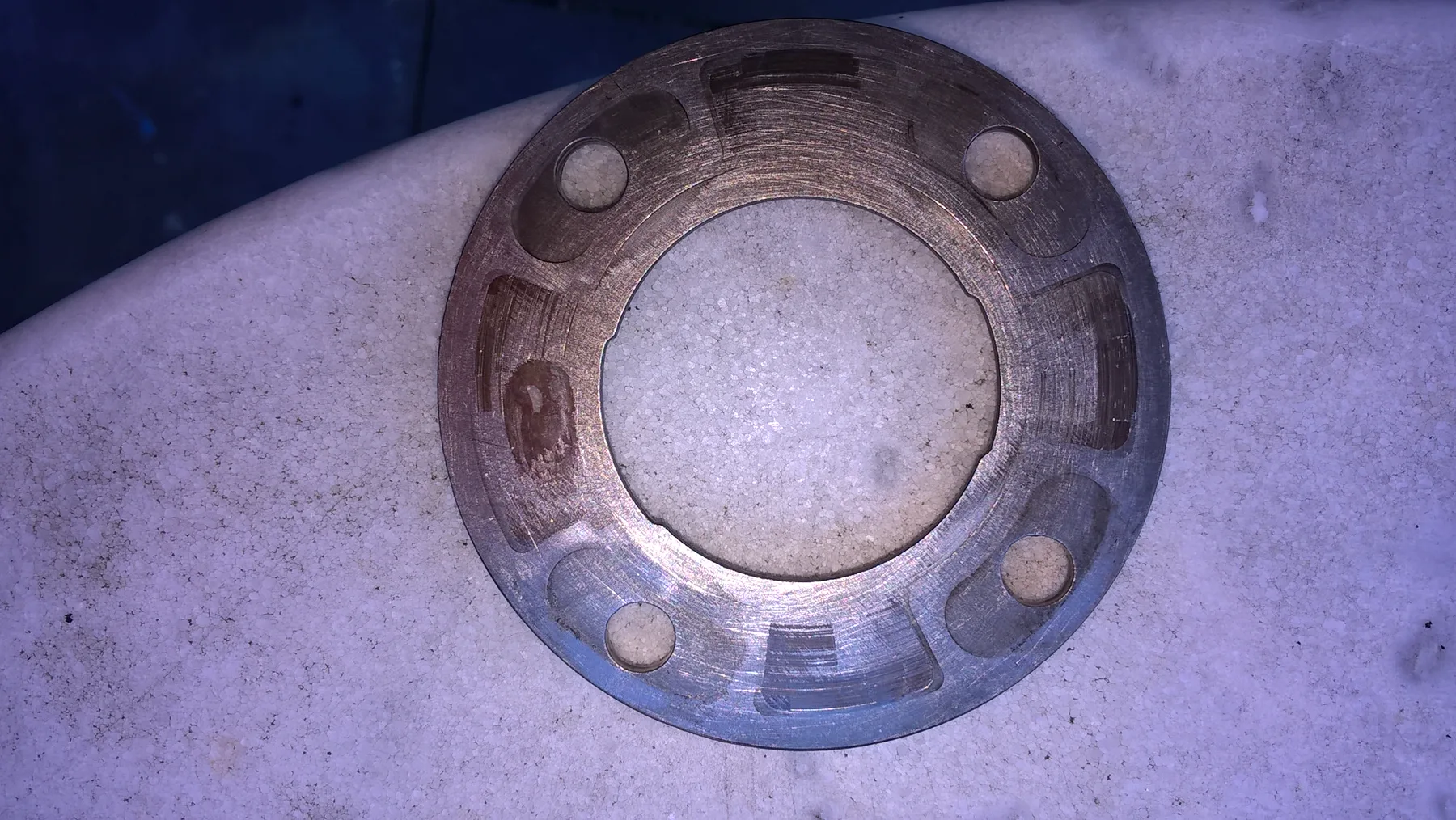
The plate in the next photograph is filed as the running plate of an M271 Evo turbo camshaft adjuster. The file description says it shows the track of the vane, and how the locking pin behaves, the pin that should hold the adjustment in the start position. The frame shows the plate: a steel ring, a large center hole, round holes, curved slots, and a dark patch on the left of the ring. The pin is not in the photograph. The Mercedes measurement above is a different document, written for engine 271.8 EVO, and it measures a tensioner. A similar engine-family name does not make this plate the chain that bulletin measures, and the patch is not the lock GM describes on the Vibe.

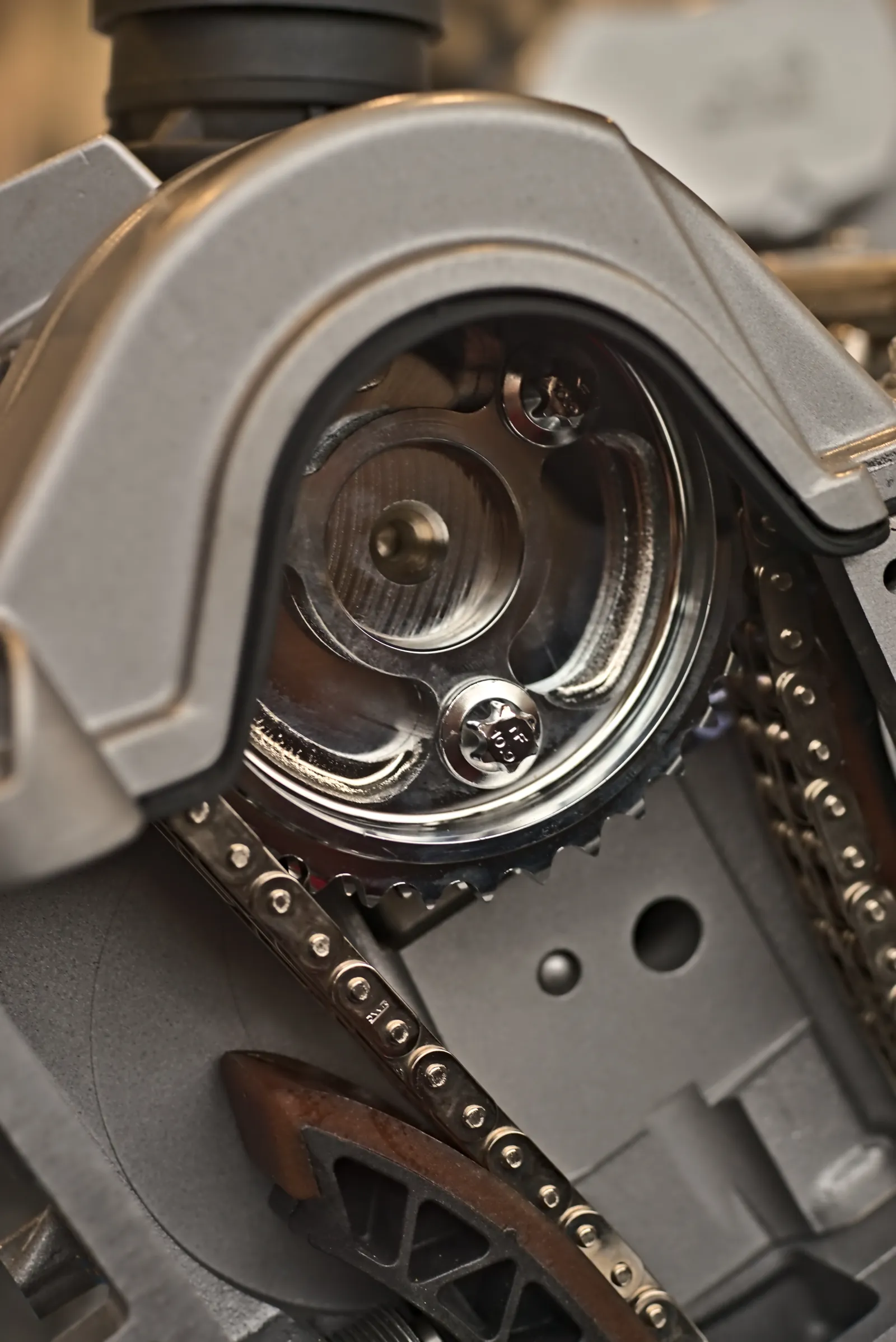
The last photograph is the chain half of the same distinction. The file titles it as a Mercedes V12 timing chain, taken at the Bremen Classic Motorshow in 2020. A roller chain is meshed with the teeth of a sprocket. Three fasteners sit in the center, around a large bore. A gray cover frames the opening, and a brown and black chain guide sits under the silver chain at the lower left. The file does not call the sprocket a phaser, and the photograph does not show vanes. The mesh is what a chain does. Wear in the joints lengthens the chain, and the teeth fall behind the crank. That is the chain’s failure, which is the subject of the timing-chain note. A phaser changes the cam’s angle inside its housing without asking the chain to grow. A chain that has grown changes the sprocket’s place on the crank without a vane having to move. The photograph is the mesh. It is not a reading of either failure.

What the scan is counting, and what the oil pressure is
California’s gasoline onboard-diagnostic rule requires a variable-valve-timing monitor for target error and for slow response on the applications the section names: 2006 through 2008 low-emission-vehicle II vehicles, and 2009 and later vehicles, when the vehicle has the system. Target error is a failure to reach the commanded valve timing within a crank-angle tolerance, detected before that miss would push emissions over the thresholds in the rule. Slow response is a failure to reach that timing within a time, judged the same way. The section tells the manufacturer to analyze reasonable hydraulic and mechanical failures. The examples it writes down are a partial or complete blockage of a hydraulic passage, a broken return spring, and a pin on a lift mechanism that does not move to the position it was given. The electronic parts, actuators, valves, and sensors, are monitored under the comprehensive-component section, which is a separate requirement and includes circuit faults. The manufacturer defines the conditions for the VVT monitor, and the rule says the monitor runs every time those conditions are met on the driving cycle, rather than once per trip. 13 CCR 1968.2. Federal rules for 2017 and later light vehicles require that onboard system to meet California’s OBD requirements.
A code from the VVT monitor establishes that commanded timing was missed, or missed on the time the calibration allows, on the terms of that rule. It does not pick among the examples the failure analysis has to consider. Those examples are a blocked passage, a broken return spring, and a pin that did not move. A sensor or a valve circuit is the comprehensive-component check, which stores its own result. Mercedes’ list for the 271.8 includes a commanded-position code and a cam-to-crank comparison, and the cause line still sends the measurement to the chain.
The chain has its own monitor, for vehicles that need the camshaft and the crankshaft aligned and that have position sensors on both. On 2006 through 2008 low-emission-vehicle II applications, and on 2009 through 2018 vehicles with variable-cam phasing and a timing belt or chain, the system has to catch a misalignment of one or more sprocket teeth. If the manufacturer shows that a single tooth does not raise emissions enough to measure, the threshold becomes the smallest number of teeth that does. From 2019, the rule allows one of two levels: the smallest slip the existing hardware can detect, or the slip that pushes emissions over the criteria in the component section. 13 CCR 1968.2. That monitor is the drive between the crank and the cam sprocket. It is a different requirement from the VVT target-error monitor.
GM preliminary information PIP3423L, October 2015, is that distinction on one family of engines. The bulletin’s 2.8-, 3.0-, and 3.6-liter engines, RPOs LP1, LAU, LF1, LFW, LY7, LLT, and LFX, may set two or more of P0016, P0017, P0018, P0019, P0008, and P0009. The instruction is to check for loose timing chains or tensioners. If the service diagnosis does not find the cause, the crankshaft-sensor reluctor pressed onto the rear of the crank may have moved, and the repair the bulletin names then is the crankshaft. GM PIP3423L. Those correlation codes, on those engines, are a reason to inspect the chain and the tensioner, and a reason to look at the reluctor. They are not a measurement of how far the chain has grown.
BMW service information B11 16 14, the February 2016 revision, sets an order for the N63 engines and production ranges it lists. If faults are already stored for VANOS or for camshaft position, those test plans come before the timing-chain check. A defective VANOS actuator or solenoid can affect the chain check’s result. BMW SI B11 16 14. An elongation figure read while a cam-position fault is still open is the figure that bulletin says the actuator or the solenoid can move.
On vehicles using SAE J1979, California has the VVT monitors tracked separately and reported as one set of values, together with the EGR monitor. 13 CCR 1968.2. A readiness line that bundles EGR and VVT is that completion counter. It is not a cam angle, and it is not a pass or fail of the chain.
The malfunction indicator for a VVT fault follows the rule’s general lamp section, which the VVT paragraph points to instead of rewriting. A steady lamp and a flash are a stored emissions fault and a misfire treated as a threat to the catalytic converter. A VVT target-error code sits with the stored faults. The VVT section does not define the flash.
Oil pressure is the supply the hydraulic parts use, and it is a weak name for the fault. Toyota’s pulley uses the engine oil pump. Nissan’s C-VTC uses oil under pressure, and oil temperature is one of the inputs in that training overview. HELLA’s layout draws oil pressure from the engine as its own item, ahead of the lines and the valve. The oil pump is what produces the flow. A low reading at a gauge or a sender says the supply is low. On a hydraulic phaser, low supply is a reason the vane may not move and a reason a lock pin may not see the pressure that pushes it back. The reading does not say whether the pump, the pickup, the oil, or a relief valve made it low. A normal reading does not say the passages past the valve are open. A blocked hydraulic passage is one of the failures California lists under target error, and that blockage can sit downstream of a pump that still makes pressure. Neither reading measures chain elongation.
A rattle at the cover in the first seconds after start is the event the bulletins above assign to an actuator, a VCT unit, a calibration, or a chain, depending on the engine. What a knock sensor reports is combustion knock, so the computer can move spark. A knock-control correction is that spark decision. It is not a cam angle, and it is not the chain measurement Mercedes specifies.
A cold rattle, a stored code, and an oil-pressure reading are three notes. On the engines in these documents, a short startup noise has been tied to an actuator that was not locked, to a worn VCT unit, to a PCM calibration, and to a chain that had to be measured with a fixture. The scan can show that commanded cam timing was missed, or that the sprocket and the crank are off by teeth, or that an electronic valve or sensor failed its circuit check, and those are different monitors. Oil pressure can show whether the supply those hydraulic parts use is low. None of the three, and not the sound by itself, names the part. The step the documents describe is to identify the engine and follow the procedure written for it.
Sources
- Toyota: VVT-i announcement, June 19, 1995 — Three components, the ECU, the oil control valve, and the pulley; the pulley uses the engine oil pump; a helical-spline piston slides along the cam axis; range up to 60 degrees of crankshaft angle; the valve controls pressure for advance and retard; overlap, pumping loss, NOx, hydrocarbons, and a later intake closing as speed rises
- Nissan: engine mechanical training text, variable valve timing — Intake timing relative to the crank on the engines in the text, exhaust as well on some; hydraulic or electromechanical mechanisms; C-VTC uses oil pressure to rotate the cams; PHASE sensors at the back of the cam; oil-control solenoids; vane or splined-shaft actuators; VQ35HR exhaust electromagnet retarder and the instruction not to disassemble it; ECM inputs include oil temperature
- U.S. patent 6,481,402, BorgWarner variable camshaft timing phaser — Rotor on the cam inside a housing, a vane in a recess, oil directed to the advance or retard side by a spool valve, and a spring-biased lock pin pushed out of lock by oil pressure
- HELLA: control valve, camshaft adjustment — Electromagnetic control valve on the cylinder head, oil sent through different channels to the phaser on the engine-management command, one or more valves, and a layout of phaser, oil lines, engine oil pressure, valve, and electrical connection
- BorgWarner: hydraulic cam phasing with dual park — Dual-park hydraulic phaser for stop-start; mid lock for a cold or conventional start, end lock for a hot restart, and an approximate duty-cycle map for mid lock, retard, holding, and advancing
- California: OBD II malfunction and diagnostic system requirements — Gasoline VVT target-error and slow-response monitors, the failure examples in that section, comprehensive-component monitoring of the electronic parts, cam-to-crank sprocket alignment on the model years the rule names, and VVT monitor reporting under SAE J1979
- EPA: 40 CFR 86.1806-17, onboard diagnostics — 2017 and later light vehicles must detect emission-control malfunctions, store trouble codes, and alert the driver by meeting California OBD requirements
- GM preliminary information PI0562F, February 2013 — 2011-2012 LaCrosse, Regal, Equinox, and Terrain, and 2012 Orlando in Canada, with LAF, LEA, or LUK: startup rattle of 3 seconds or less, actuator not locked by oil pressure, internal section moving end to end, refill stops the noise, P0011 may set
- GM service bulletin 09-06-01-015A, June 2013 — 2009 Pontiac Vibe 1.8-liter LAY: cold-soak knock or rattle usually under two seconds, timing gear not locked in the startup position, and a new gear installed unlocked in the advanced position then locked fully retarded
- Ford technical service bulletin 20-2166, June 4, 2020 — 2018-2019 Expedition and Navigator built on or before April 8, 2019: 2-5 second tick, tap, or rattle from the top front cover after a cold soak of 6 hours or more, possibly a worn VCT unit; replace all four VCT units and update the PCM; do not replace other timing parts off the parts list
- Ford customer satisfaction program 21B10, supplement 3, September 13, 2021 — Certain 2017-2020 F-150 and 2018-2020 Expedition and Navigator 3.5-liter GTDI vehicles in the letter's build ranges, including Raptor and Limited in this supplement: rattle after an extended shutdown or knock at warm idle; Ford's statement that the noise does not affect safety, performance, or emissions; PCM reprogram; separate programs 21N03 and 21N08
- Mercedes-Benz LI05.10-P-058758, March 19, 2014 — Engine 271.8 EVO: 2-5 second rattle from the chain drive after start and camshaft-position fault codes; chain may be stretched; measuring tensioner cutoff at 79 mm
- GM preliminary information PIP3423L, October 2015 — Listed high-feature V6s setting two or more of P0016, P0017, P0018, P0019, P0008, and P0009: check loose chains or tensioners; a moved crankshaft reluctor is the further cause the bulletin names
- BMW service information B11 16 14, February 2016 — N63 engines in the listed production ranges: run stored VANOS or camshaft-position test plans before the timing-chain check, because a defective actuator or solenoid can affect that check
References checked .