What a certification label actually is
A certification label is the manufacturer's label required by 49 CFR 567.4. It states who built the vehicle, the month and year of manufacture, GVWR, GAWR, the VIN, the vehicle type, and the FMVSS conformity sentence. It is not the tire placard, the VECI label, registration, or a safety inspection sticker.
The driver’s door jamb holds more than one card. The one that opens with Manufactured By, or Mfd By, is the certification label. 49 CFR 567.4 is the rule for it. The maker rivets it, or sticks it, so it will not come off without being destroyed or defaced.
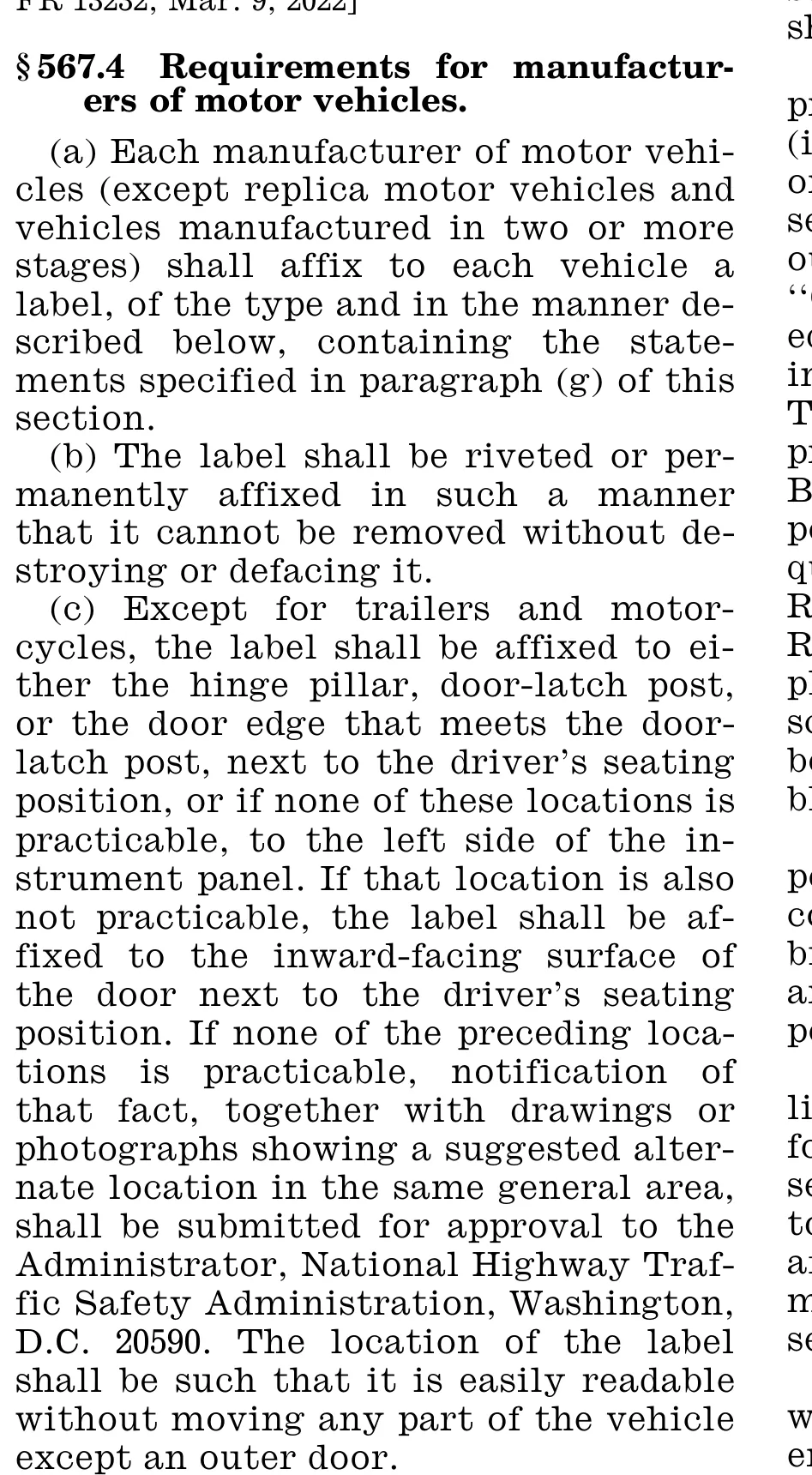
On a car, a truck, or a multipurpose passenger vehicle the usual spot is the hinge pillar, the door-latch post, or the door edge that meets that post, next to the driver. If none of those will work, it goes on the left side of the instrument panel, or on the inward face of the driver’s door. You should be able to read it without moving anything but the outer door. A trailer carries the label on the forward half of the left side. A motorcycle carries it near the steering head. The door is the ordinary case.
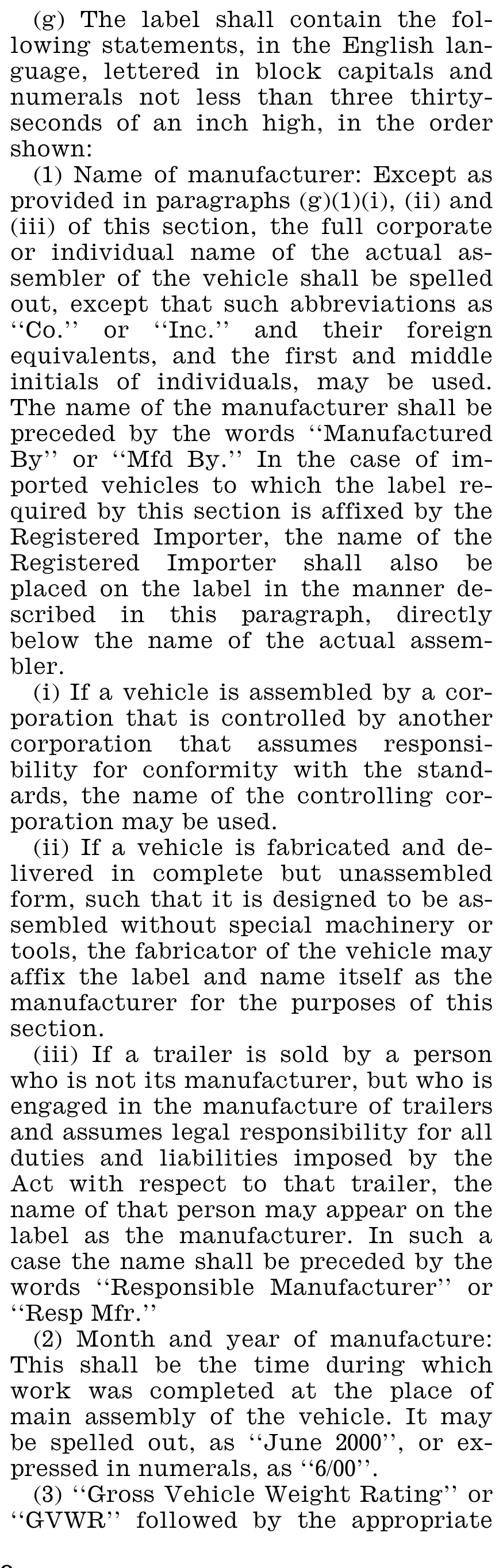
The lines run in a set order. First the assembler’s name, after Manufactured By or Mfd By. Then the month and year the work was finished at the main assembly plant. The rule allows June 2000 or 6/00. That date is not the model year. Then Gross Vehicle Weight Rating, or GVWR, a rating in pounds. It cannot sit below the unloaded vehicle, the rated cargo, and 150 pounds for each designated seat. Then Gross Axle Weight Rating, or GAWR, for each axle, front to rear.
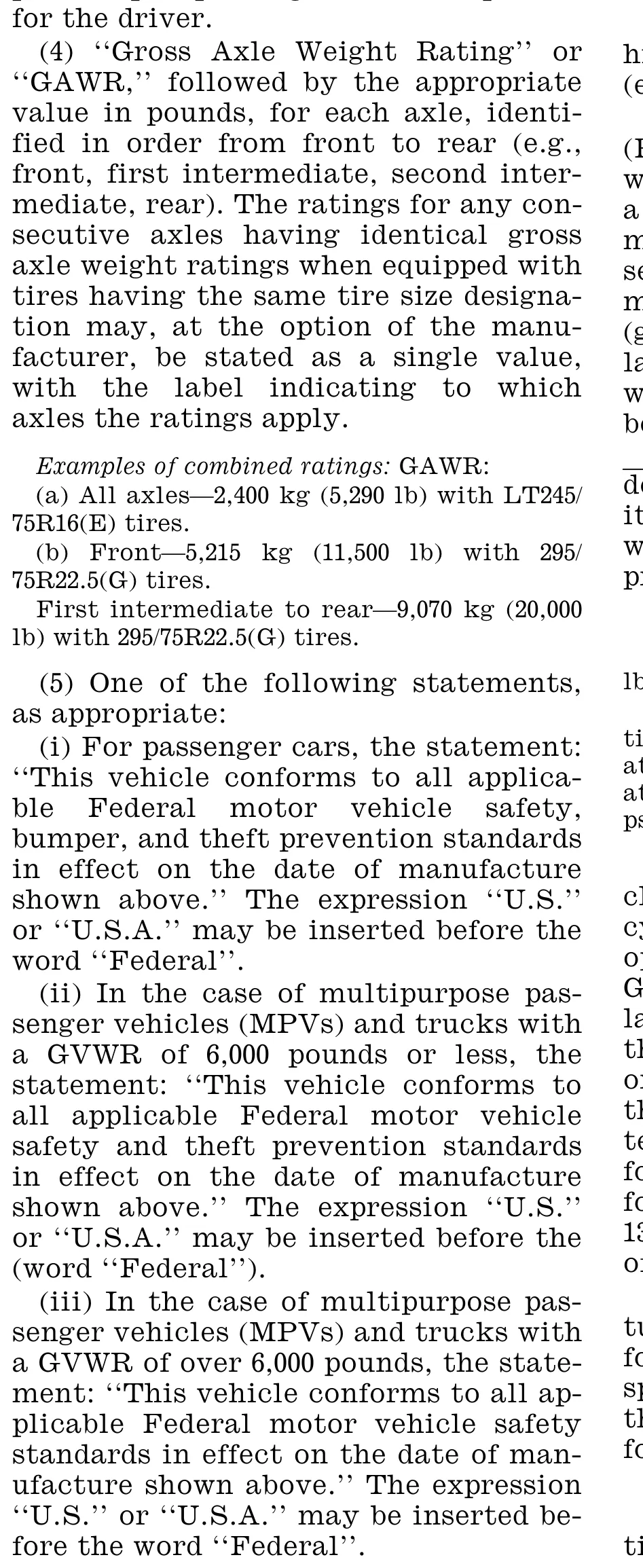
The next line is the certification sentence, and it is not one sentence for every vehicle. A passenger car says it conforms to all applicable Federal motor vehicle safety, bumper, and theft prevention standards in effect on the date of manufacture shown above. An MPV or a truck at 6,000 pounds GVWR or less keeps safety and theft prevention, and drops the bumper words. Over 6,000 pounds, the sentence is the safety standards alone. That is also the sentence for the other vehicle types. The maker may put U.S. or U.S.A. in front of Federal. After the sentence come the VIN and the type classification from 49 CFR 571.3, such as truck, MPV, bus, or trailer.
Tire size is not a required line of its own. It shows up when a rating is tied to a tire. The rule’s GAWR examples put a tire size after the pounds. For a passenger car, 49 CFR 567.4(h) allows two ratings on the same label: 4,400 pounds GVWR with P195/65R15 tires, or 4,800 pounds with P205/75R15 tires, and the front and rear GAWR written the same way, with a cold pressure beside the tire. A pressure printed there belongs to that rating. It is not the Tire and Loading Information placard. That placard is 49 CFR 571.110: the cold pressures for this vehicle, the occupant-and-cargo limit, and the tire size fitted at first retail sale.
The VECI label is the emissions sticker, usually under the hood. A registration sticker is the state tab on the plate or the windshield. A safety inspection sticker is a state inspection. None of those is the manufacturer’s certification of the vehicle.