Published by HALOX Co.
What a charcoal canister actually does
How tank vapor collects on the charcoal canister's activated carbon, how the vent and purge valves send it into the engine, and what an EVAP leak code or a loose fuel cap identifies.
Heat on a closed gasoline tank turns part of the fuel into vapor, and the vapor leaves through a vent. On the way out it meets a canister of activated carbon, which holds it. That hold is what a charcoal canister is for, while the car sits and while the tank is being filled. Crankcase vapor is a separate circuit, the one in what a PCV valve actually does.
Bosch’s purge-valve page names two ways the tank vapor starts: heat radiated onto the tank, and surplus fuel that picks up heat before it returns. The vapor is captured on an activated-charcoal filter and purged from there later. Standard’s account of the system, dated August 6, 2026, stores that vapor in the fuel-vapor canister until the engine is ready to use it.
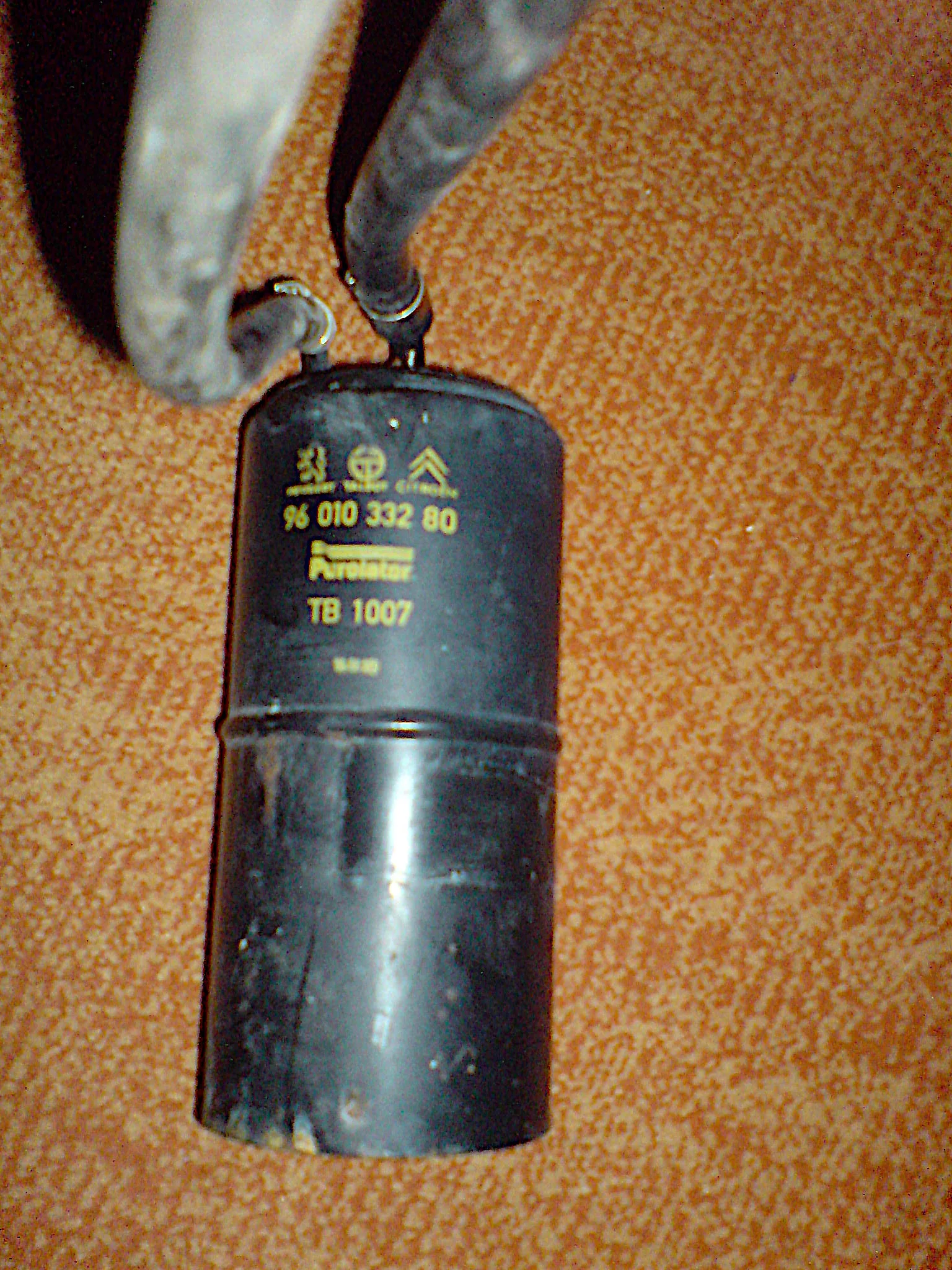

This is the charcoal canister from a Peugeot 205. In the photograph it is a black cylinder on orange carpet, with two hoses clamped to the top. Yellow print on the canister shows the Peugeot, Talbot, and Citroën logos, the part number 96 010 332 80, Purolator, and TB 1007.
Vapor out of the tank, onto the carbon
The parked load and the refueling load both end on that carbon, and the rules measure them apart.
Section 86.1813-17 measures diurnal and hot-soak emissions on their own test sequences, and it caps running loss at 0.05 grams per mile for the vehicles it covers, other than gaseous-fueled vehicles. Those evaporative and refueling standards do not apply to an electric vehicle, a fuel-cell vehicle, or a diesel-fueled vehicle, except where the section brings one of them back in. The refueling paragraph does that for a diesel light-duty vehicle.
Refueling is the load EPA’s May 16, 2012 rule describes as onboard refueling vapor recovery. Vapor displaced as the tank fills is routed into an activated-carbon canister on the vehicle, and the carbon captures it. A seal in the fill pipe lets liquid gasoline in and blocks vapor from leaving at the filler. In most cases, the rule says, that seal is liquid: incoming gasoline backs up slightly near the bottom of the fill pipe. The legal capture requirement is 95 percent. From tests of more than 1,100 in-use vehicles, that rule puts the average in-use efficiency at 98 percent.
The same rule’s phase-in is a schedule, not one model year. New passenger cars start in 1998 at 40 percent, then 80 percent in 1999 and 100 percent in 2000. Light trucks and vans under 6,000 pounds gross vehicle weight rating run from 40 percent in 2001 to 100 percent in 2003. Heavier light trucks, 6,001 to 8,500 pounds, reach 100 percent in 2006, and new trucks up to 10,000 pounds built as a complete chassis are all on the system by 2006. The rule leaves motorcycles, and heavy-duty gasoline vehicles not manufactured as a complete chassis, outside the requirement.
California’s refueling procedures, amended through August 25, 2022, put passenger cars, light-duty trucks under 8,501 pounds, and medium-duty passenger vehicles on the procedure from the 2001 model year. For gasoline, alcohol, diesel, fuel-flexible, and hybrid electric vehicles, the refueling limit is 0.20 grams of hydrocarbons per gallon dispensed. The federal section prints its own refueling standard at 0.20 grams total hydrocarbon equivalent per gallon for vehicles on volatile liquid fuel, and it applies that number to a diesel light-duty vehicle as well. The California procedures also carry evaporative-system monitoring, the malfunction criteria, and the rules for the indicator lamp and stored codes over onto the refueling system.
The federal section is written for more than one canister layout. For vehicles with non-integrated refueling canisters, the bleed-emission test does not apply to the refueling canister. A shared canister is the layout Bosch and Standard describe. A separate refueling bed is a layout the standard still names.
On the 2025 RAV4 Hybrid, the U.S. and Canada owner’s manual describes the tank the driver opens. The tank has a structure that requires the pressure to come down before fuel will go in, and several seconds pass after the opener is pressed before the vehicle is ready to fill. That is this hybrid’s sealed tank. EPA’s liquid seal is the separate account of vapor staying in the fill pipe while the gasoline goes in.
Fresh air in, vapor toward the intake
Purge is the carbon giving the vapor back. Standard sends fresh air in through the vent valve, has the controller open the purge valve when its conditions are met, and sends the vapor into the engine to be burned. Bosch places the purge valve between the intake manifold and the charcoal canister. Opening that valve is what lets fresh air be drawn through the canister so the captured vapor is purged. EPA’s account of refueling recovery places the purge after the engine is started. Standard places the opening at the moment the controller’s conditions are met. Between those two descriptions, purge is an engine-running event with a valve in charge of it, and the fresh air that strips the carbon comes in at the vent.
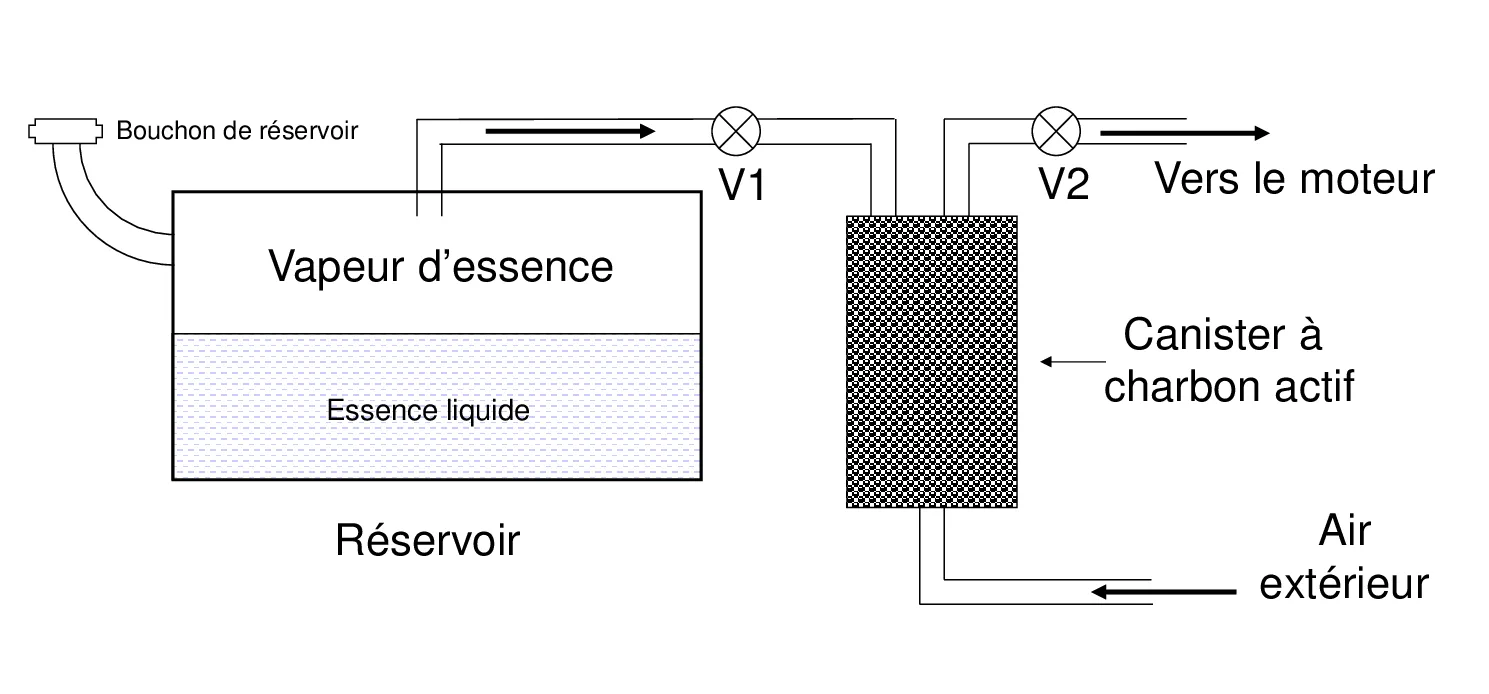

The drawing lays the route out in one frame. The labels are in French. The tank is marked Réservoir, with Vapeur d’essence above Essence liquide, and the filler cap is marked Bouchon de réservoir. A line runs through valve V1 to a cross-hatched block marked Canister à charbon actif. Air extérieur comes in at the bottom of the canister. From the canister a line runs through valve V2, and the arrow is marked Vers le moteur, toward the engine. Standard’s vent valve and Bosch’s purge valve are the named parts that let the air in and open the way to the intake manifold.
A sealed system, and what a light reports
Once that path is sealed, the monitor looks for a leak. For the 2017 model year and later, section 86.1806-17 requires that once the monitoring conditions are satisfied, a test vehicle detect a leak with an effective diameter at or above 0.020 inches, light the malfunction indicator, and store a confirmed code. For a leak of that size the code is a generic SAE J2012 code for an evaporative very small leak. The section’s examples are P0456, P04EE, and P04EF, or a manufacturer code EPA has approved. The demonstration installs the orifice in at least two places: at the fuel cap or between the cap and the tank, and in the vapor line between the canister and the tank or between the canister and the purge valve. The code the section assigns is the code for a hole of that size. The test that produces it is run at the filler and near the canister, so the code is shared by those locations.
The leak standard next to it is a limit on the system as certified, not the lamp. Section 86.1813-17 says a fuel system on volatile liquid fuel may not exceed an effective leak diameter of 0.02 inches, and a manufacturer may ask to go larger, up to 0.040 inches, on a tank of more than 25 gallons. The diagnostics paragraph is the separate requirement that a hole of 0.020 inches be found and lit.
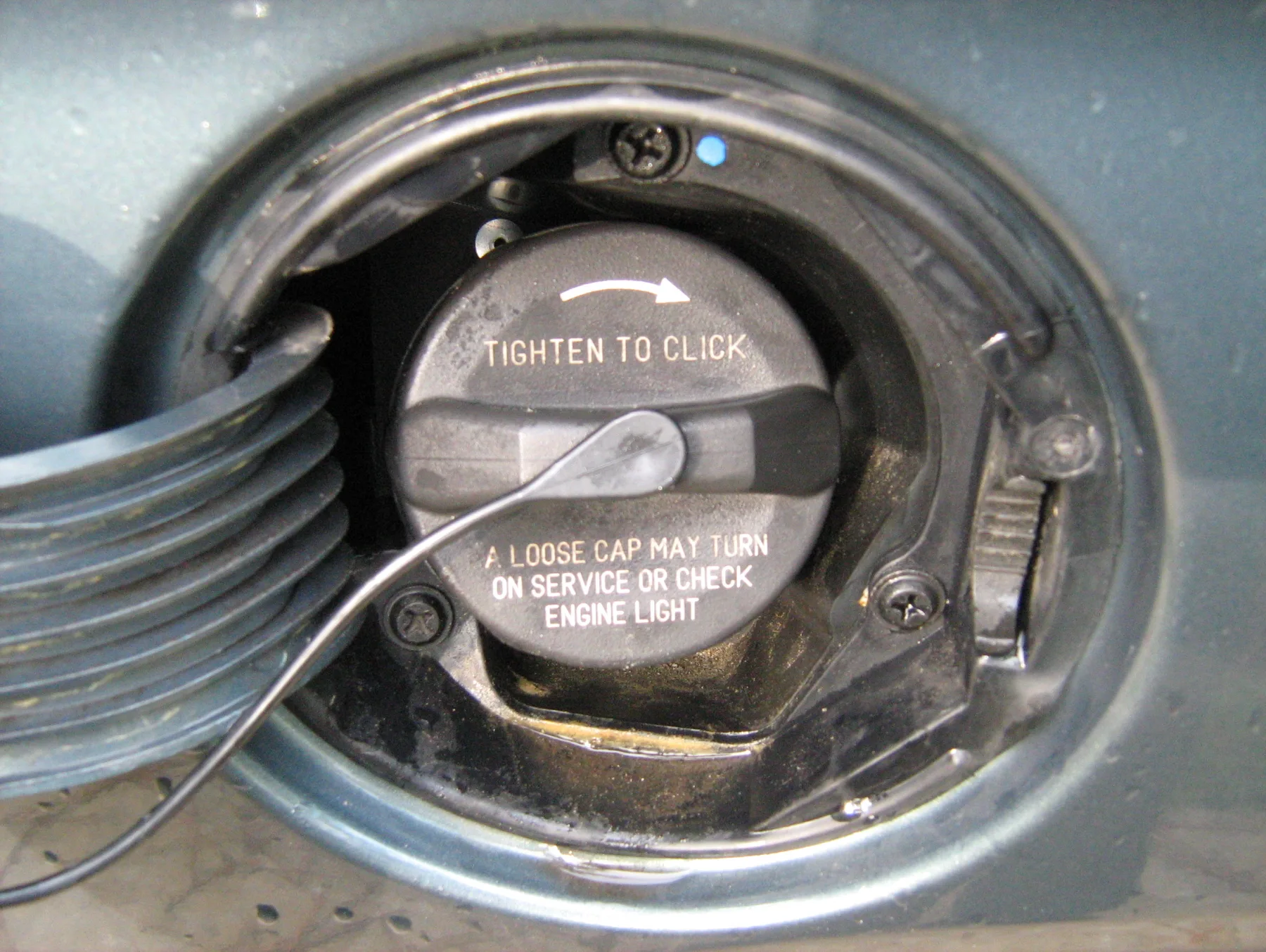


A loose cap is one way to open the filler end of that system. The cap in the photograph is seated in the filler neck behind an open fuel door, and a thin wire tether runs across it. The molding reads TIGHTEN TO CLICK, with a curved arrow, and A LOOSE CAP MAY TURN ON SERVICE OR CHECK ENGINE LIGHT. The RAV4 Hybrid manual tells the driver to turn the fuel-tank cap until a click is heard, and it says the cap turns slightly the other way once it is released. If the display shows Check Fuel Cap, the manual says the cap may be unfastened or loose: turn the power switch off, check the cap and tighten it securely, and if the message remains, wait a few seconds and then turn the power switch off again.
Standard names more than the cap. A loose or damaged gas cap, a cracked hose, or a faulty purge or vent valve can each turn the check-engine light on, and the same page lists a damaged charcoal canister with the cap, the hoses, the valves, and the tank as a cause of a leak. That page uses a scan tool to confirm why the light is on and a smoke machine to confirm where the leak is. Bosch says a faulty canister purge valve will cause a check-engine warning. The light is the monitor’s report that it found a problem. A very-small-leak code names that class of leak. It does not tell a loose cap from a hose, a valve, or the canister, because section 86.1806-17 stores that same kind of code for a demonstration orifice at the filler and for one near the canister.
On a narrow group of trucks, Ford named the cap and then kept going. SSM 49778, the special service message NHTSA posted, covers some 2021 F-Super Duty, F-650, and F-750 trucks and 2021–2022 E-Series vans with the 6.2L or 7.3L gasoline engine. An illuminated malfunction indicator with P0457 stored may be a loose fuel-filler cap, and the 2021 cap on those trucks takes three full turns to tighten. Further diagnosis is pinpoint test HX in the powertrain control and emissions diagnosis manual.
The canister’s work is the hold and the return. Vapor leaves the tank, the carbon holds it while the car sits or takes on fuel, and fresh air through the vent valve carries it off the carbon and into the engine once the purge valve opens. The monitor is looking for a leak in that sealed path. A very-small-leak code says a hole of the size in the rule was found somewhere that path is checked. A loose cap is one of the places the check is built to see, and seating the cap is where the RAV4 message and the Ford bulletin both start.
Sources
- EPA: widespread use of onboard refueling vapor recovery, 77 FR 28772 — May 16, 2012 final rule: ORVR as an activated-carbon canister, the fill-pipe seal, purge into the engine once it is started, the 1998–2006 phase-in, the 95 percent capture requirement, and the 98 percent in-use figure from tests of more than 1,100 vehicles
- 40 CFR 86.1813-17: Evaporative and refueling emission standards — Tier 3 diurnal and hot-soak measurement, the 0.05 gram-per-mile running-loss standard, the 0.20 gram-per-gallon refueling standard, the 0.02-inch fuel-system leak standard, non-integrated refueling canisters, and the vehicles those standards do not cover
- 40 CFR 86.1806-17: Onboard diagnostics — Model year 2017 and later: detection of a leak at or above 0.020 inches, malfunction-indicator illumination, the very-small-leak code examples, and the filler and canister locations used in the demonstration
- CARB: California refueling emission standards and test procedures for 2001 and subsequent model motor vehicles — Procedures amended through August 25, 2022: applicability from the 2001 model year, the 0.20 gram-per-gallon refueling standard, and the incorporation of evaporative onboard-diagnostic monitoring for refueling systems
- Bosch: canister purge valves — Vapor from heat at the tank or from fuel returning hot, capture on an activated-charcoal filter, the purge valve between the canister and the intake manifold, and a faulty valve as a cause of a check-engine warning
- Standard Motor Products: what an EVAP system is — Training page dated August 6, 2026: vapor stored in the canister, fresh air through the vent valve, controller timing of the purge valve, combustion of the vapor, leak monitoring, the several parts that can turn the light on, a scan tool to confirm why the light is on, and a smoke machine to locate the leak
- Toyota: 2025 RAV4 Hybrid owner's manual, opening the fuel tank cap — U.S. and Canada manual OM0R193U for the 2025 RAV4 Hybrid: tank pressure before refueling, the click that seats the cap, the slight turn back once the cap is released, and the Check Fuel Cap steps of tightening the cap, then waiting a few seconds before turning the power switch off again
- NHTSA: Ford special service message SSM 49778 — Certain 2021 Super Duty, F-650, and F-750 trucks and 2021–2022 E-Series vans with the 6.2L or 7.3L: an illuminated malfunction indicator and P0457 that may be a loose fuel-filler cap, three turns to tighten that cap, and the referral to pinpoint test HX
References checked .