Published by HALOX Co.
What a drum brake actually does
How a duo-servo drum brake lets the drum add force on both shoes, why a uni-servo loses that help in reverse, and how a cable parks the shoes with the wheel cylinder still.
Two shoes, and a drum that is already turning. The shoes press outward on the inside of a shell that rotates with the wheel. A rotor takes that friction on the outside, pads against both faces of a disc. On some drums the rotation does a second job. Once a shoe is touching, the drum drags it harder into the shell.
Dexter’s trailer running-gear manual, the copy NHTSA hosts as MC-10242554-0001, draws that second job in two versions, duo-servo and uni-servo. The book is about trailer axles. It also says the hydraulic brakes on the trailer are much like the ones on an automobile or a light truck. Fluid from a master cylinder, or from an actuator, moves a wheel cylinder, and the cylinder applies force against the shoes and the drum. The difference the manual names is the trailer’s actuation system, which answers a signal from the tow vehicle and supplies the fluid. On the car, FMVSS 135 defines a hydraulic brake system the same way: fluid carries force from the service-brake control to the service brake, and the system may include a brake power assist unit, the booster.
The wrap, forward and backward
Dexter’s duo-servo uses a dual-piston wheel cylinder. Apply the brakes and the double-acting cylinder moves the primary shoe and the secondary shoe toward the drum. Friction between the drum and the lining tries to turn the primary shoe into the secondary shoe. The secondary shoe is forced onto the anchor pin, and from there the two shoes try to wrap the drum. The manual’s line is that the brake has used frictional force to help the applying force on both shoes. Backing up swaps the shoes. They rotate with the drum, the secondary shoe leaves the anchor, and the primary shoe moves against it. Dexter says the action is the same in reverse as it is forward. That duo-servo is typically used, on these pages, with an electric/hydraulic, vacuum/hydraulic, or air/hydraulic supply.
A uni-servo uses a single-acting cylinder. The primary shoe is pressed against the drum and moves with the rotation, and that movement pushes the secondary shoe through the adjuster. Reverse braking, the manual says, is significantly less effective than braking forward. The free-backing shoe is the variation Dexter describes for a trailer on a surge hitch, where brake force from the surge mechanism can make backing impossible. The primary shoe sits on a pivot, so it applies going forward and rotates away from the drum when the trailer is backing.
The electric drum on the same trailer is the shoe and the drum with a different push. Dexter says those electric brakes are similar to the drum brakes on an automobile, and the basic difference is the actuator: hydraulic pressure on the car, an electromagnet on the trailer. Current pulls the magnet against the armature face of the drum and moves an actuating lever in the direction the drum is turning. A cam block at the shoe end of the lever pushes the primary shoe out. Force from that shoe, through the adjuster, moves the secondary shoe out against the drum.
One cylinder, or one at each shoe
The parts sit on a backing plate. That is the view with the drum off.
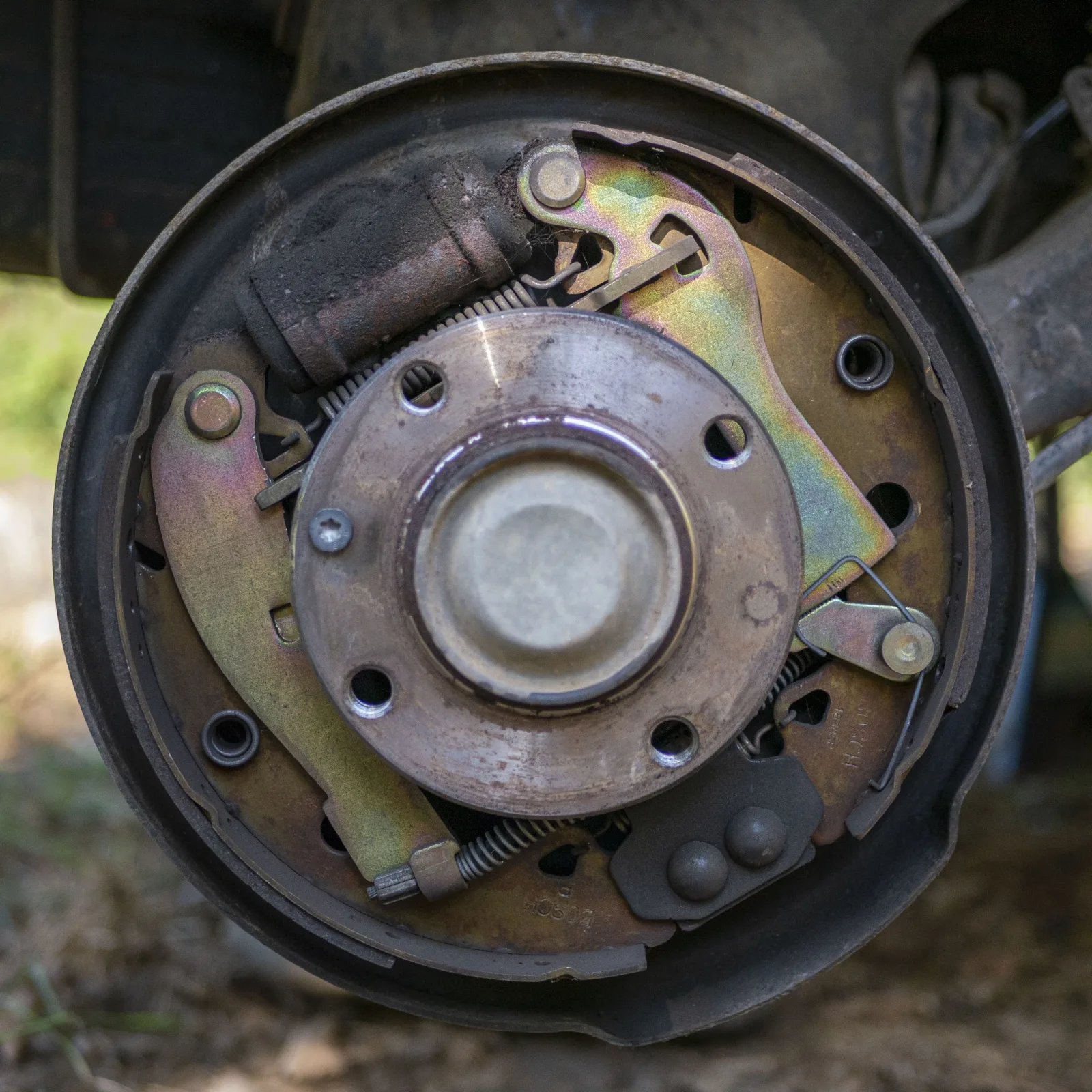

The file identifies this as the right rear drum of a 2005 Citroën C15 First after 120,000 km, and it calls the brake a Bosch unit. The photograph is outdoors, still on the car. The background is blurred dirt ground and greenery. The car’s rear axle arm is at the upper right. In the center is a hub flange with a domed center cap and four empty bolt holes, and no wheel studs are visible. The dark, rusted wheel cylinder sits at the upper left, with a coil spring running right just under it. The two shoe webs are gold-tinted zinc-plated steel, and the linings are hidden behind the webs at the rim. At the upper right is a gold-tinted adjuster lever and quadrant on a pivot pin. At the right is a lever end with a pin and a thin wire clip. At the bottom are a lower coil spring and a dark gray anchor block with two round bolt heads. Dexter’s duo-servo drawing names the hardware around its one cylinder: an anchor post, retractor springs, the backing plate, a primary shoe and a secondary shoe, an adjuster, a hold-down spring, an actuating pin, and the hydraulic wheel cylinder. The photograph shows the wheel cylinder, the shoe webs, the coil springs, the adjuster lever and quadrant, and the anchor block.
A plate can carry a cylinder at each shoe.
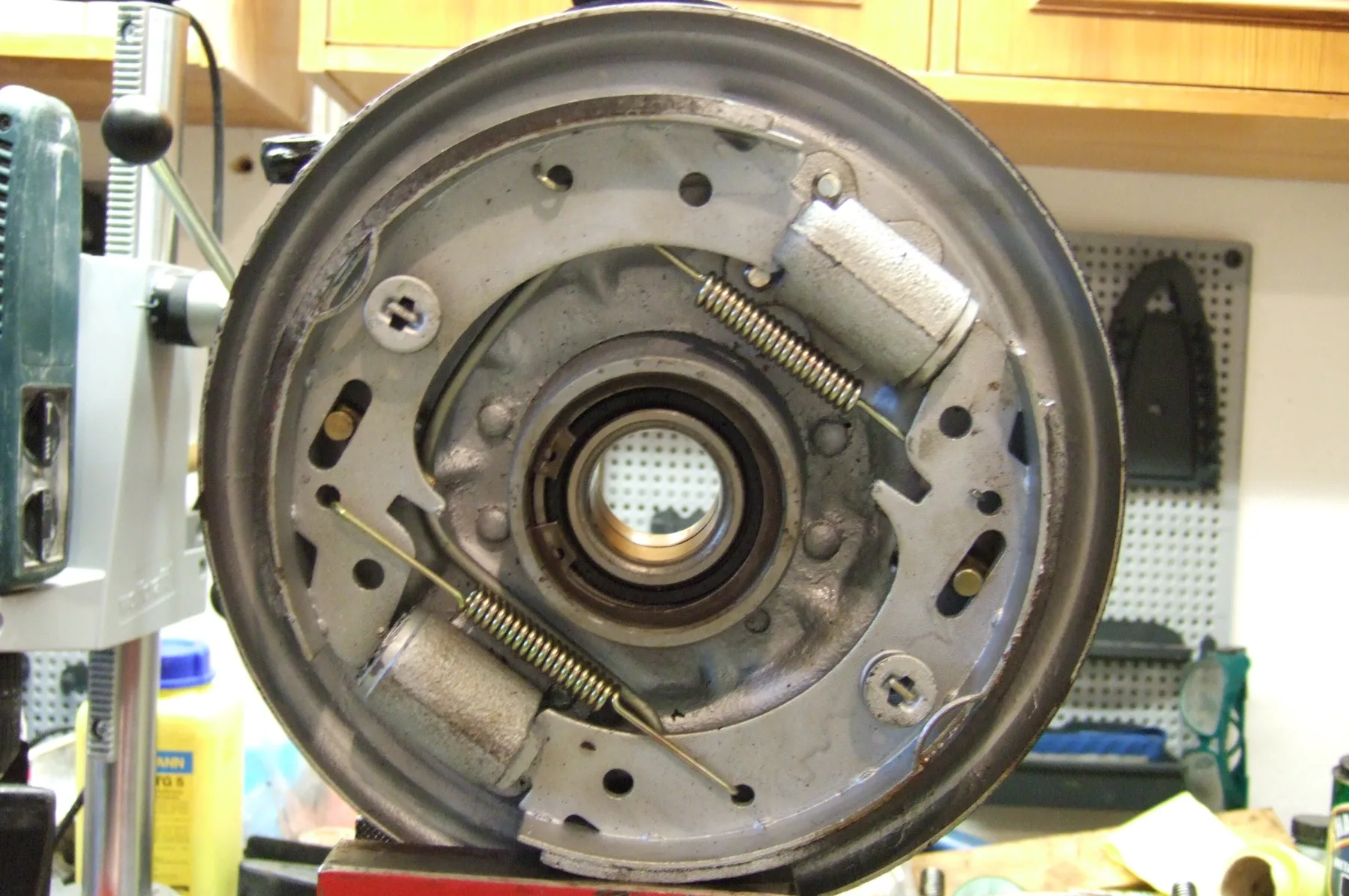

The file identifies this as a dismounted duplex brake from an IFA Trabant 601, drum off. It is off the car, standing upright in a home workshop on a red-painted stand. A drill press is at the left, with a pegboard wall and light wooden cabinets behind. The backing plate is light gray and silver. Two silver-gray wheel cylinders sit diagonally opposite each other, one at the upper right and one at the lower left. Each has a coil spring and a wire rod running diagonally from it. No rubber boots and no brake lines are visible. The center is a hub opening with a bearing and seal, and no wheel studs are visible. Small screw heads hold the shoes at the upper left and lower right. Dexter’s duo-servo and its uni-servo each use one wheel cylinder. This plate uses two, which is what the file is calling a duplex brake.
Open the cylinder and the pistons are loose in the bore.
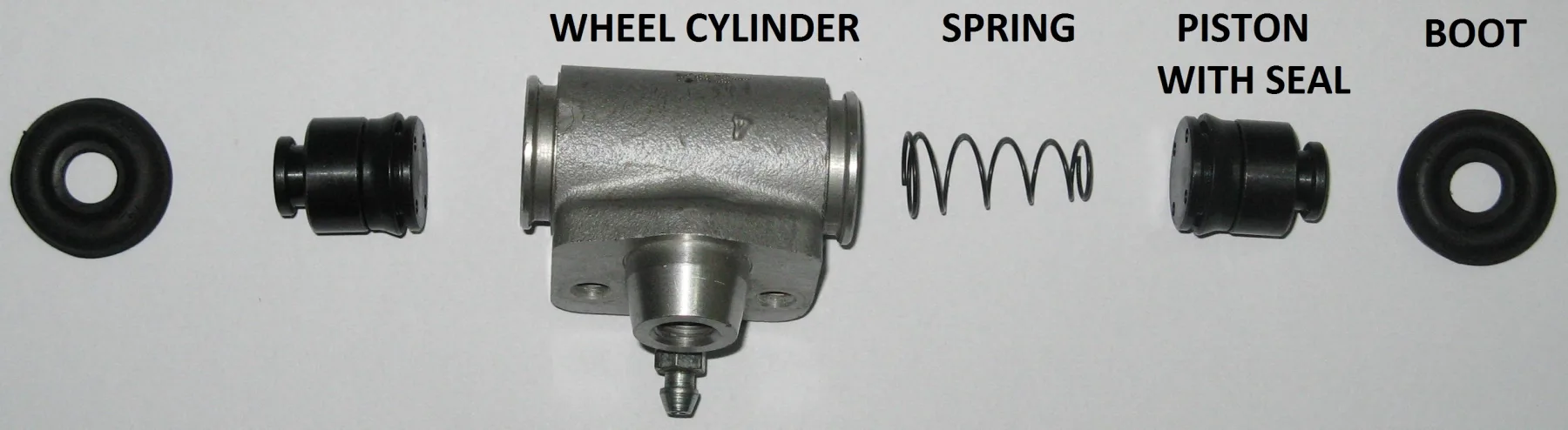

The file identifies this as the child parts of a wheel cylinder. The parts sit in one row on a light gray background, each with black capital letters printed on the photo. From left to right: a black rubber boot, a piston with seal, the gray cast WHEEL CYLINDER body (open bores at both ends, a threaded inlet boss underneath, and a bleeder screw), a SPRING, a PISTON WITH SEAL, and a BOOT. There are no metal clips and no separate small seals.
Hyundai bulletin 21-BR-002H, March 2021, is listed for all Hyundai vehicles, and it includes a rear-drum section. Debris on the wheel cylinder and the boots, that section says, is not an immediate indication that the cylinder is leaking. The leak is its own inspection. If any brake-shoe spring is broken, the bulletin says to replace all of the shoe springs, and it recommends new springs when the shoes themselves are replaced. Grease stays off the lining and off the drum’s friction surface. Dexter treats a lining as due for replacement when it is worn to 1/16 inch or less, soaked with grease or oil, or abnormally scored or gouged. Hairline heat cracks in a bonded lining are normal on that page. When the shoes are replaced, Dexter wants both shoes on that brake and both brakes on the axle, which is how it says the axle keeps its balance. The same page warns that some older linings may contain asbestos dust, and it tells the person doing the work to avoid grinding the lining or blowing the dust off.
The gap between shoe and drum is a set distance until the lining wears. On Dexter’s 12¼-inch forward self-adjust hydraulic brakes, which the manual dates to March 1997, the adjuster works on a forward stop and on a reverse stop, and only after lining wear has opened enough gap. The mechanism rotates the screw at the bottom of the brake, lengthening the distance between the shoes and closing the gap to the drum. FCA bulletin 05-003-15, May 27, 2015, is one van: the 2015 Ram ProMaster City built on or before December 2, 2014, with four-wheel anti-lock brakes, sales code BGK. The rear brake in that job is a drum held by a retaining pin, an upper return spring, a lower return spring, a front-facing shoe, a rear-facing shoe, retaining clips, a shoe adjuster, and a wheel cylinder on the backing plate fed by a hydraulic tube. The adjuster is turned until a slight drag is felt as the drum rotates. Hyundai’s drum section has the drum measured for that kind of question: inside diameter and runout, before machining and after, with surface dirt and corrosion cleaned off first, checked against the service limits in that vehicle’s shop manual.
The cable, while the pistons stay put
The service brake under FMVSS 135 is worked by a foot control. The parking brake has its own control, by hand or by foot, and the standard requires a parking brake of a friction type with a solely mechanical means to keep it engaged. An electrical switch is one of the controls the test allows: an electrically activated parking brake is applied by activating that control. The hold, for the vehicles this standard covers, is five minutes in each direction on a 20 percent grade, the vehicle at GVWR, the transmission in neutral. The force in the test stays at or under 400 newtons (89.9 pounds) on a hand control and 500 newtons (112.4 pounds) on a foot control. The standard applies to passenger cars manufactured on or after September 1, 2000, and to multipurpose passenger vehicles, trucks, and buses with a GVWR of 3,500 kilograms (7,716 pounds) or less manufactured on or after September 1, 2002. Temperature in the procedure is read from a thermocouple in the most heavily loaded shoe or disc pad, with the rubbing surface a drum or a rotor, so the rule is written for both.
On Dexter’s hydraulic drums the mechanical path is a cable, and the manual lists that parking feature as unavailable on some sizes. On the 10-inch and 12-inch brakes the cable body mounts to the backing plate and the cable end attaches to an internal lever on the secondary shoe. Force goes through a parking strut to the primary shoe, and the load spreads the two shoes until they meet the drum. Friction between the lining and the drum is the hold. On the 12¼-inch brakes the lever works a cam, and the cam spreads the shoes. The ProMaster City bulletin hooks the park-brake cable to the rear-facing shoe. The cable is slackened at an adjustment nut, at least two or three turns, before the drum comes off.
Bosch’s drum-brake notes walk through a cable in general terms. The notes say the description is intentionally general and cannot apply to every vehicle, and that the maker’s own information governs the repair. The parking-brake cables are loosened at an adjustment unit. A lever sits with the shoes, and the cable comes off the lever when the shoes come off. On the layout in the notes the lever is at the front. On other vehicles it is behind the shoes and is reached through a wheel-bolt hole. Piston clips in the same notes keep a piston from falling out of the wheel cylinder while the shoes are off the plate.
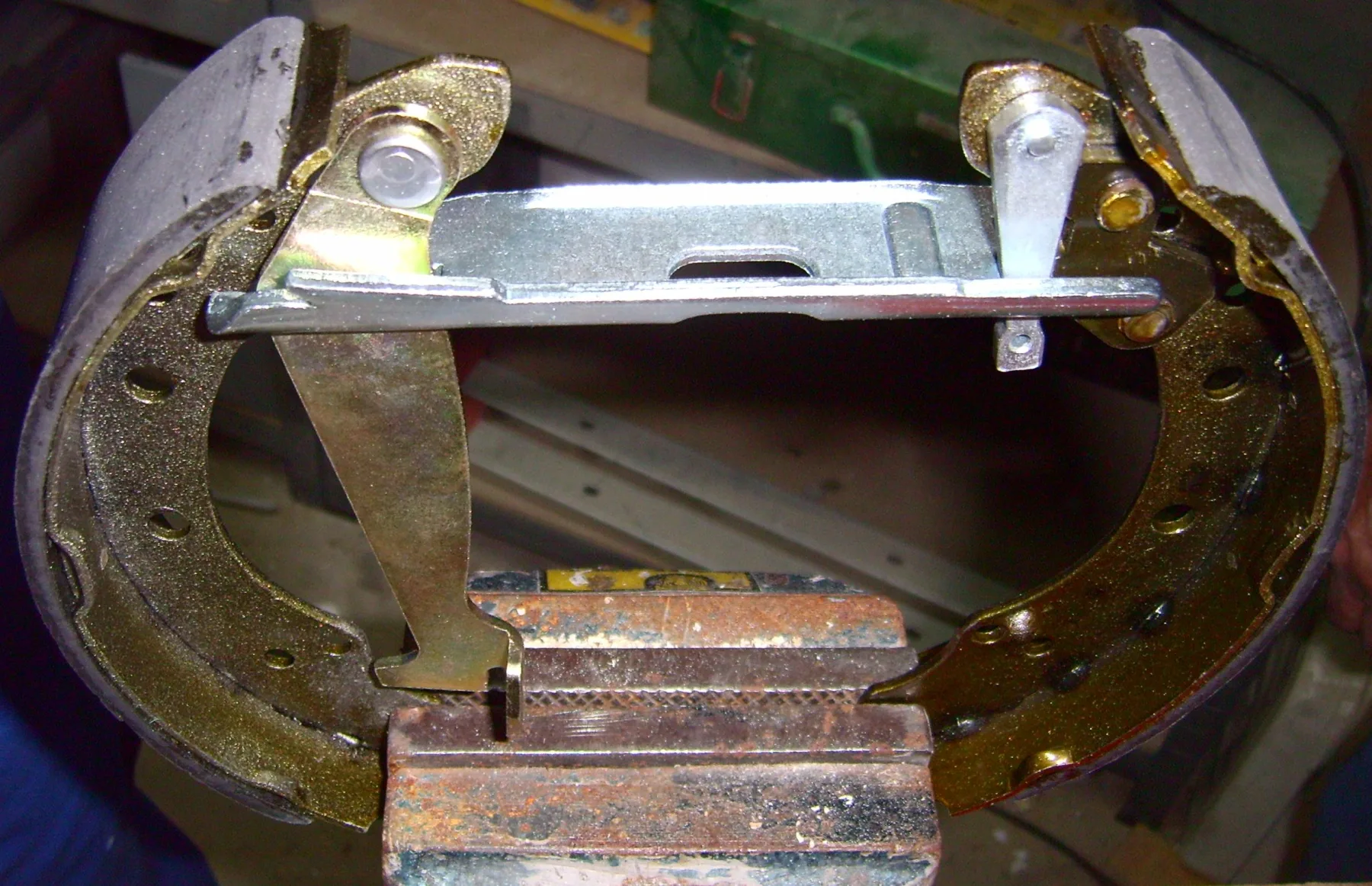

The file identifies this as parts from a drum brake on a 2003 Škoda Fabia I. The two shoes are clamped upright in a rusty bench vise in a workshop, with a green metal toolbox behind. The shoe webs are gold-tinted with drilled holes, and the gray linings are on the outside. A flat silver strut bar with a slot spans the top between the shoes. A gold parking lever hangs down from a pivot pin on the left shoe, with a hooked lower end. A small silver piece hangs down near the right end of the strut. No cable and no coil spring are visible, and rivets cannot be confirmed. Dexter’s 12¼-inch brake takes the gap up with a screw at the bottom. The Citroën photograph shows an adjuster lever and a quadrant. The file calls this set the shoes, actuating rod, and adjusting wedge. The three adjusters are three different pieces.
Fluid moves the pistons. On a duo-servo the drum then helps both shoes, ahead and in reverse. On a uni-servo that help is the forward stop. The cable can spread the shoes while the pistons stay where they are.
Sources
- Dexter trailer running-gear manual, NHTSA file MC-10242554-0001 — Hydraulic trailer brakes described as much like an automobile or light truck, fluid from a master cylinder or actuator moving a wheel cylinder that applies the shoes and drum, with the trailer's actuation system as the named difference; duo-servo with a dual-piston wheel cylinder, primary shoe driven into the secondary, secondary forced onto the anchor, both shoes wrapping, and the same action in reverse; duo-servo typically on an electric/hydraulic, vacuum/hydraulic, or air/hydraulic system; uni-servo with a single-acting cylinder, the secondary shoe actuated through the adjuster, reverse braking significantly less effective; free-backing shoe on a surge-hitch trailer; electric trailer brakes similar to automobile drum brakes, electromagnet instead of hydraulic pressure, lever and cam block, force through the adjuster; 12¼-inch forward self-adjust hydraulic brakes from March 1997, screw at the bottom, forward and reverse stops, only after enough gap from lining wear; hydraulic parking cable on 10-inch and 12-inch brakes, lever on the secondary shoe, strut to the primary shoe, and a cam on the 12¼-inch brakes; parking feature not on every size; lining replacement at 1/16 inch or less, grease or oil, or abnormal scoring, hairline heat cracks normal in bonded linings, both shoes and both brakes on the axle, asbestos-dust caution
- 49 CFR 571.135, FMVSS No. 135, light vehicle brake systems — Application to passenger cars made on or after September 1, 2000, and to multipurpose passenger vehicles, trucks, and buses with GVWR of 3,500 kg (7,716 lb) or less made on or after September 1, 2002; hydraulic brake system as fluid transmitting force from the service-brake control to the service brake, and a system that may include a brake power assist unit; service brakes by a foot control; parking brake control independent, hand or foot; parking brake a friction type with solely mechanical means to retain engagement; parking test at GVWR, transmission in neutral, 20 percent grade, five minutes each direction; hand control at most 400 N (89.9 lb), foot control at most 500 N (112.4 lb); electrically activated parking brake applied by its control; thermocouple in the most heavily loaded shoe or disc pad, and a drum or a rotor as the rubbing surface
- FCA bulletin 05-003-15, May 27, 2015: 2015 Ram ProMaster City rear brakes — 2015 Ram ProMaster City built on or before December 2, 2014, with 4-wheel anti-lock brakes, sales code BGK; rear drum with a retaining pin, upper and lower shoe return springs, front-facing and rear-facing shoes, retaining clips, shoe adjuster, wheel cylinder on the backing plate, and a hydraulic tube; park-brake cable on the rear-facing shoe; cable slackened at the adjustment nut; adjuster set for a slight drag as the drum is rotated
- Hyundai bulletin 21-BR-002H, March 2021: brake service best practices — Listed for all Hyundai vehicles; rear-drum section measuring inside diameter and runout before and after machining, against the shop manual, after removing surface contamination and corrosion; debris on the wheel cylinder and boots is not an immediate indication of a leak; broken shoe spring replaced as a full set of shoe springs; grease kept off the lining and the drum friction surface
- Bosch: drum brakes, tips, tests and repair — Descriptions intentionally general and not applicable to every vehicle, with the vehicle maker's information governing the repair; parking-brake cables loosened at an adjustment unit; a parking-brake lever with the shoes, at the front on the layout described and behind the shoes on other vehicles; cable detached from the lever; piston clips keeping a piston from falling out of the wheel-brake cylinder
References checked .