Published by HALOX Co.
What a farm plate actually is
What Oregon, Wisconsin, and Texas put on a farm plate, which trips each plate allows, and how FMCSA's covered-farm-vehicle rule reads that plate.
Oregon DMV registers a farm vehicle when the motor vehicle carries or moves freight, articles, or people on the highway. A trailer does not qualify, and a motor home does not qualify. The plate below is the metal version of that registration: FARM above and below the number, an F prefix, a fir tree, and a sticker that reads December 2018. The sticker dates that plate. The registration it stands for is the one on the current DMV page and in the state’s farm-trucking guide.
The F plate, and the trailer beside the truck
ODOT’s farm-trucking guide, dated July 2024, says DMV issues the F plate after the Commerce and Compliance Division approves a farm certification. When that approval is delayed, DMV can issue a temporary farm registration permit of up to 45 days.
The permitted haul starts with the farmer’s own agricultural commodities, products, or livestock, grown or raised on that farm. Goods the farm packed or processed still qualify when the farmer keeps ownership. A product that has been turned into a finished state is outside that haul. Supplies, equipment, and materials that will be used or consumed on the farm qualify, and so do materials incidental to the farm’s regular operation. Personal use is on the same list for the farmer, an immediate family member, or an employee. The guide’s examples include a trip to the grocery store and hauling a camper. Hauling for another qualifying farmer is limited to a documented exchange of labor, for something that will be used on that farm.
Holding the truck out to haul for the public, for compensation, is for-hire in the guide’s words, and the F plate does not grant it. Occasional for-hire hauling inside Oregon takes a separate permit from the Commerce and Compliance Division. That permit runs from point to point within the state. It does not authorize household goods, passengers, or a for-hire trip across a state line.
The plate is also not the variance permit for a move over legal size or weight. The guide says DMV may still issue a farm plate for that vehicle, and the farmer still has to get the variance permit from the Commerce and Compliance Division before the move.
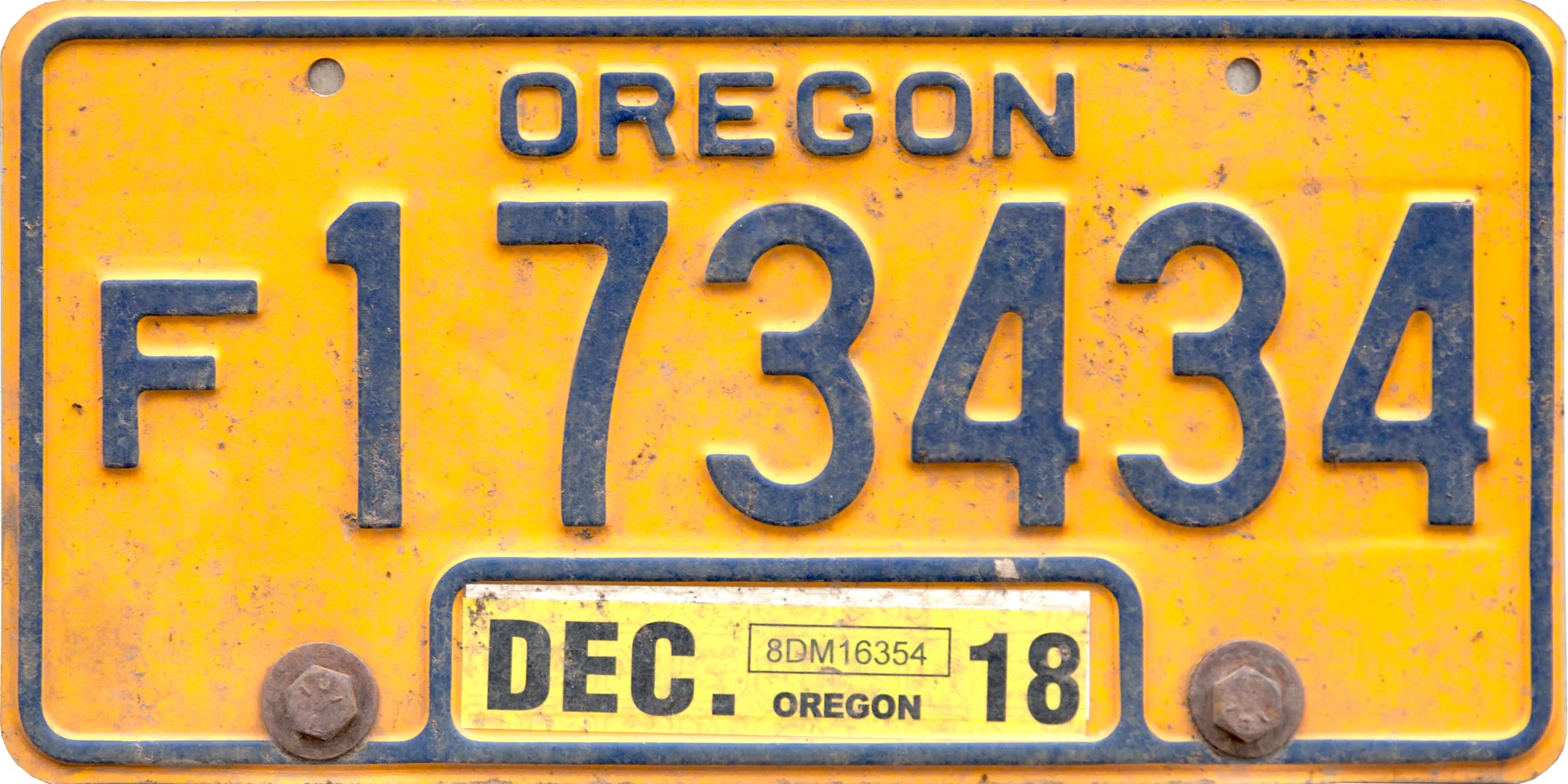

The December 2018 sticker is the validation in the photograph. The uses above are the ones in the July 2024 guide and on the current DMV page.
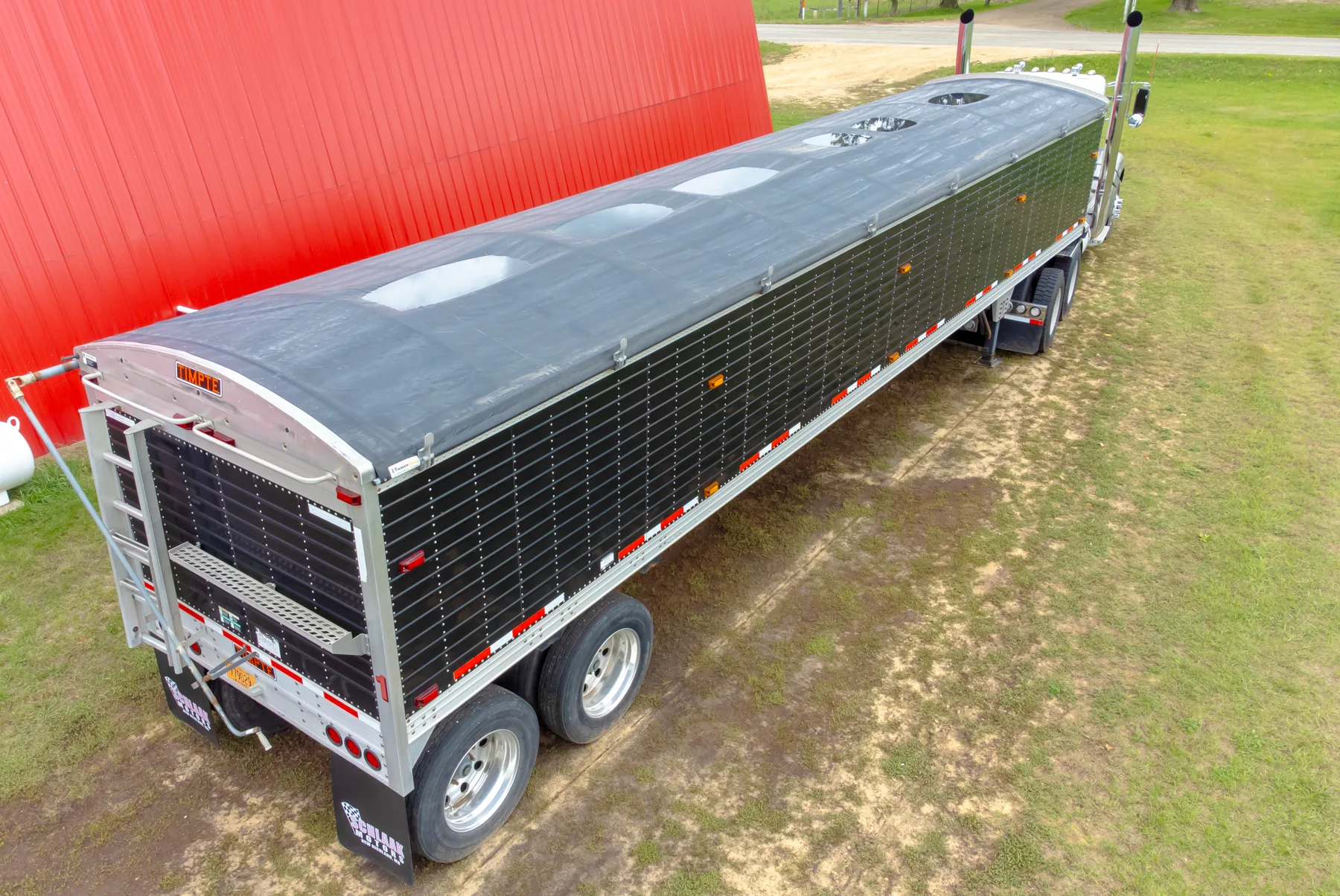

A grain hopper, with no plate on the rear. Oregon’s farm registration stays on the motor vehicle. Texas can put a plate on the trailer itself.
Wisconsin’s line is the registered weight
Wisconsin’s heavy-plate guide calls a heavy farm truck a farm truck over 12,000 pounds. The state issues two plates, they stay with the vehicle, and the design it lists as current was issued in 2008. The farm-truck page says those plates expire at the end of February, with FEB stamped at the upper right and a year sticker at the lower right. The plate in the photograph reads FARM, with FEB at the upper right and a sticker that reads 22. The sticker does not show the registered weight.
The use follows that weight. The truck may not be used in a non-farm occupation, and it may not be used to commute to and from other work. Registered under 38,000 pounds, the use has to be primarily for the farm, and personal or family use is allowed. Registered at 38,000 pounds or more, the use has to be exclusively for the farm, and personal or family use is out. A truck that also does non-farm work takes a different registration, dual-purpose farm or an ordinary truck. On the farm-truck page, dual-purpose registration is available at 4,500, 6,000, or 8,000 pounds for the non-farm occupation, and the truck may operate up to 12,000 pounds when the work is farm work.
A farm trailer wears its own plate. The heavy-plate guide says that trailer must be used exclusively for farm purposes, the state issues one plate, the plate stays with the trailer, and the plate expires on December 31.
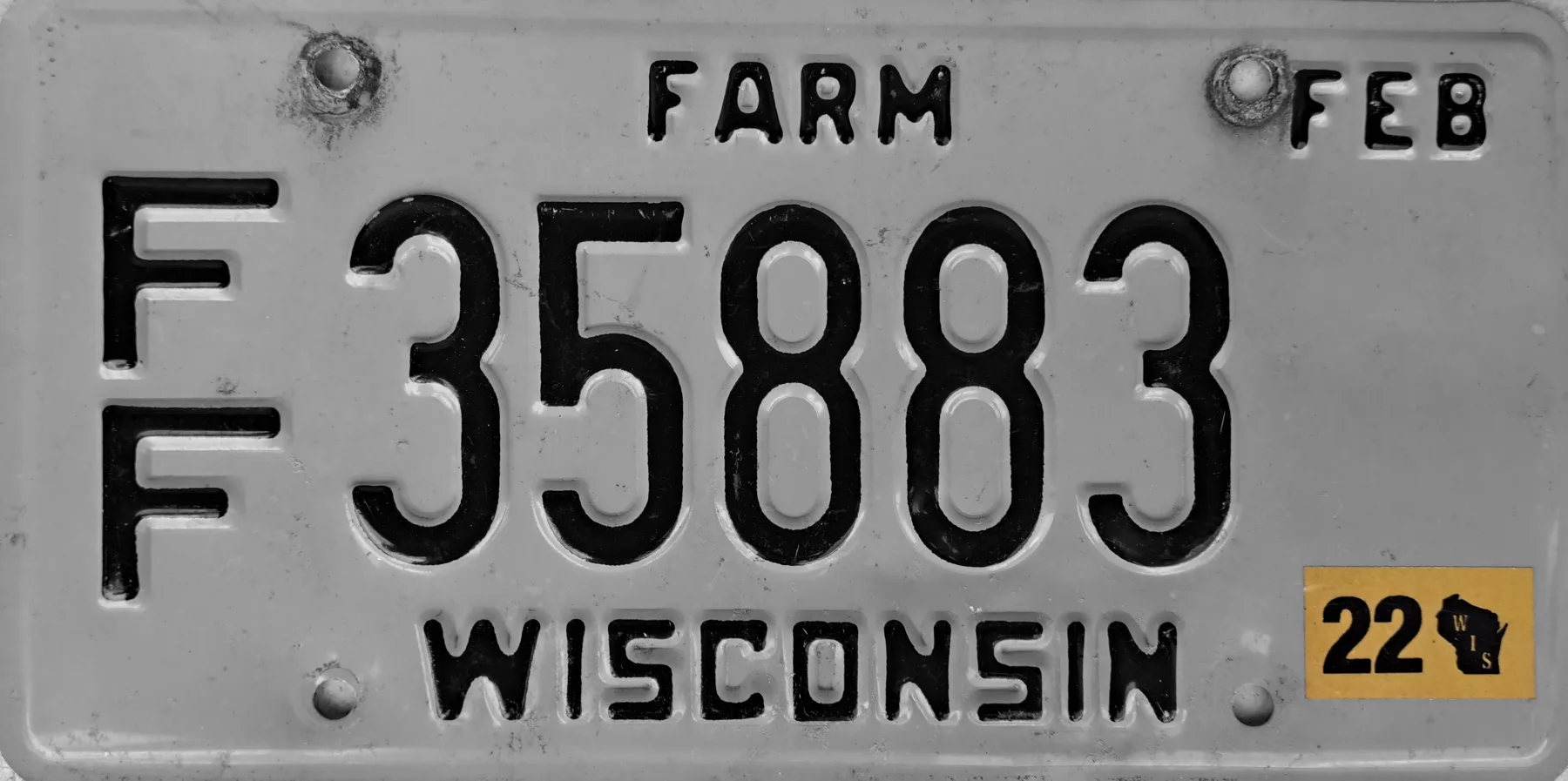

FEB at the upper right and the 22 sticker are the marks on this heavy farm plate. The photograph is one plate on a bench. It does not show the second plate, and it does not show a registered weight.
Texas splits the truck from the trailer
The application TxDMV posts for a farm truck or farm truck tractor is a certification of use. The owner signs that the truck will haul that owner’s poultry, dairy, livestock, livestock products, timber in its natural state, and farm products to market or to another point for sale or processing; laborers from their place of residence; and materials, tools, equipment, or supplies, without charge, from the place of purchase or storage to the owner’s own farm or ranch. Equine activities and livestock shows are on that certification. The application also allows passenger trips, without charge, by the owner or the owner’s family, for church, school, a doctor, or other necessities of the home and family. Other gainful employment, besides farming or ranching, is off the list.
The truck plate is not issued for an ordinary passenger vehicle, unless the vehicle was reconstructed for delivery and a corrected title is applied for. It is not issued for hauling livestock except for sale. It is not issued for gainful employment or for hire, including the trip to and from a job. The applicant shows a current Agricultural and Timber Exemption registration number from the Texas Comptroller, unless that application exempts the applicant.
The trailer certification is separate. The owner signs that a farm trailer or semitrailer will be used to haul seasonally harvested agricultural products or livestock from the place of production to processing, market, or storage, or farm supplies from the place of loading to the farm, and for equine activities and livestock shows, and that the gross weight for the year will not go over 34,000 pounds. TxDMV’s trailer page sorts the paperwork by that weight. At or under 4,000 pounds, a farm trailer used primarily as a farm vehicle is exempt from title and registration, the owner may still ask for a title, and the trailer may receive a farm trailer plate. Above 4,000 pounds and through 34,000 pounds, title is optional and the farm trailer plate is available. Above 34,000 pounds the trailer does not qualify for the farm trailer plate. It is titled and registered with an ordinary trailer plate. A farm trailer plate does not mean a title was issued. An owner who skips the title keeps the ownership evidence.
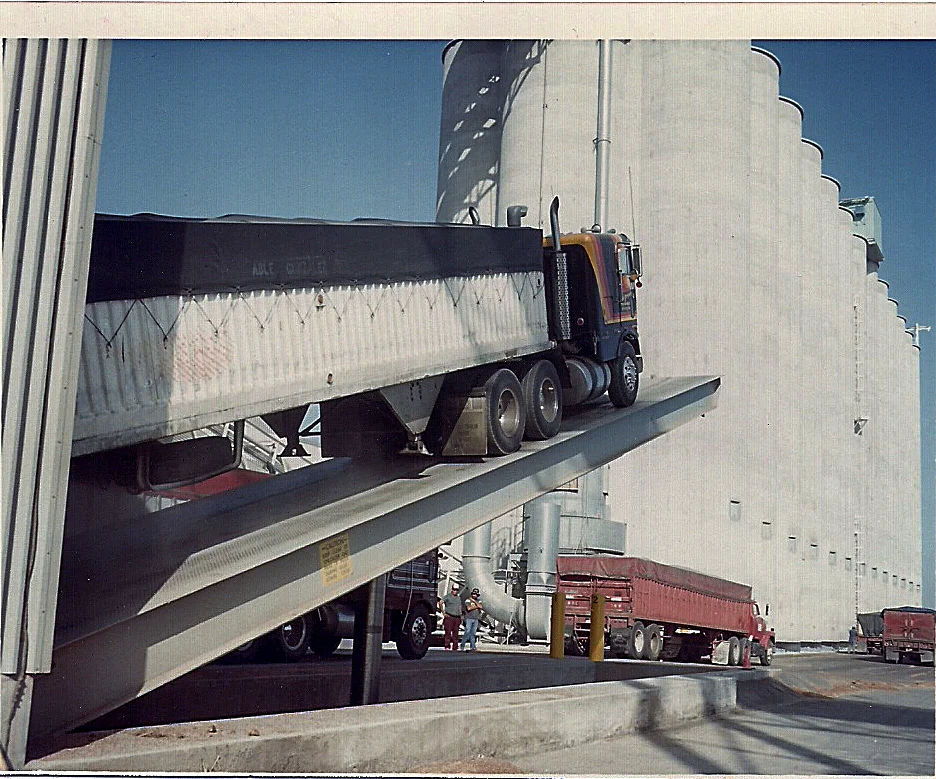

Grain trucks at an elevator, photographed in December 2011. A haul to market or to a processor is the trip the Texas certification describes, and it is one of the hauls on Oregon’s list. No plate is readable here, so the photograph does not say which registration is on the truck.
The federal rule uses the plate as a marker
FMCSA’s covered-farm-vehicle definition is a straight truck or an articulated vehicle, registered with a license plate or another designation from the state of registration that lets an officer identify it as a farm vehicle. The operator is the owner or operator of a farm or ranch, or an employee or a family member of that owner or operator. The load is agricultural commodities, livestock, machinery, or supplies, to or from a farm or ranch. The operation is not for-hire. A tenant hauling the landlord’s share under a crop-share agreement is the exception written into that for-hire line.
Weight decides where those conditions travel. At or under 26,001 pounds, using whichever is greater among the gross vehicle weight rating, the gross combination weight rating, the gross vehicle weight, and the gross combination weight, the exemptions apply anywhere in the United States. Over 26,001 pounds, they apply in the state of registration, or across a state line within 150 air miles of the farm or ranch where the vehicle is being operated.
The exemption rule takes that vehicle, and the person driving it, out of the commercial driver’s license requirements, the drug and alcohol testing requirements, the medical qualifications and examinations, the hours-of-service limits, and the inspection, repair, and maintenance requirements. The plate is the marker an officer can read. It does not show who is driving, what is in the bed, or the weight. Oregon’s grocery-store example can sit inside that state’s personal-use permission and outside this definition, because the definition is built on a farm load. Wisconsin’s personal or family use under 38,000 pounds splits the same way. A for-hire trip under Oregon’s separate in-state permit sits outside the federal ban on for-hire work.
The plate is a state registration for a limited use. It does not title the truck or the trailer, it does not authorize holding out to haul for the public, and it does not replace a permit to run over legal size or weight. It is also not the USDOT number a carrier marks on the power unit. The federal exemptions are a second reading, of the driver, the load, the weight, and the distance, after the plate has identified the vehicle as a farm vehicle.
Sources
- Oregon DMV: Vehicle types — Oregon; farm registration for motorized vehicles that carry freight, articles, or people, with trailers and motor homes excluded, and Commerce and Compliance approval before title and registration
- ODOT: Guide to Farm Trucking in Oregon — Oregon; F plates after farm-certification approval, permitted uses, personal use, for-hire hauling, and the separate variance permit; guide dated July 2024
- Wisconsin DMV: Farm trucks and trailers — Wisconsin; ban on non-farm occupation, personal and family use under 38,000 pounds, exclusive use at 38,000 pounds and above, dual-purpose registration, and sticker placement
- Wisconsin DMV: Heavy trucks and trailers license plates — Wisconsin; heavy farm truck over 12,000 pounds, two plates that stay with the vehicle, and a farm trailer plate limited to exclusive farm use
- TxDMV: Application for Farm License Plates — Texas; eligibility proof and the uses a farm-truck or farm-trailer applicant certifies; revision October 2017, the application TxDMV still posts
- TxDMV: Trailers — Texas; farm trailer plate, optional title at or under 34,000 pounds gross weight, and ordinary trailer plates above that weight
- 49 CFR 390.5T: Definitions — United States; covered farm vehicle, including the state plate or other designation, the operator, the cargo, for-hire carriage, and the weight and distance split
- 49 CFR 390.39: Exemptions for covered farm vehicles — United States; exemptions from the commercial driver's license, drug and alcohol testing, medical qualifications, hours of service, and inspection, repair, and maintenance
References checked .