Published by HALOX Co.
What a glow plug actually does
How a glow plug heats a cold diesel chamber for a compression start, and why the controller can keep it glowing after the engine is already running.
A diesel lights its fuel with heat from compression, not with a spark. Squeeze the intake air hard enough and it is hot enough to fire the fuel on its own, which NGK’s glow-plug sheet calls spontaneous ignition. In ordinary conditions that air is around 900°C when the fuel arrives, on the same company’s 2022 note. A cold engine spends the heat on the way. The cylinder, the pistons, and the valves take it out of the incoming air, and more of it when that air is cold too. Denso puts the same loss on the mass of the block and the head. The plug is for the start where compression alone does not leave the chamber hot enough.
A spark plug is how a gasoline engine begins the burn. This part is only a heater, switched on before the starter turns. The heater tube is brought rapidly past 800°C. Single-coil sheathed examples on that sheet need 20 to 25 seconds to reach 800°C, and the quickest examples on the same table are about 4 seconds to 900°C. The dash lamp, on the engines that have one, is that wait.
The sheath, and the chamber it enters
The working end is a rod in the cylinder head, a glow pencil on the NGK sheet. In a metal plug the heating coil sits inside a heat-resistant tube. Magnesium oxide packed around the wire, in the 2022 note, cushions the coil and carries the heat out to the sheath. A second coil, on the self-regulating plugs, raises its resistance as the temperature climbs, so the wire can come up quickly and then hold instead of burning out. Denso describes that extra resistor the same way: the hotter the plug, the harder it is to push more current through.
The rod has to meet the fuel where the air is already moving. On the sheet it sits in the glow chamber or the pre-combustion chamber, most useful on the edge of the mixing vortex, and a pencil that reaches too far in gets in the way of the mixture. The figure there is drawn three ways: an indirect-injection engine, a swirl-chamber engine, and a direct-injection engine. On a direct-injection common-rail diesel, Bosch seats the heating element in the head, as close as it can sit to a jet from the injector. GM bulletin 16-NA-337, on the 2016–2017 Chevrolet Low Cab Forward, lists the Isuzu 3.0L as direct injection and describes the plugs as warming the compressed air inside the combustion chambers. The instruction there is to start once the wait-to-start light has gone out.
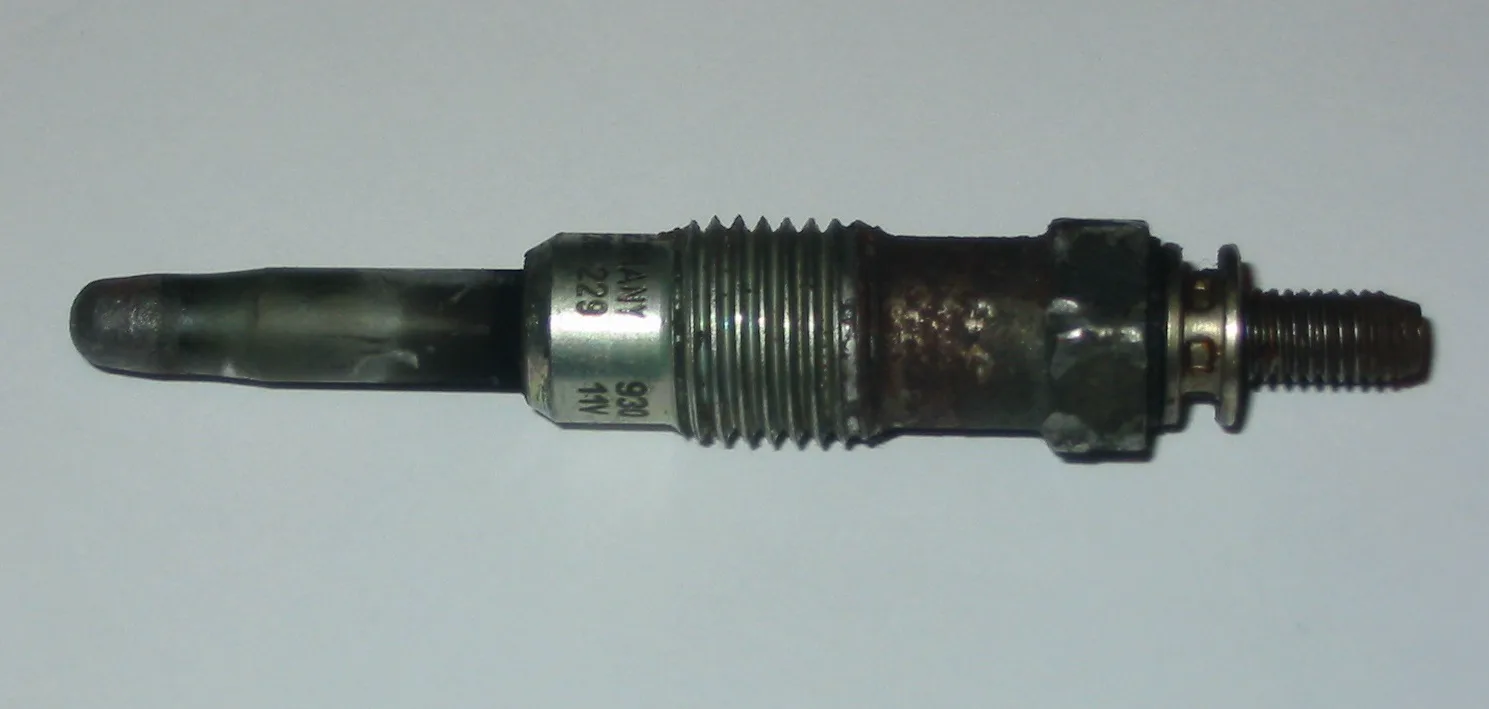

The photograph is one used plug on a pale gray background. The file calls it a glow plug from a diesel engine and does not name the engine. At the left is the smooth heater rod, unthreaded, with a rounded tip discolored dark gray. A silver collar beside it carries partly visible stamped markings, characters like 229, 930, and 11V. Then a threaded section, a rust-brown body, and a rusty hex. At the right, a small ring and a threaded terminal stud. No nut is on the stud.
A ceramic tip, where the sheath runs out of room
The metal tube is one way to get the heat into the chamber. Ceramic is the other. On the NGK sheet the heating coil is encased in silicon nitride, so the hot section can be smaller in a chamber already crowded by the injector and the valves, and the plug can stay in post-glow for up to ten minutes at a higher temperature than a metal sheath. The 2022 note has a ceramic plug past 1,000°C in under two seconds, then an after-glow of more than ten minutes at up to 1,350°C, with less blue and white smoke and less hydrocarbon and carbon monoxide. Bosch’s low-voltage version is that element inside a protective tube, a nominal 7 volts, up to 1,350°C and typically 1.4 seconds to 1,000°C. Metal plugs, on BorgWarner’s ignition page, are the slower sheath: about 2 to 5 seconds of preheating, and a start the page calls reliable even at -30°C. The 2014 Cruze bulletin lists ceramic plugs, on the 2.0L diesel, for a better cold start than conventional metal ones. That engine is direct injection, the injector in the middle of the cylinder and the bowl in the piston as the chamber.
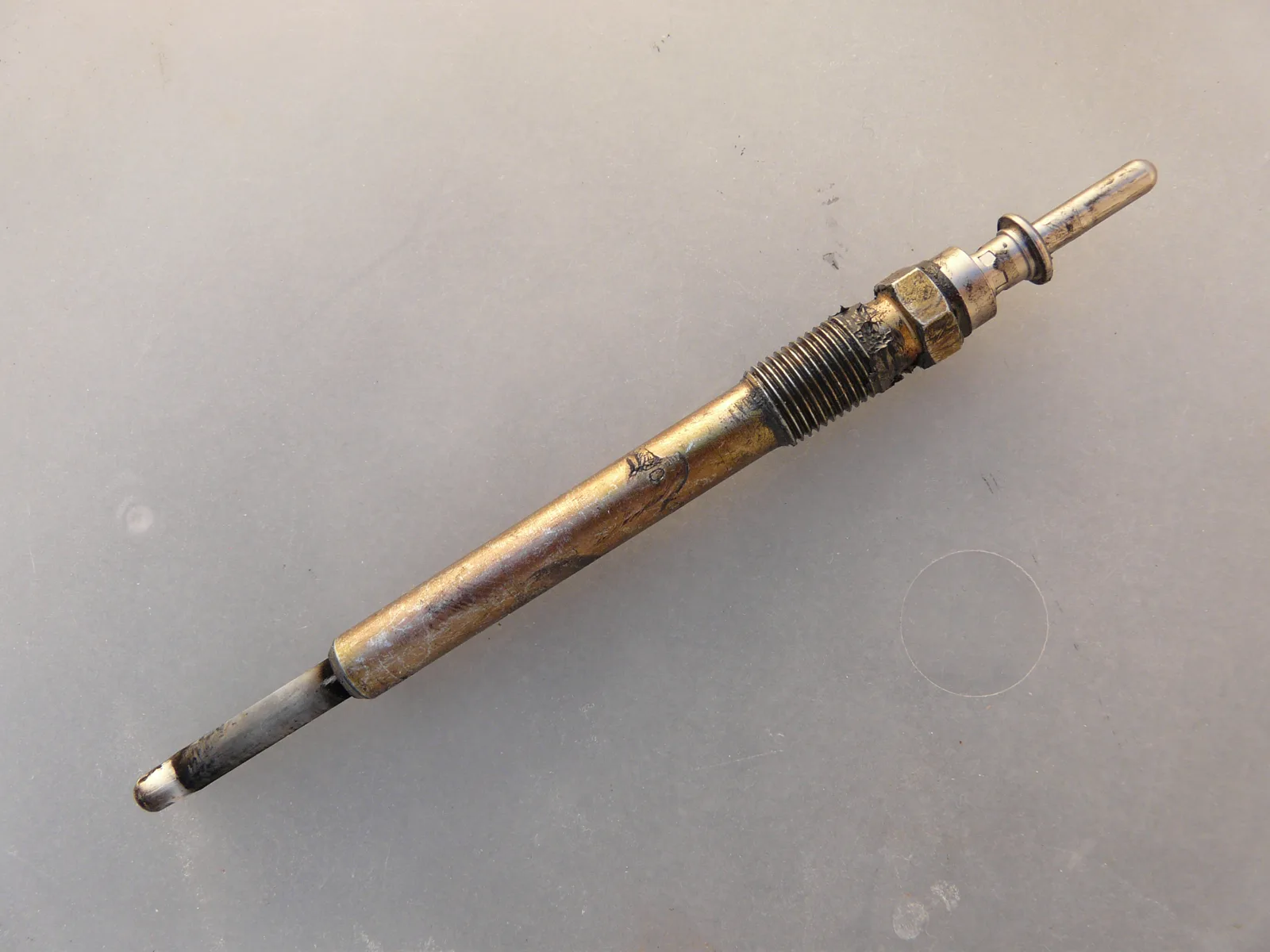

The file identifies this plug as a used ceramic glow plug, after about 20,000 km. It lies diagonally on a plain light-gray surface. The terminal pin and its collar are at the upper right, then a brass-colored hex and a short threaded section darkened with deposits. A long brass-colored body runs down to the lower left and ends in a thin gray heater tip, dark where it meets the body and pale at the end.
The lamp goes out, and the plug can stay hot
Something has to decide the current. The system is the plug, a control unit, and the software that picks the heat, on Bosch’s glow-system page. The engine computer makes that choice from the key, the coolant temperature, and engine speed, and the control unit turns it into current in the plug. A microcontroller sets the timing, how much current, and how long, on BorgWarner’s control-unit page. On older engines that hardware is a relay, mostly a switch. Newer units stay in conversation with the engine computer. An instant-start controller sets the time and the voltage of each plug on its own, through a pre-heat, an intermediate phase, and a post-heat.
The lamp is the pre-glow a driver can see, and the wait is not one length. In the 1500 section of the 2017 Ram diesel supplement, the Wait To Start telltale comes on for about two seconds, longer when it is colder, and it may not come on if the intake manifold is already warm. The truck does not start until the light is gone. On the Cruze the light may stay off when the engine is already warm, and when it does light it is brief, because that glow system heats quickly. The Low Cab Forward is the same pause: crank after the light has turned off.
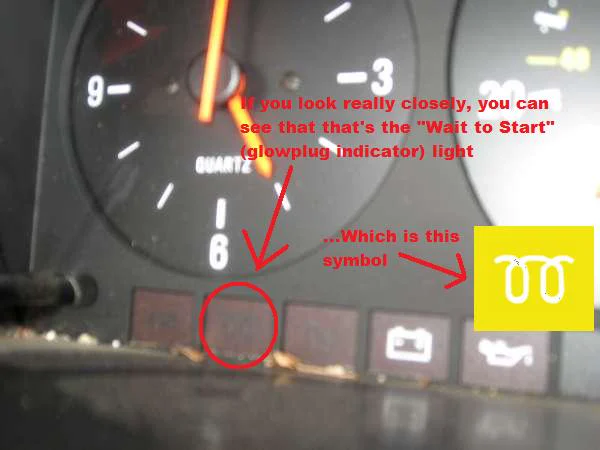

The file identifies the cluster as the glow-plug light in a 1984 Volvo 240DL diesel. Those words are not in the frame. What the frame shows is a dark cluster, an analog clock marked QUARTZ with white numerals at 9, 3, and 6 and orange-red hands, and part of another gauge at the upper right. The red writing, the arrow, the circle, and the yellow square were added by the photographer. The red text says that if you look closely, that is the Wait to Start glowplug indicator light. The circle is around one unlit window in the row of lamps along the bottom. A second red note points to a yellow square with a white coil, the glow-plug symbol drawn in. To the right of the circled window are a battery symbol and an oil-can symbol. Nothing in the cluster is lit.
Once the engine is running, the chamber is still cold and still giving heat away. Post-glow leaves the plug on through that warm-up. On the NGK sheet a self-regulated plug can cover the first stretch of running, possibly the first few hundred meters. Without it the exhaust carries more white and blue smoke, emissions are higher, and the engine makes the knock of a cold diesel. Bosch ties that same heat to lower HC and CO and to a burn that stays lit. On the advanced quick-glow plugs the computer holds battery voltage for the short preheat, then about 6.5 volts while the engine is cranking and 5 volts after it has fired, which is how a long post-glow stays controlled. Except in very cold air, the plug’s work after the start is smoke, emissions, and the way the engine runs before it is warm. On the Ram 1500 the pre-heat cuts white smoke from an engine that is still warming, and the glow-plug current can keep cycling for several minutes.
Later, the same current is sometimes pointed at the exhaust rather than the start. The 2022 note describes an intermediate glow meant to keep carbon off the EGR valve, and a regeneration glow, the plugs well over 1,000°C, while a particulate filter is brought above 600°C for around ten minutes. Bosch uses the plugs the same way for a NOx-storage catalyst and a particulate filter.
Compression is supposed to be the match. On a cold start the metal takes that match away, and the rod in the head is how the heat is put back, before the starter turns and for a while after the engine is already running.
Sources
- NGK: Glow plugs, 20 questions and answers — Spontaneous ignition from compressed intake air, with no spark; cold cylinder, pistons, and valves taking heat from the intake air; the plug energized before cranking and the heater tube past 800°C; named single-coil sheathed examples at 20–25 seconds to 800°C and the quickest examples on the sheet at about 4 seconds to 900°C; the glow pencil in the head, in the glow chamber or pre-combustion chamber, at the edge of the mixing vortex; the figure for an indirect-injection engine, a swirl-chamber engine, and a direct-injection engine; a coil in a heat-resistant tube; a regulating coil whose resistance rises with temperature; ceramic element in silicon nitride, a smaller tip, post-glow up to ten minutes; advanced quick-glow at battery voltage for the short preheat, about 6.5 volts while cranking and 5 volts in post-glow; post-glow after ignition, for the self-regulated plug over possibly the first few hundred meters, against white and blue smoke, higher emissions, and cold-start knocking
- NGK Spark Plug: glow plugs, January 2022 — Intake air compressed to around 900°C in ordinary conditions; cold walls, pistons, and valves taking that heat; magnesium oxide around the coil in a metal rod; ceramic plugs past 1,000°C in under two seconds and an after-glow of more than ten minutes at up to 1,350°C, with less blue and white smoke and less hydrocarbon and carbon monoxide; an intermediate glow against EGR carbon; a regeneration glow well over 1,000°C while a particulate filter is heated above 600°C for around ten minutes
- Bosch Mobility: glow system for diesel engines — Plugs with ceramic or metal elements, a glow control unit, and heating software; the engine computer selecting heat from the key, coolant temperature, and engine speed; lower HC and CO in the warm-up and combustion kept stable; heating also used for the NOx storage catalyst and the diesel particulate filter
- Bosch Mobility: ceramic low-voltage glow plug — The plug in the cylinder head, heating element close to a fuel jet, for common-rail engines; a ceramic element inside a protective tube; up to 1,350°C, typically 1.4 seconds to 1,000°C, nominal 7 volts
- BorgWarner: ignition technologies — Metal glow plugs with a preheating time of about 2 to 5 seconds and starts described as reliable even at -30°C
- BorgWarner: Instant Start System — A controller setting glow time and voltage for each plug; electronically controlled pre-heating, intermediate heating, and post-heating
- BorgWarner: glow plug control units — A microcontroller setting timing, current, and duration; older applications using a relay that works mainly as a switch; newer control units in constant communication with the engine computer
- DENSO: the technical evolution of glow plugs, 24 July 2019 — In cold weather the mass of the block and the head absorbs compression heat so the fuel does not ignite; a double-coil plug whose extra resistor raises resistance as the plug gets hotter
- GM bulletin PI0978, May 2013: 2014 Chevrolet Cruze Clean Turbo Diesel — 2014 Cruze 2.0L diesel, RPO LUZ: central direct injection, injector in the middle of the cylinder, bowl in the piston as the chamber; ceramic glow plugs for greater cold-start performance than conventional metal plugs; wait-to-start light on the driver information center, which may stay off if the engine is warm, and which is brief because the glow system heats rapidly
- GM bulletin 16-NA-337, March 2017: Chevrolet Low Cab Forward — 2016–2017 Chevrolet Low Cab Forward, Isuzu 3.0L 4JJ1-TC, listed as direct injection: preheating warms the compressed air in the combustion chambers with glow plugs; start after the wait-to-start light has turned off
- 2017 Ram diesel supplement, 1500 section — 2017 Ram 1500 diesel supplement, the 1500 section: Wait To Start telltale for about two seconds, longer when colder, and possibly not at all if the intake manifold is already warm; the truck does not start until the telltale is gone; the pre-heat reduces white smoke from a warming engine; glow-plug heating can keep cycling for several minutes under the engine control module
References checked .