Published by HALOX Co.
What a knock sensor actually does
How knock is the mixture igniting early, how a piezoelectric sensor on the block reports it, and how the computer retards spark and then keeps adjusting it for the octane in the tank.
The knock sensor does not retire the octane in the owner’s manual, and it is not the ping. On the Department of Energy fuel-economy page, octane is how well a gasoline resists knocking or pinging, the air-fuel mixture detonating before it should. That page says many newer vehicles can move the spark to cut the knock, and that power and fuel economy still fall when the fuel is below the octane the vehicle requires. The myths page comes at premium from the other direction. A vehicle that was not designed for premium, and that does not knock hard on regular, should not be counted on for an economy gain from premium in ordinary driving.
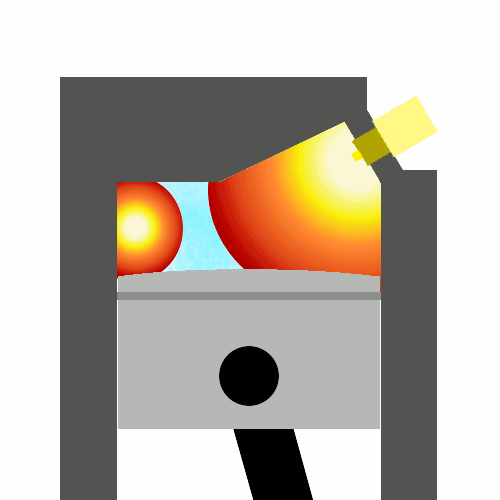


Bosch’s knock-sensor page describes knocking as the air-fuel mixture igniting itself early. If that continues, the damage the page names first is the cylinder-head gasket and the cylinder head. The drawing is one frame from an animation of that burn. The cylinder is shown in cross-section, with dark gray walls. A light gray piston with a black wrist-pin circle and a black connecting rod sits in the lower half, and the combustion space is above the piston. A yellow spark plug is angled in at the upper right. A large orange-red-to-yellow flame front spreads from the plug across the right of the chamber. A smaller red-and-yellow ball of flame sits at the far left, and a pale blue strip of unburned mixture is left between them. That ball at the left is the end-gas igniting on its own, a second flame front the plug did not start. The file’s German description names two flame fronts as the cause. The spark plug is still the intended start of the burn. Knock is combustion the plug did not lead.
The crankcase carries a piezoelectric ring
Bosch mounts the sensor directly on the crankcase. It measures structure-borne noise with a piezoelectric element, a ring of piezo ceramic, and it picks knock out by the higher frequencies in that noise. The page’s diagram of the sensor names a seismic mass with that ceramic. The signal goes to the engine computer, and the computer moves the ignition timing. The page describes the output as linear across a wide band of frequencies, and as the signal that starts knock control under different fuel qualities.
Kia’s Tech Times for 2013, Volume 16, Issue 4, the dealer-technician issue NHTSA has posted, attaches the sensor to the engine block. Knocking, that page says, is typically ignition timed too far ahead for the engine speed and the load. The crystal produces an AC voltage when it senses vibration from 5 kHz to 20 kHz caused by knock. Later in the same issue, the account of how electrons move says a knock sensor’s piezoelectric crystal shifts electrons when the crystal is pushed, squeezed, or twisted, and that the crystal moves with the engine vibration. Hearing every cylinder, the knock page says, depends on the sensor being tightened to the torque the service information specifies.
On one engine the layout is written down in a new-model bulletin. GM bulletin 19-NA-091, June 2019, covers the 2020 Chevrolet Silverado and GMC Sierra 2500HD and 3500HD. For the 6.6L gasoline V8, RPO L8T, it describes one or two flat-response, two-wire knock sensors. The piezo crystals produce an AC voltage whose amplitude and frequency follow engine vibration, or noise, and that voltage is the signal to the ECM. The ECM uses the system to set ignition timing for the best performance it can get while holding detonation, which the bulletin also calls spark knock, short of a damaging level. That paragraph is this engine. It is not a sensor count for every truck.
Advance comes out in steps, and it does not stay out
Bosch’s 2016 data sheet for the KS-4-K1 and the KS-4-S says the risk of knock falls when the ignition point is moved later, and that the aim is still to light the mixture as early as possible so the engine gets the most energy out of whatever fuel quality it has. The sheet’s figure for engines with knock control is up to 9 percent less fuel used and 5 percent more torque. Those percentages belong to that sheet.
Kia’s training page is the step-by-step version. Once knock is detected, the ECM or PCM reduces timing advance a few degrees at a time until the knock stops. It then keeps advancing and retarding ignition so the mixture stays at the timing the controller is holding for power, fuel economy, and lower combustion emissions. The fuel-economy page’s “many newer vehicles” is the wider group that can move the spark at all. Kia’s loop is the version that keeps moving it after the first correction. Neither one makes a lower octane free. The fuel-economy page says power and fuel economy still suffer.
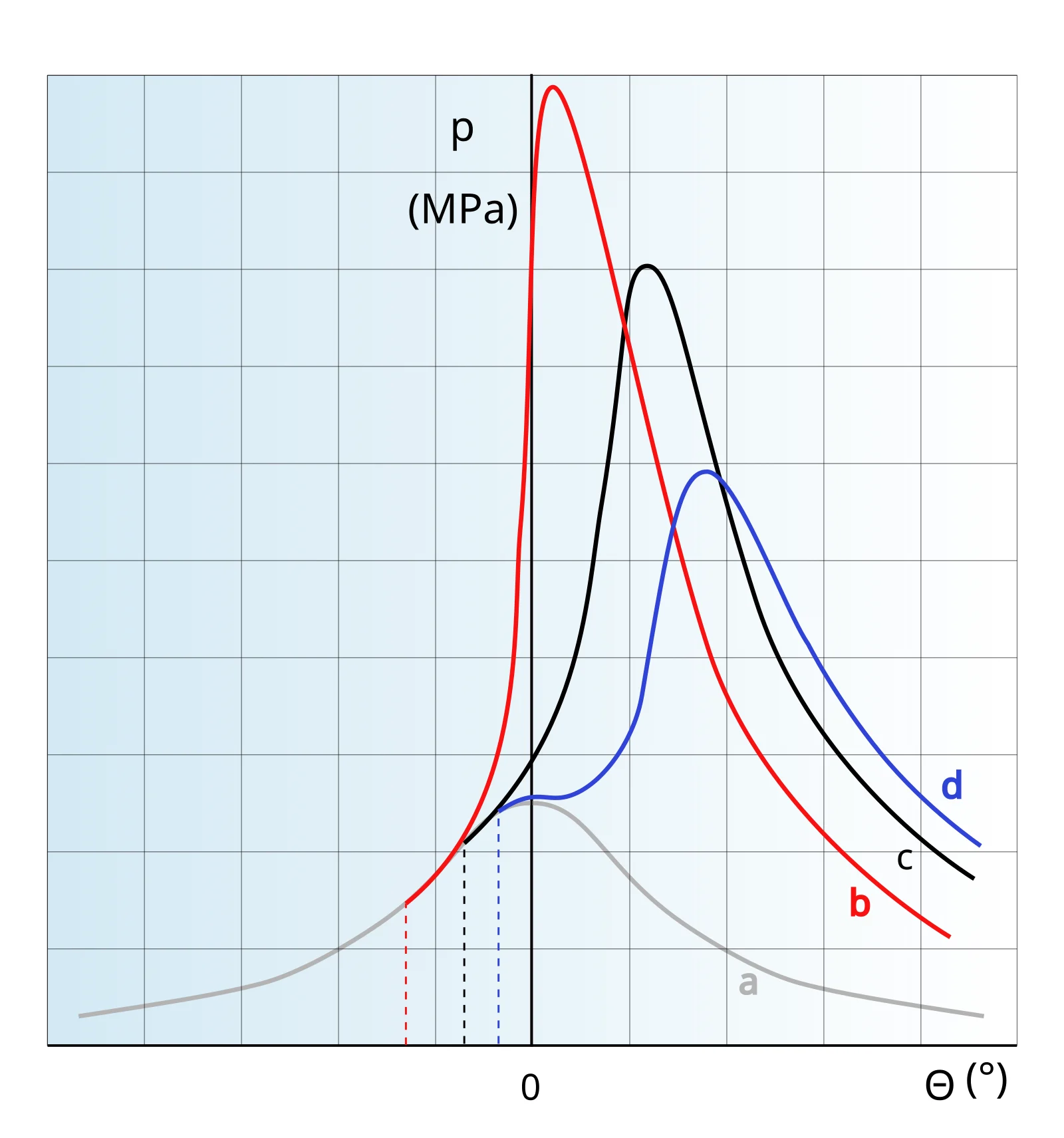

The chart is cylinder pressure against crank angle. Pressure is marked p, in MPa, on the vertical axis. Angle is marked Θ, in degrees, on the horizontal axis, with a 0. Curve a is gray and stays low. Curve b is red and rises the highest, and it begins farthest to the left of that zero. Curve c is black. Curve d is blue and peaks lower than the red curve. Dashed vertical lines in red, black, and blue stand on the grid. The file description assigns the letters: a is a misfire, b is too soon, c is optimal, and d is too late. The computer’s job, in the Bosch and Kia accounts, is to choose a timing in that family. The chart itself has no knock sensor on it.
The pump number is a knock rating
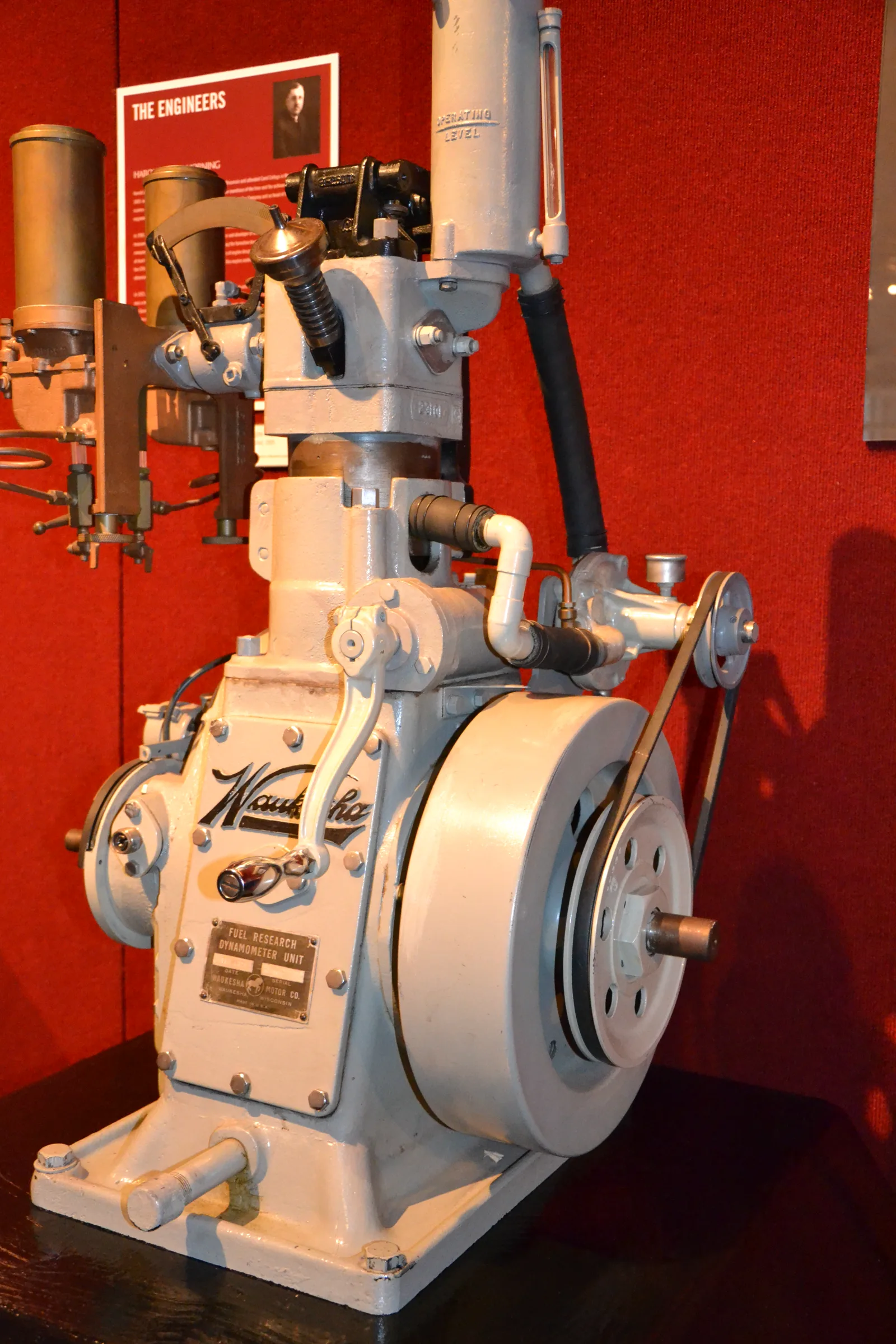

The machine in the photograph is a single-cylinder engine painted pale gray off-white, standing on a dark base against red fabric walls. The script word Waukesha is cast on the crankcase, and a small brass plate below it reads FUEL RESEARCH DYNAMOMETER UNIT. A large solid pale flywheel sits at the lower right, with a black belt running up to a small pulley. A black hose and a white pipe are at the right of the cylinder. A tall cylindrical part at the top is marked OPERATING LEVEL and has a sight glass. Brass canisters and linkages are at the upper left, and a red poster headed THE ENGINEERS is on the wall behind. The file identifies that machine as a Waukesha CFR variable-compression engine built to determine the knock rating of gasoline, and as an ASME landmark. The number on a U.S. pump is that kind of rating, printed for the grade.
The fuel-economy page gives the usual unleaded spread as 87 for regular, 88 to 90 for midgrade, and 91 to 94 for premium. Some high-elevation areas sell 85. The page traces that grade to high-elevation regions, where barometric pressure is lower, and to a time when most carbureted engines tolerated it. A modern gasoline engine, it says, should still get the fuel the manufacturer specifies, including where 85 is on the pump.
Higher octane is often required or recommended for a higher compression ratio, or for an engine that uses a supercharger or a turbocharger to force more air in. More pressure in the cylinder is more mechanical energy from a given mixture, and the mixture needs the higher octane so it does not pre-detonate. In those engines, the page says, high-octane fuel improves performance and fuel economy.
Below the required octane, the engine can run poorly, and the engine and the emissions system can be damaged over time. The warranty may be voided. An older vehicle can make the knock as a sound. Many newer ones move the spark, and the power and the fuel economy still suffer. Above the required octane, most vehicles may pick up a little performance and mileage in severe duty, towing or a heavy load, especially in heat. In ordinary driving the page expects little or no benefit. If the manual requires midgrade or premium, the extra cost is the one the page says to pay. If the manual does not require premium and only says the vehicle will run better on a higher octane, the higher price is typically more than the fuel saved.
The sensor on the crankcase is how the computer hears the knock and moves the spark. The octane the engine was built for is still the fuel’s half of that limit.
Sources
- Bosch Mobility: knock sensor — Knock as the air-fuel mixture self-igniting early, sustained damage named first at the cylinder-head gasket and cylinder head, a sensor on the crankcase reading structure-borne noise with a piezoelectric element, higher sound frequencies, an ignition-timing adjustment by the ECU, a ring-shaped piezo ceramic, a linear characteristic over a broad frequency range, and knock control across fuel qualities
- Bosch: knock sensor product data sheet, KS-4-K1 and KS-4-S — 2016 sheet: later ignition as the way the knock risk comes down, the aim of the earliest ignition for the energy in any fuel quality, and up to 9 percent less fuel and 5 percent more torque for engines with knock control
- U.S. Department of Energy: selecting the right octane fuel — Octane as resistance to knocking or pinging from premature detonation, typical U.S. grades, 85 octane at elevation, higher octane with higher compression or with supercharging or turbocharging, spark-timing adjustment on many newer vehicles, and the power and economy results of fuel above or below the required grade
- U.S. Department of Energy: fuel economy myths — Premium versus regular under normal driving, and the severe-duty case of towing or a heavy load in hot weather
- Kia Tech Times, Volume 16, Issue 4, 2013 — Dealer-technician issue posted by NHTSA: the sensor on the block, knock as timing too far advanced for speed and load, a piezoelectric crystal and an AC voltage from vibration at 5 kHz to 20 kHz, electrons moved when the crystal is pushed, squeezed, or twisted, torque for detection in every cylinder, and timing taken out a few degrees at a time and then advanced and retarded again
- GM service bulletin 19-NA-091, June 2019 — 2020 Chevrolet Silverado and GMC Sierra 2500HD and 3500HD, 6.6L gasoline V8 RPO L8T: one or two flat-response two-wire knock sensors, a piezo crystal AC voltage that follows vibration or noise, and ECM control of ignition timing against damaging detonation, also called spark knock
References checked .