Published by HALOX Co.
What a leaf spring actually does
How a leaf pack takes axle load into the frame through the seat, U-bolts, eyes, hanger, and shackle, and how multi-leaf, mono, parabolic, and composite leaves differ.
A rear tire puts its load into the wheel, and the wheel puts that load into the axle housing, where a leaf spring can carry it on to the frame. In the layout TM 9-8000 calls Hotchkiss drive, the spring does the locating as well. The Army manual of 25 October 1985, with Change 1, says the springs are pivoted on brackets at their forward ends and shackled to the frame at the rear, that they resist the torque reaction, the drive thrust, and the alignment of the axle housings, and that the rear spring brackets are where that driving thrust is applied to the frame. A coil spring, in the same chapter, cannot absorb torque in the suspension, so control arms and stabilizers keep the geometry.
The housing meets the pack
The manual’s live axle is the housing together with the drive gears, the differential, and the shafts, and the spring meets that assembly at the housing the wheels turn on.
On Hendrickson’s HTS rear suspension for Autocar, the publication calls the axle connection wide seats with heavy-duty U-bolts. The spring seat engages an axle dowel, the center bolt engages an alignment hole in the seat, and the U-bolts clamp a top pad, the seat, and the axle’s bottom cap. On this suspension the longitudinal torque rods, together with the spring seat, maintain control of acceleration and brake forces, and the publication says not to operate the vehicle if those rods are disconnected or not working. Hendrickson sets the HTS U-bolt locknuts at 425 ± 25 foot-pounds, a torque specific to that suspension, and calls for it to be checked again after the first 1,000 miles.
Appendix A to 49 CFR part 396 is the minimum periodic inspection standard for a commercial motor vehicle. A U-bolt, a spring hanger, or another axle-positioning part fails that inspection when it is cracked, broken, loose, or missing and the axle has shifted from its normal position. The same sentence says that after a turn, lateral axle displacement is normal with some suspensions and that straight-line travel brings the axle back into alignment, so a step to one side after a corner is not, under that sentence, a loose U-bolt.
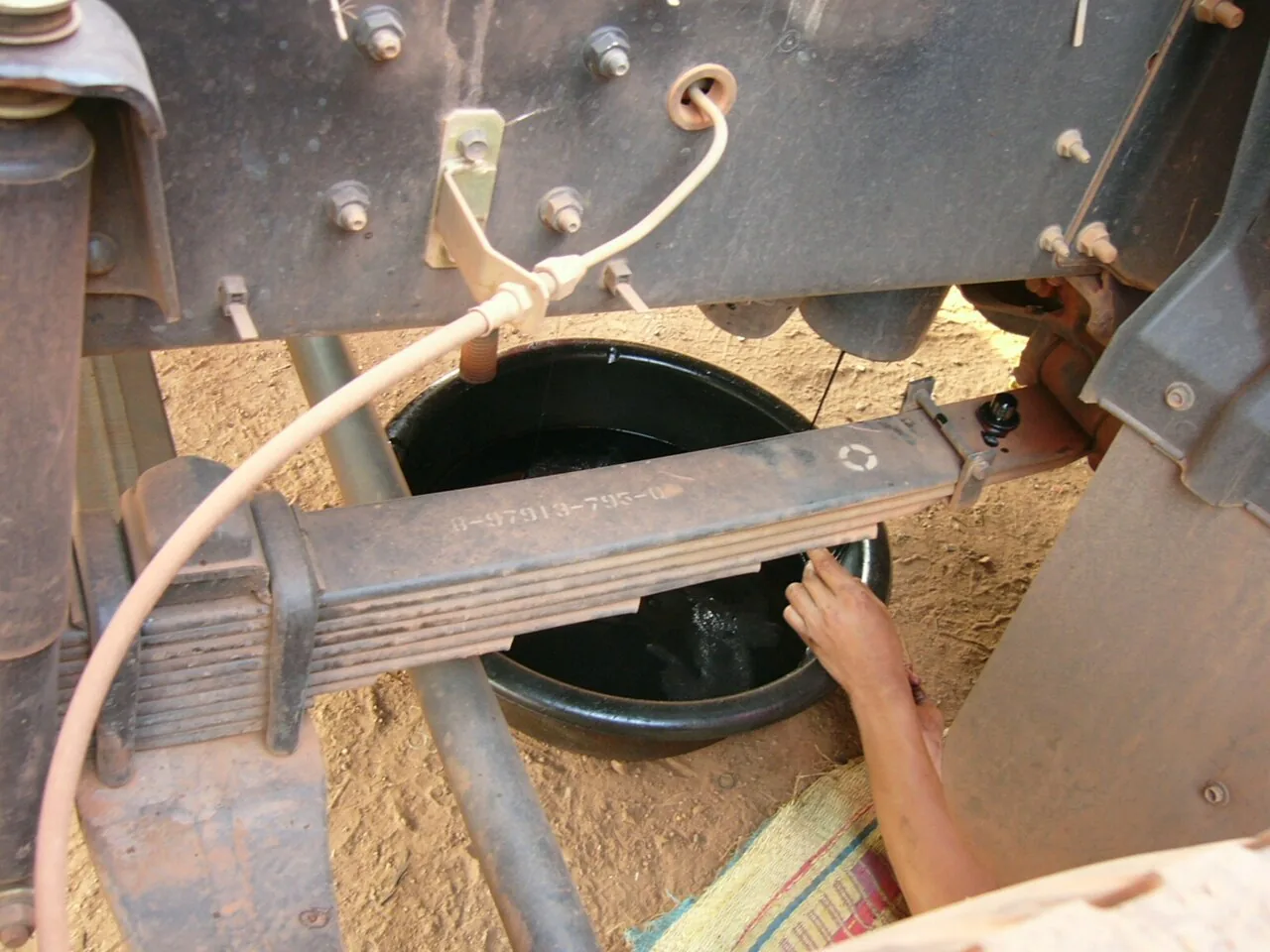


The photograph is the underside of a truck: a stack of leaves clamped to the axle with U-bolts, and an oil drain plug on the housing above the pack, the other detail the file page names when it calls the part a leaf spring of a truck. The page does not name the make, a leaf count, or a torque, and the frame does not show the HTS torque rods or whether the nuts are at the torque Hendrickson prints for that suspension.
The full-length leaf, then the leaves under it
Leaf springs, the manual says, are usually semielliptical and made of high-quality alloy steel, and it describes two. The single leaf, or monoleaf, is one layer, thick in the center and tapered toward each end, for lighter suspensions that do not have to carry great loads. A multileaf is a single leaf with additional leaves attached by spring clamps, which stiffen the spring so it can carry a greater load. A center bolt holds the leaves at the middle, keeps them spaced along their length, and stops them moving off center. As the pack works, the leaves rub, and the manual says that friction gives the multileaf a damping quality, that some of these springs may not need a shock absorber, and that a frictional material laminated between the leaves limits wear and squeaks.
The inspection appendix sorts the pack by what fails: any broken or missing leaf, a broken main leaf on its own line, including an assembly with more than one main spring, and a leaf displaced so that it could touch a tire, a rim, a brake drum, or the frame. The appendix does not say the main leaf is the leaf that carries the eyes, and it does not give a thickness or a count. Section 393.207(c) says no leaf spring shall be cracked, broken, or missing, or shifted out of position. Section 393.1 limits part 393 to commercial motor vehicles as section 390.5 defines them, and a requirement in that part that refers to a vehicle under 4,536 kg (10,001 pounds) GVWR applies only when the vehicle or the combination meets that definition, so a leaf in a photograph is not one of those inspection results.
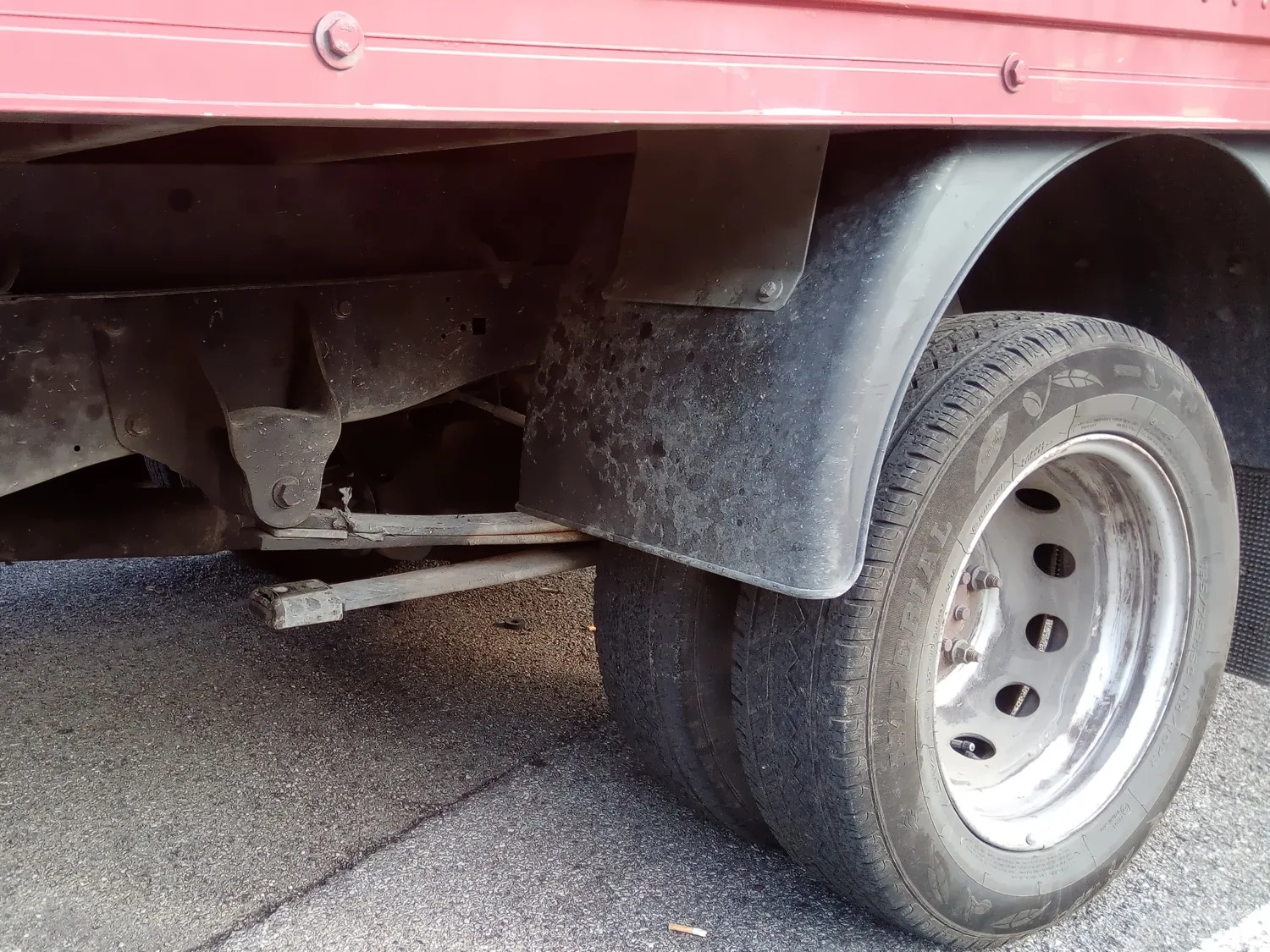

Off the vehicle, on the gravel, the file calls this a progressive-type leaf spring: one leaf runs the full length and finishes in an eye at each end, shorter leaves lie under it and stop short of those eyes, and clips bind the stack. The lengths are the multileaf the manual describes, one leaf with leaves added to it. The photograph does not show a spring rate, or the thick center and tapered ends the manual gives the monoleaf.
The front bracket and the rear shackle
The manual attaches the spring with a bracket usually mounted rigidly to the frame at the front and a shackle at the rear, so the spring can lengthen and shorten through its arc without binding. On Hotchkiss drive the forward end is the pivot, the rear end is the shackle, and the rear brackets are where the driving thrust reaches the frame. Hendrickson’s March 2015 spring brochure says the spring eye bushings are designed as a system with the spring, for roll stability, ride, and durability, and it does not print a bushing size.
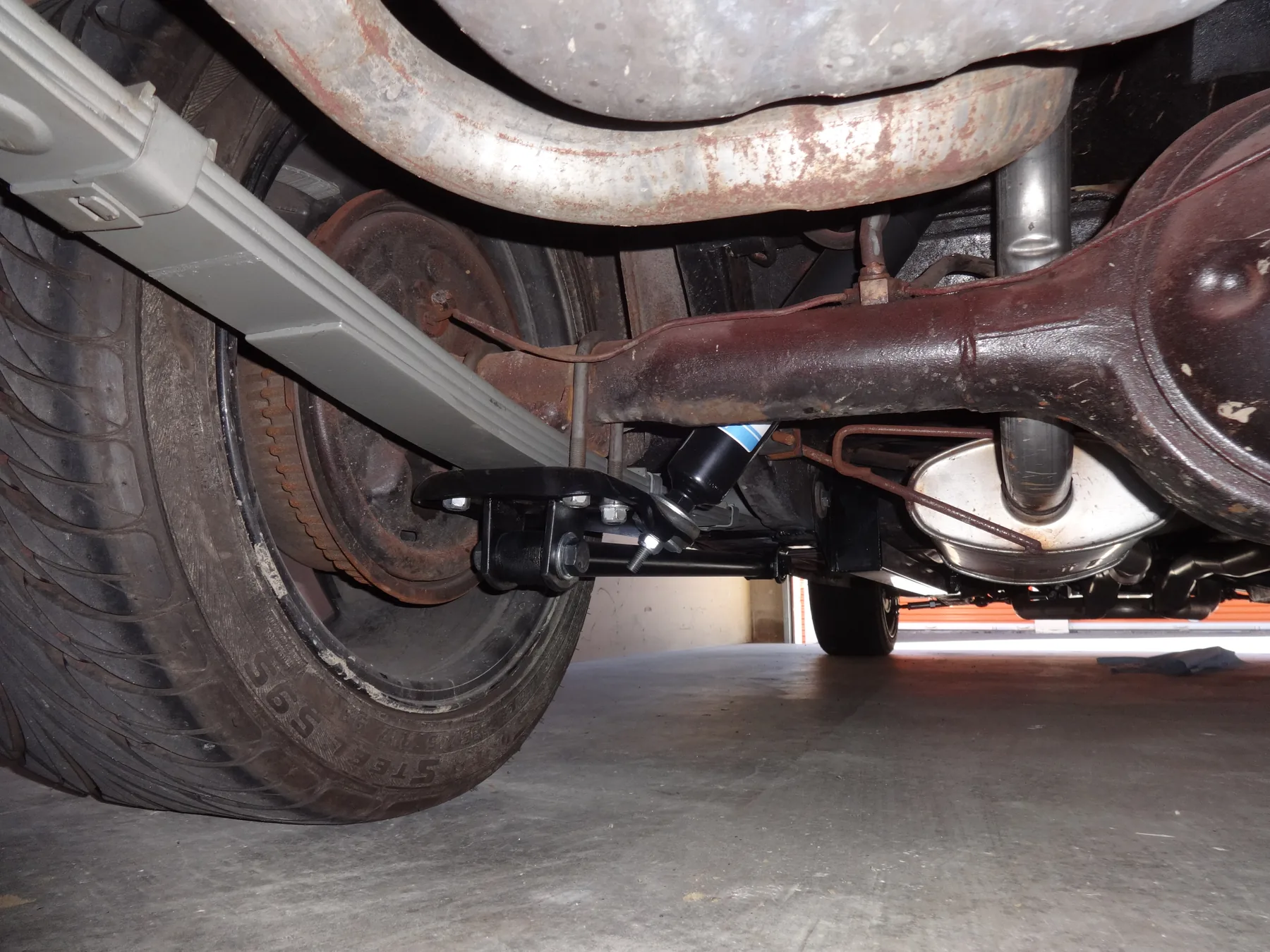

The file is the rear underside of a 1965 Mustang: the rear eye sits in a shackle, the front eye sits in a hanger on the frame rail, U-bolts clamp the pack to the axle between those ends, and a shock absorber stands beside the housing. The spring is the support, and the shock absorber is the damper beside it. The manual’s line that some multileaf springs may not need a shock describes some applications, not this Mustang. Ford’s 2026 F-150 specifications, version 1.1 of 31 March 2026, list heavy-duty gas-pressurized rear shocks as the standard rear shock on a truck whose rear configuration is a leaf spring and a solid axle. A shock in the photograph shows a damper mounted beside this spring, without showing the valving or whether these leaves are still supplying the friction the manual describes.
What the spring hands the frame
A Hotchkiss spring has to transmit the driving thrust, so the manual says the springs have to be fairly flat, and because they resist torque they are stiffer than the springs in some other live-axle layouts. The manual ties a harsh ride to those requirements, and it gives simplicity, cost, and ruggedness as the reasons the layout stayed in use.
The torque-tube drive in the same chapter shackles the springs at both ends. The tube takes the torque reaction and the driving thrust, so the springs can be more flexible, and the thrust arrives at the engine mounting or a frame crossmember. The coil-and-control-rod drive puts the coils between the housing and the frame to support the weight. Control rods take the torque, the thrust, and the housing’s alignment. The manual counts four: two below the axle centerline, toward the outside, and two inboard, above the centerline. Under acceleration the upper rods go into tension and the lower rods into compression, and under braking the manual says that pair reverses. A control arm is that kind of link where the spring cannot take the torque. The stabilizers the chapter pairs with a coil are the sway bar’s job, a spring that couples the two sides of an axle rather than the spring that carries the axle’s weight. A MacPherson strut is a locating member of another kind, the structural leg at one corner, while the eye of a leaf is the end of the spring, held in a bracket or a shackle.
The F-150 table prints two rears, a leaf spring with a solid axle, and, on the Raptor, a five-link coil with a Panhard rod, still with a solid axle. The front in the same table is an independent double-wishbone with a coil-over shock and a stamped lower control arm, cast aluminum on the Raptor. The table does not give a leaf count, a shackle length, or a rate.
Stellantis’s 2026 Ram heavy-duty release draws the line by model: the 2500 rear is a five-link coil, with an available automatic-leveling rear air suspension, and the 3500 continues on a rear Hotchkiss leaf-spring system and offers a supplemental air suspension. The release does not say the supplemental air replaces the leaf, or how many leaves the 3500 carries, or whether those springs are flat.
One leaf, a taper, or a composite
The same Hendrickson brochure sets three steel springs side by side: a parabolic taper-leaf custom designed for on-highway and vocational trucks and built with Hendrickson’s process and materials, a multi-leaf stacked spring, and a monoleaf, tied to its SRX technology, for truck steer axles, for weight and ride. Fewer leaves, the brochure says, mean less interleaf friction and less dynamic hysteresis, and the materials are there so the spring rate holds while the assembly gets lighter. The current steel-spring page still prints that weight claim, designs that can weigh as much as 70 percent less than a conventional multi-leaf flat spring from using fewer leaves, with the same list of benefits. The percentage is Hendrickson’s, for those designs. The Army manual’s monoleaf is one tapered layer for a lighter load, and the brochure’s monoleaf is a named steer-axle product, so the two sources describe one leaf in two different places and neither says the two parts are the same spring.
LITEFLEX, Hendrickson sheet 45745-553 Rev C of March 2025, is a medium-duty hybrid composite leaf assembly. The sheet says the assemblies are up to 50 to 75 percent lighter than traditional steel spring assemblies, and that this configuration saves up to 190 pounds against a traditional steel assembly rated 23,000 pounds. The material is epoxy and E-glass at 68 to 74 percent fiber by weight, wound so the glass filaments run continuously from end to end of the leaf. The design, the sheet says, can be adapted to a manufacturer’s current steel spring assembly, including the package, the radius-leaf size, the clamp group, and the rate, and any application has to meet Hendrickson’s specifications and be approved by the vehicle manufacturer on the vehicle as it was built.
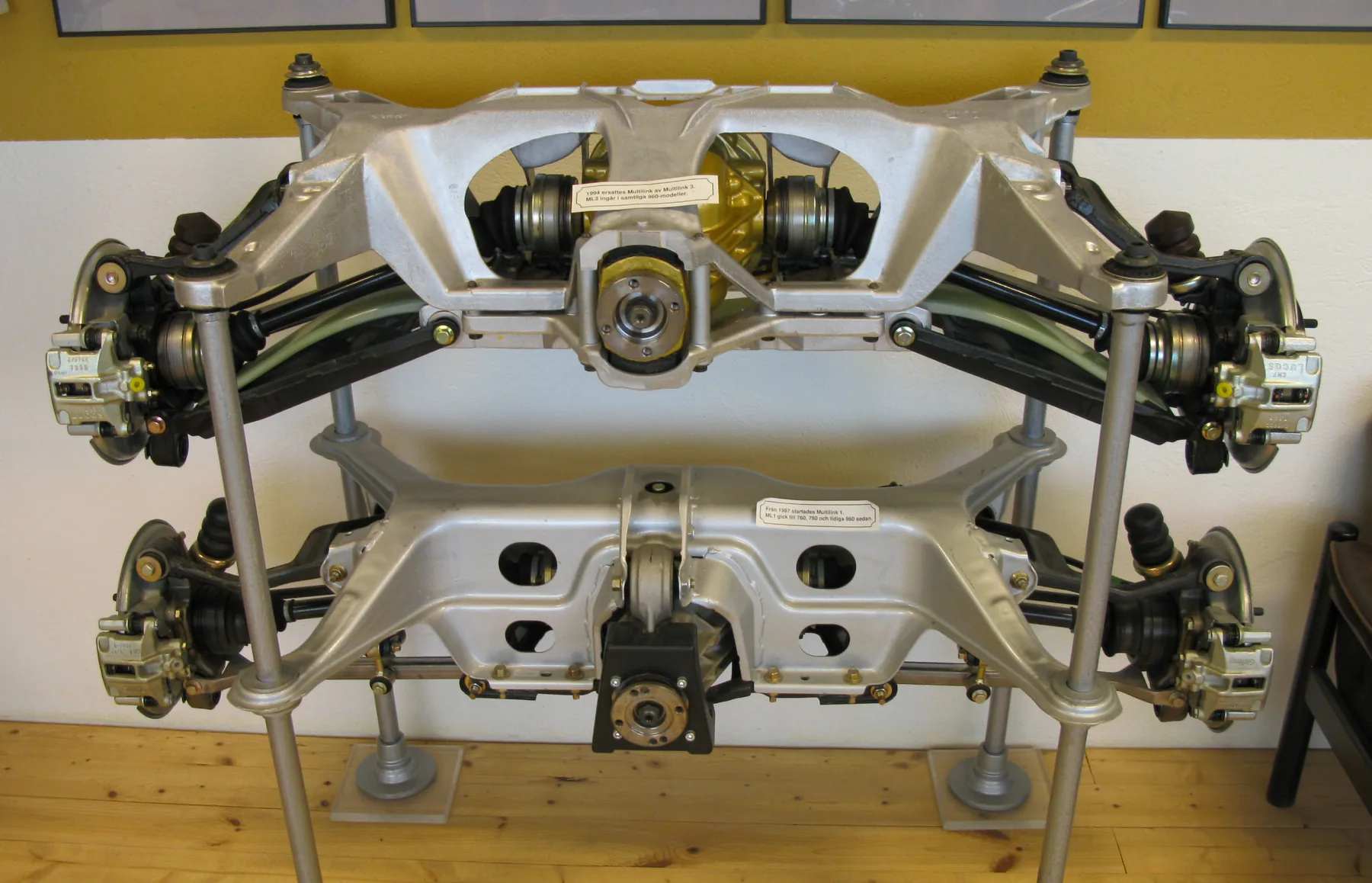

The file places the two assemblies at Bil & Teknikhistoriska Samlingarna in Köping. The upper one is the Multilink 3 used on the 960 and S90, with the light-green transverse composite leaf running across the links, and the lower one is the Multilink 1 used on the 760 and 780 from 1987 on, whose coil springs are not attached. That transverse spring, in the multilink arrangement the file names, is separate from the longitudinal pack clamped to the axle in the truck photograph and from the LITEFLEX hybrid, and the file does not print a rate for it.
On a Hotchkiss axle the load goes from the tire to the wheel, from the wheel to the housing, through the seat and the U-bolts into the pack, and through the front bracket and the rear shackle into the frame, with the same spring carrying the driving thrust to those rear brackets. Added leaves, a single tapered leaf, and a filament-wound leaf are different ways of building the member that bends. Where a coil carries the weight, as the F-150 Raptor and the Ram 2500 do, links do the locating that the leaf does in the Hotchkiss layout.
Sources
- Department of the Army: TM 9-8000 — Chapter 30 of the 25 October 1985 manual, with Change 1: monoleaf and multileaf springs, the center bolt, the front bracket and rear shackle, and Hotchkiss, torque-tube, and coil-and-control-rod live axles
- Ford: 2026 F-150 technical specifications — Version 1.1, 31 March 2026: leaf spring with a solid axle at the rear, the Raptor's five-link coil and Panhard rod, the double-wishbone front, and the rear shock line
- Stellantis: What's New for 2026, Ram Heavy Duty — U.S. release: five-link coil and available automatic-leveling air suspension on the 2500, and the 3500's Hotchkiss leaf spring with a supplemental air suspension
- Hendrickson: spring technology brochure 32558-001 — Rev D, March 2015: parabolic taper-leaf, multi-leaf, and monoleaf springs, fewer leaves and interleaf friction, and spring eye bushings
- Hendrickson: parabolic and multi-leaf steel springs — Current product page: weight reduction against a conventional multi-leaf flat spring, and the benefits Hendrickson lists for using fewer leaves
- Hendrickson: HTS rear suspension for Autocar, 17730-277 — Rev C procedure: wide spring seats, U-bolts, the center bolt in the seat, longitudinal torque rods, and the U-bolt torque for that suspension
- Hendrickson: LITEFLEX hybrid composite springs, 45745-553 — Rev C, March 2025: filament-wound epoxy and E-glass hybrid composite leaf assemblies, weight against a steel pack, and the clamp-group adaptation
- 49 CFR 393.207: Suspension systems — Leaf-spring condition on a commercial motor vehicle, with the part 393 scope in 49 CFR 393.1 limited to commercial motor vehicles as 49 CFR 390.5 defines them
- 49 CFR part 396, appendix A: Minimum Periodic Inspection Standards — U-bolts, spring hangers, and other axle-positioning parts; a broken main leaf; and the note on lateral axle movement after a turn
References checked .