Published by HALOX Co.
What a registration card actually is
How California, Texas, New York, Virginia, and Florida issue the registration card, receipt, or certificate, what that paper carries, and what a renewal receipt or a phone copy still leaves to the title and the insurance card.
California issues a registration card. Texas issues a registration receipt. New York’s registrations page uses one word for two objects: the sticker on the windshield, and the paper registration certificate that has to stay in the vehicle. Virginia issues a registration card with the plates and the decals, and tells the driver to keep that card whenever the vehicle is operated. Florida issues a registration certificate, and the validation decal provided on that certificate is the one that goes on the plate.
Those are the copies the registrant is handed. They are not the title, and they are not the insurance card.
Issued beside the title
California’s page on the card says that when the department registers a vehicle it issues a certificate of ownership to the legal owner and a registration card to the owner. If there is no legal owner, the owner gets both. The same page allows regulations for a certificate of title, or a certificate of ownership, in electronic form. That sentence is about the ownership certificate. The registration card is still the card issued to the owner. When the lien is the electronic record in what an electronic lien title actually is, the registrant still has the card.
Virginia’s page on the two documents says the department issues a certificate of title and a registration card as separate documents. The department may keep the title as an electronic record instead of printing it, and an owner or a lienholder on that record can request a paper title. The registration page puts the jobs in plain words. A title proves you own the vehicle. Registration proves the vehicle is authorized to be driven. A title and a registration stay two records after the card is in the door pocket.
On a leased vehicle, California puts the lessor and the lessee on the registration card as the owner and the lessee, and it prints those words on the card and on the ownership certificate. A transfer of that vehicle takes the lessor’s signature release. The card is where those two roles are labeled. The purchase option, if there is one, is a different paper.
The face of the California card contains the date it was issued, the name and the residence, business, or mailing address of the owner and of the legal owner, the registration number, and a description of the vehicle as complete as the application required. The director may modify the form, the arrangement, and the information on that face when doing so promotes the efficiency of the department. When the department can tell, at the initial registration or at a transfer, the face also identifies some histories: a vehicle rebuilt after a total-loss salvage declaration, a vehicle previously reported dismantled, a vehicle previously registered to a law enforcement agency and used in that work, a former taxicab, a vehicle manufactured outside the United States and not intended for sale here, and a vehicle the face marks with the words Lemon Law Buyback. That last line is the notation in what a lemon law buyback title actually is. The card carries the notation the department could ascertain. It does not become a rebuilt title by being the card.
New York does not settle on one name for the paper. The registrations page says certificate. The sample page shows a registration receipt, a window sticker, and a renewal notice, and it tells you where those samples carry the current plate number, the registration class code, and the first three characters of the registrant’s last name. The samples aimed at a title transaction show the vehicle identification number, the make, and the model year. The same page says an inspection-station search uses the model year, the fuel type, and the vehicle weight taken from the registration document. The driver manual says that once the vehicle is registered you have plates, a registration document, and a registration sticker. The insurance requirements page says the registration can list one name or two. How those names have to match the insurance identification card is that card’s own rule.
The plate and the windshield carry the other half
California’s evidence page says evidence of current registration is the valid registration card and the validation stickers on the rear license plate. A truck tractor, and a commercial vehicle with a declared gross vehicle weight of 10,001 pounds or more, displays the year sticker on the front plate. Some older motorcycle plates have a sticker well too small for the month and year stickers, and the page tells the owner to place the stickers so they do not overlap. The stickers are the marker in what a registration sticker actually is. On this page, the card is the other half of what counts as evidence.
The driver handbook says that in a collision you show the driver’s license, the vehicle registration card, the insurance information, and the current address, to the other driver, to law enforcement, and to anyone else involved. The license and the card are separate things in that list. The page on presenting registration says the driver presents the registration or identification card, or other evidence of registration, when a peace officer demands it, and that a person does not present a card, a temporary receipt, a plate, or a permit that was not issued for that vehicle.
The page on keeping the card says the owner, on receiving it, keeps the card or a facsimile copy with the vehicle. That does not apply when the card has to come out for a renewal or a transfer application, or when the vehicle is left unattended. The page’s words are “facsimile copy.” It does not describe a telephone. At the counter, the photocopy page accepts a legible photocopy of the last-issued California registration for transactions, except unavailable records, and it does not accept a photocopy of the title. A copy that works for the card at the office is a different permission from a copy of the ownership certificate.
New York says the paper certificate must be kept in the vehicle. The windshield sticker is the other half of what that page calls the registration. The driver manual says to take the plates and the windshield registration sticker off before a trade-in or a sale, because the sticker shows the plate number. Removing them is about tickets that would otherwise follow the plates. It is not a release of liability, and the manual does not say the certificate transfers the vehicle.
Virginia says a complete registration is one front plate and one back plate, or one plate if the vehicle is a motorcycle, a tractor truck, a semitrailer, or a trailer; decals that display the expiration; and a registration card. Keep the card with you whenever you operate the vehicle. The decals are on the plates. The card is what you carry.
Florida says a complete registration is three things. A metal plate, whose number matches the number on the registration and on the decal. A registration certificate in the possession of the operator, or carried in the vehicle at all times. And a validation decal that is provided on the certificate and then affixed in the upper right-hand corner of the plate. The page says that set is evidence of having paid the registration taxes and fees. It also says a registration expires at midnight on the first owner’s birth date, unless the owner is a business.
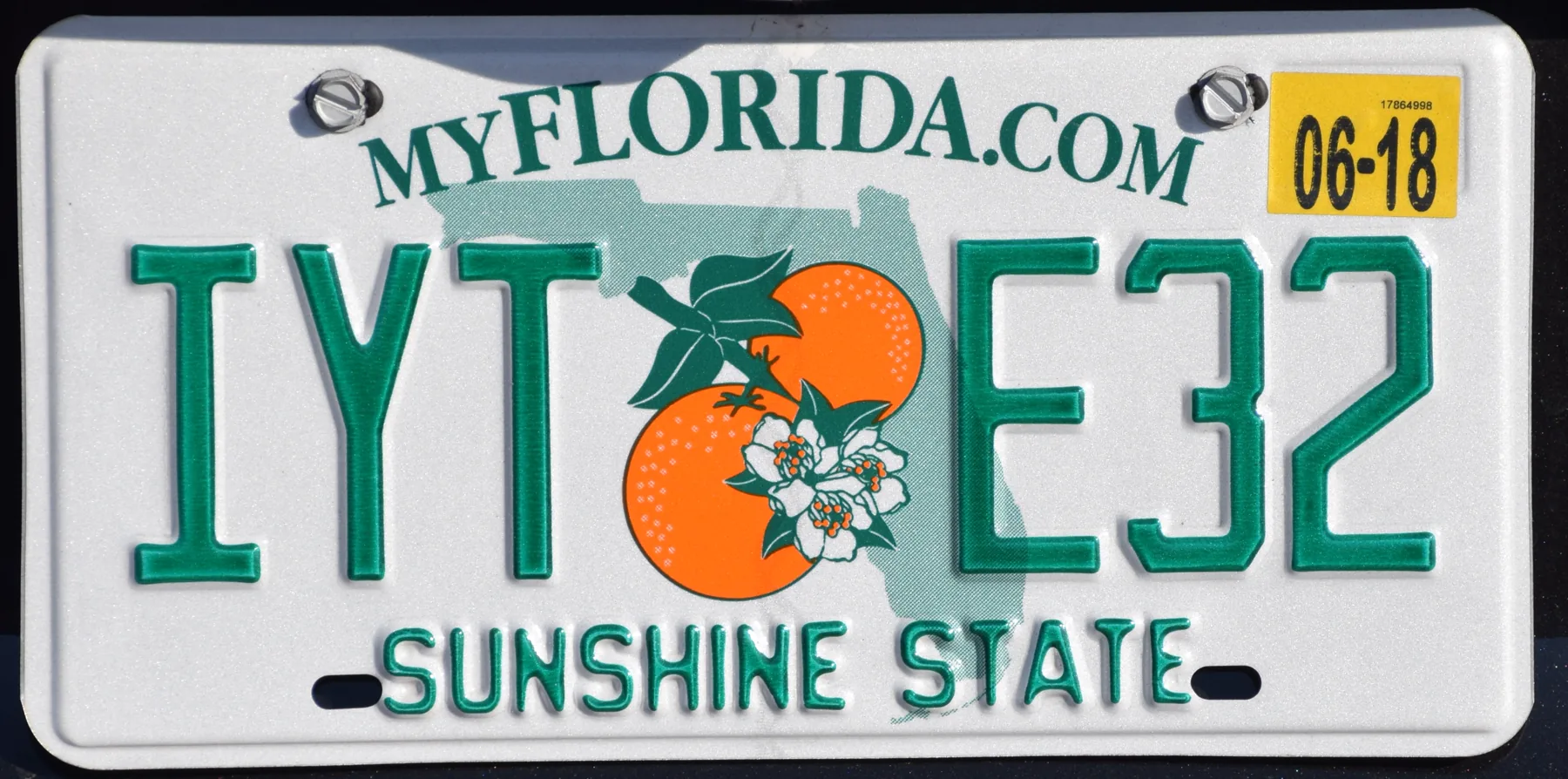

A white Florida plate, photographed straight on, with green characters reading IYT E32. A pale green outline of the state sits behind two oranges, green leaves, and white blossoms. MYFLORIDA.COM runs along the top and SUNSHINE STATE along the bottom. Two metal fasteners fill the top mounting holes. A yellow sticker in the upper right reads 06-18, with 17864998 in smaller digits above those. The Commons file is dated March 17, 2018. Florida’s page puts the validation decal in that upper-right corner, and it says the number on the plate has to match the number on the registration and on the decal. The photograph shows the plate and the sticker in that corner. It does not show the certificate.
Texas calls the paper a registration receipt. The lost-receipt page says commercial vehicles are required to have the receipt in the vehicle at all times. For every other vehicle, the same page recommends keeping the receipt in the vehicle, because it serves as proof of registration. A duplicate can be requested in person or by mail. In person, that is a county tax office or a regional service center. The registration page sends an in-person renewal to the county tax office or an approved substation, with the renewal notice and proof of current liability insurance. If the notice is missing, that page lists the plate number, the vehicle identification number, or the previous year’s registration receipt.


A two-story red brick building under a blue sky, with sun glare on the upper brick. The white sign to the left of the door reads Marion County Tax Office, beside a Texas outline and a star, then Karen Jones, Tax Assessor-Collector, and the line “Making a Difference in the Lives of the People We Serve.” The door is numbered 114. A brass mailbox stands on a post to the left of the sign, and a dark plaque with a Texas outline is on the wall to the right. An iron balcony crosses the second floor. The rear corner of a gray SUV, its taillight showing, is at the left edge. The Commons file dates the photograph to October 15, 2016, in Jefferson, Texas. TxDMV sends the in-person renewal to a county tax office. The photograph shows this office’s sign. It does not show a registration receipt, and the name on a 2016 sign is the name painted there.
While the new paper is still in the mail
Texas’s sticker page says to allow about three weeks for the sticker to be processed, printed, and mailed. During that wait, the registration renewal receipt may be used as proof of current registration for up to 31 days. That receipt is sent to the email address given at registration. The 31 days are the life of that emailed receipt as proof. They are not a new registration period, and the receipt is not the sticker. Last year’s receipt, on the registration page, is one of the three ways to identify the vehicle when the renewal notice never arrived. The other two are the plate number and the vehicle identification number. Insurance proof is still on the in-person list.
Florida expects the portal registration in the mail within seven to ten business days, and it says to ask if 20 calendar days have passed. An emailed confirmation receipt may be used as proof of payment until that registration arrives. The mobile app gives a digital document to use until the mail arrives, and an address cannot be changed in the app. If the department cannot electronically verify insurance, it issues no registration on the app, online, or in person. The check happens before the certificate exists. The certificate is still not the insurance card. The emailed confirmation is proof of payment for a certificate that has not arrived. The app’s digital document is for that same wait.
Virginia will print a replacement registration card from a myDMV account, or mail one, when the card is lost, stolen, damaged, or mutilated, or when you want an additional card. That printout is a card. The renewal page describes a different piece of paper for the gap before the new card and the new decals arrive. With fewer than 15 days left on the current registration, or after it has expired and is still within 90 days, an Official Internet Receipt carried with the registration card extends the current registration for up to 15 days from the date of renewal. The page says most customers get the new card and decals by mail within five days, and it tells them to allow 15 days. The receipt works with the card you already have. It does not retire that card.
The same Virginia title-and-card page allows an electronic registration card only for a person who already holds the physical card, and only in addition to it. No electronic card is issued unless that physical card is held. Showing the electronic card does not remove a requirement to possess the physical one. A rule that could be met by showing the physical card may be met by showing the electronic card at the discretion of the person it is shown to. The printed replacement from myDMV and this electronic card are two different things on two different pages. Florida’s digital document is for the days before the mailed registration arrives. Virginia’s electronic card, when the department issues one, assumes the physical card is already in hand.
A 1951 card prints its own year
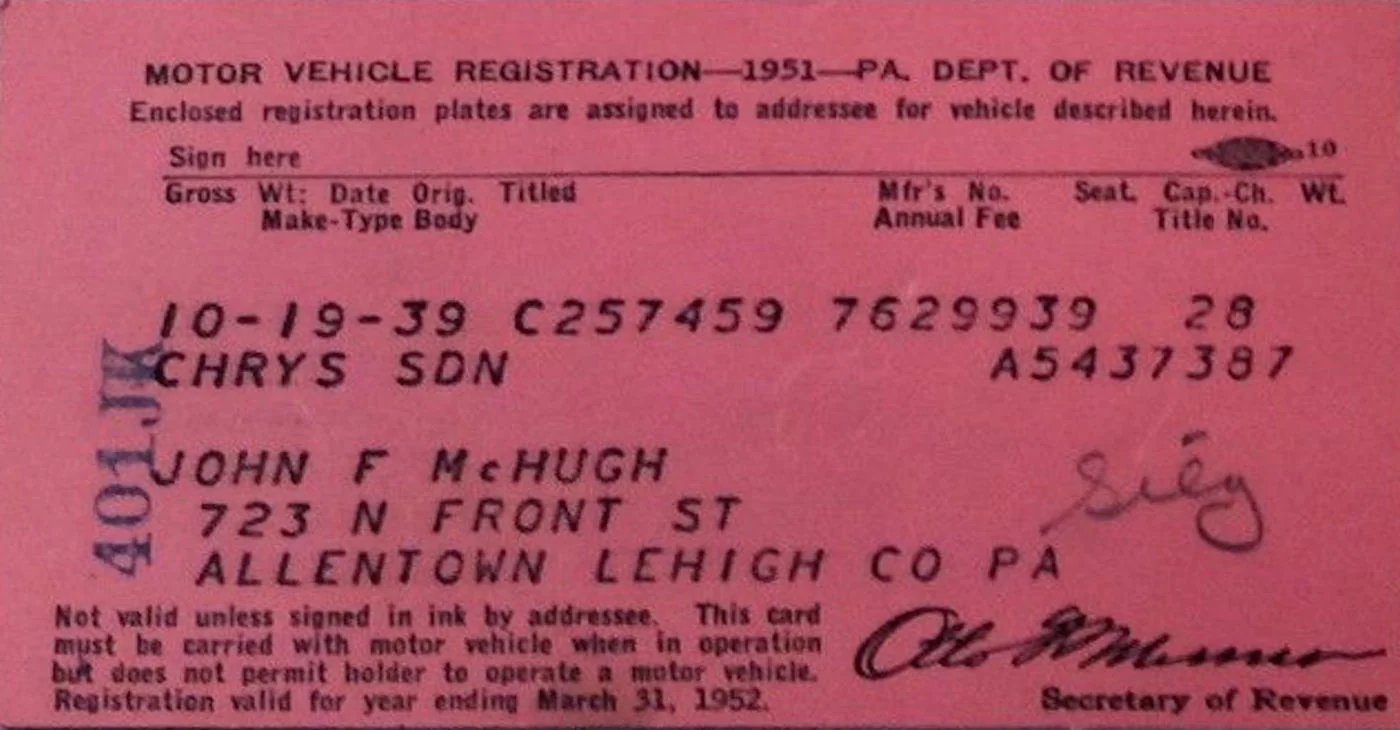

A pink card headed MOTOR VEHICLE REGISTRATION—1951—PA. DEPT. OF REVENUE. The next line says the enclosed registration plates are assigned to the addressee for the vehicle described. Typed lines include 10-19-39, C257459, 7629939, 28, CHRYS SDN, and A5437387. A blue stamp down the left edge reads 401JK. The name and address read JOHN F McHUGH, 723 N FRONT ST, ALLENTOWN LEHIGH CO PA. A handwritten signature sits on the right, and a printed signature sits above the words Secretary of Revenue. The bottom of the card says it is not valid unless signed in ink by the addressee, that it must be carried with the motor vehicle when in operation, that it does not permit the holder to operate a motor vehicle, and that the registration was valid for the year ending March 31, 1952.
Those sentences are what this card printed in 1951. They are not the instructions on the California, Texas, New York, Virginia, or Florida pages above. The photograph shows a registration card from that year: a paper that names a vehicle, a plate, a person, and an address, and that says, on its own face, what carrying it was for then. It is not a current Pennsylvania registration, and this article does not use it as one.
Florida wants the number on the certificate, the decal, and the plate to be the same number, and it calls that set evidence the registration taxes and fees were paid. California’s evidence page wants the valid card and the stickers together, with the front-plate exception for the trucks it names. Texas will take last year’s receipt when the renewal notice is missing, and it will treat this month’s emailed renewal receipt as proof for up to 31 days while the sticker is in the mail. Virginia’s electronic card, if issued, still assumes the physical card. The paper in the door is the copy that office gave the registrant. The title is the ownership record. The insurance card is the insurer’s card. A buyer holding the seller’s current registration card is holding the registrant’s copy.
Sources
- California Vehicle Code, registration card issued with the certificate of ownership — On registering a vehicle, the department issues a certificate of ownership to the legal owner and a registration card to the owner, or both to the owner if there is no legal owner. The department may adopt regulations for an electronic certificate of title or certificate of ownership. Amended by Stats. 2026, Ch. 82, effective July 13, 2026.
- California Vehicle Code, what the registration card carries on its face — The face contains the date issued, the name and residence, business, or mailing address of the owner and of the legal owner, the registration number, and a description of the vehicle. When the department can ascertain the fact at initial registration or transfer, the face identifies specified prior uses, including the words Lemon Law Buyback. The director may modify the form, arrangement, and information on the face.
- California Vehicle Code, lessor and lessee on the registration card — On a leased vehicle the lessor and the lessee are shown on the registration card as the owner and the lessee, and those words appear on the card and the ownership certificate. A transfer takes the lessor's signature release.
- California Vehicle Code, keeping the registration card with the vehicle — On receiving a registration card, the owner keeps that card or a facsimile copy with the vehicle. The requirement does not apply when the card is removed for a renewal or transfer application, or when the vehicle is left unattended.
- California Vehicle Code, presenting registration to a peace officer — The driver presents the registration or identification card, or other evidence of registration, when a peace officer demands it. A person does not present a registration card, identification card, temporary receipt, plate, or permit that was not issued for that vehicle.
- California DMV: Evidence of registration — Evidence of current registration is the valid registration card and the validation stickers on the rear license plate. A truck tractor, and a commercial vehicle with a declared gross vehicle weight of 10,001 pounds or more, displays the year sticker on the front plate. Some older motorcycle plates need the stickers placed so they do not overlap a small sticker well.
- California DMV: Photocopy and fax copy of documents — A legible photocopy of the last-issued California registration is acceptable for transactions except unavailable records. A photocopy of the title is not acceptable.
- California DMV driver handbook: collisions — In a collision, the driver shows the driver's license, the vehicle registration card, the insurance information, and the current address to the other driver, to law enforcement, and to anyone else involved.
- TxDMV: Where's my sticker? — Allow about three weeks for the sticker to be processed, printed, and mailed. During that time the registration renewal receipt, sent to the email address given at registration, may be used as proof of current registration for up to 31 days.
- TxDMV: Register your vehicle — An in-person renewal takes the renewal notice and proof of current liability insurance to the county tax office or an approved substation. Without a renewal notice, the page lists the license plate number, the vehicle identification number, or the previous year's registration receipt.
- TxDMV: Lost or misplaced registration receipt — A duplicate receipt can be requested in person or by mail, at a county tax office or a regional service center. Commercial vehicles are required to have the receipt in the vehicle at all times. For every other vehicle, the page recommends keeping the receipt in the vehicle because it serves as proof of registration. The page also names a form and a fee, which this article does not repeat.
- New York DMV: Registrations — The registration is the sticker on the windshield and the paper registration certificate that must be kept in the vehicle.
- New York DMV: Sample registration documents — The vehicle samples are the registration receipt, the window sticker, and the renewal notice. They show where to find the current plate number, the registration class code, and the first three characters of the registrant's last name. Samples for a title transaction show the vehicle identification number, the make, and the model year. An inspection-station search uses the model year, fuel type, and vehicle weight from the registration document.
- New York DMV driver manual: owning a vehicle — When the vehicle is registered, the owner receives plates, a registration document, and a registration sticker for the windshield or the plates. Before a trade-in or a sale, the plates and the windshield registration sticker come off the vehicle. The sticker shows the plate number.
- New York DMV: Insurance requirements — A vehicle registration can list one name or two. Both names appear on the insurance identification card, and the name on the registration has to match the name on that card.
- Virginia DMV: Register your vehicle — A complete registration is a front plate and a back plate, or one plate for a motorcycle, tractor truck, semitrailer, or trailer; decals that display the expiration date; and a registration card. A title proves ownership. Registration proves the vehicle is authorized to be driven. Keep the registration card whenever you operate the vehicle.
- Code of Virginia: issuance of the certificate of title and the registration card — The department issues a certificate of title and a registration card as separate documents. It may keep the title as an electronic record, and an owner or lienholder may request a paper title. An electronic registration card may be issued only to a person who already holds the physical card, and only in addition to that card. Displaying the electronic card does not remove a requirement to possess the physical credential. Whether the electronic card satisfies a person who may accept the physical card is up to that person. The historical citation on the page includes 2022, chapter 183.
- Virginia DMV: Replace a vehicle registration card — A card that is lost, stolen, damaged, or mutilated, or an additional card, can be printed from a myDMV account or mailed.
- Virginia DMV: Renew a vehicle registration — With fewer than 15 days left, or after expiration and still within 90 days, an Official Internet Receipt carried with the registration card extends the current registration for up to 15 days from the renewal date. The page says most customers receive the new card and decals by mail within five days and tells them to allow 15 days. A late fee printed on the expired-registration path is not repeated here.
- Florida Highway Safety and Motor Vehicles: Motor vehicle registrations — A complete registration is a metal plate whose number matches the registration and the decal, a registration certificate in the operator's possession or in the vehicle at all times, and the validation decal from that certificate affixed to the upper right of the plate. That set is evidence that the registration taxes and fees were paid. Registrations expire at midnight on the first owner's birth date unless the owner is a business. Online, in-person, and mobile-app issuance stops if insurance cannot be verified electronically. Mail from the portal is expected in seven to ten business days. An emailed confirmation may be used as proof of payment until the registration arrives. The app provides a digital document until the mail arrives, and an address cannot be changed in the app. Fee figures on the page are not repeated here.
References checked .