Published by HALOX Co.
What a repair order actually is
How California, New York, Florida, and Texas treat the shop's estimate, work order, and invoice, what concern, cause, and correction mean on a GM warranty job card, and what that final copy does and does not settle for a warranty claim, a recall lookup, or a later sale.
A repair order is the shop’s paper for one job on one car. It is how that shop writes the price it offered, the permission it got, and the work it says it did. California’s bureau does not use one name for the whole of it. The page separates an estimate, a work order, and an invoice. New York uses those words too, and the written estimate is the one you have to request. Florida has you sign a choice when the repair will cost more than the amount that page states. The Texas attorney general tells you to get the authorization in writing. That page does not say the shop must hand you an estimate before it starts.
The final copy is still the shop’s copy. It is not the title, and it is not the registration.
Before the work is authorized
California says an estimate is required before an automotive repair dealer performs repairs. The estimate is a paper or electronic document with an estimated price for parts and labor for a specific job, and it has to describe that job. Each part on it is new unless the estimate identifies the part as used, rebuilt, or reconditioned.
Preventive maintenance is the exception on that page. The page names oil and other fluid changes and rotating tires, and it says the definition includes other services. An estimate is not required for those services when the customer authorizes the service and either the service is free or the total price for parts and labor is displayed conspicuously or is made available to the customer and acknowledged. A job that mixes a repair with that maintenance still needs the estimate for the repairs.
Opening the car to find the job is its own estimate. A tear-down estimate is required before a portion of the vehicle, or a component, is disassembled for diagnosis. It carries what a standard estimate carries, plus the cost of the tear-down, a description of the general area that will be opened, the cost of reassembling that area, the cost of parts a tear-down normally destroys, such as gaskets, seals, and O-rings, and, when it applies, a notice that the tear-down might prevent restoring the vehicle to the condition in which the customer provided it. The page says “Front of vehicle” is an acceptable description of that area and “Area of damage” is not, and it does not require an itemized list of every part that will come off. It also wants the maximum time to reassemble the vehicle or the component if the customer does not want the repairs to proceed. That time is counted from the date of the tear-down authorization. When the tear-down is finished, the shop gives an itemized estimate for the repairs and gets authorization either to repair or to reassemble. If the customer declines both, that fact is written on the tear-down invoice.
Nothing starts without authorization, including a diagnosis, a no-charge repair, and a warranty repair, and no charges accrue before it. Authorization is the customer’s consent for a specific job. A written authorization is the signature and the date. An oral one is recorded on the estimate with the date, the time, the name of the person authorizing, and the telephone number called, if any. An electronic one records the date, the time, the name, and the email address or phone number contacted, if any. Emails and texts that supplement the estimate stay with that transaction. The customer gets a copy of any document that requires a signature, at the time of signing.
A car dropped off before the shop opens, or towed in with nobody in it, is what the page calls unusual circumstances. The shop still prepares an estimate, contacts the customer with what that estimate lists, and documents the authorization on the estimate and on the invoice before the repairs begin. A note left with the car is not that authorization.
Work beyond the original estimate is a revised work order: the additional parts and labor, their cost, and the new total. The shop contacts the customer and documents the new authorization on the work order and on the invoice. The customer may name another person to authorize additional diagnosis, repairs, or parts. That person cannot be the shop, including an employee or someone acting for the shop, and cannot be an insurer involved in a claim on that vehicle.
On this page the work order is the paper or electronic document that contains the repairs the customer requested, the estimate for the specific job, the customer’s authorization of that estimate, and the vehicle’s odometer reading. Letting a customer sign a work order that does not state the repairs requested, or does not state the odometer reading, is one of the acts for which the page says a registration may be denied, suspended, revoked, or placed on probation.
New York’s rights page says a shop may not perform any services unless you give permission. If you request it, the shop must give a written estimate of the parts and labor necessary for each specific repair. The estimate lists each part and its cost, shows which parts, if any, are used or not of original quality, and shows the labor charge for each repair and the method used to calculate it. The shop may not charge more than that estimate without your permission. If the shop prepares the written work order, you get a copy. If you prepare it, the shop attaches it to the invoice. If the authorization is verbal or by telephone, the invoice shows the date, the time, and the name of the person who gave it.
The department’s repair-shop regulations add a sentence the rights page does not itemize. A written estimate, when one has been requested, includes a description of the problem reported by the customer. The invoice includes that description as well.
Florida requires a shop that is paid to repair other people’s vehicles to register, with stated exceptions for people repairing their own vehicles and for shops that repair only vehicles used for agricultural or horticultural purposes. A registered shop posts, in a conspicuous place in the customer service area, its registration certificate and a sign advising consumers of their rights. The sign includes the department’s telephone number and a statement that consumers are entitled to the return or inspection of replaced parts if they asked when the work order was placed. New York tells you to look for a different sign: a green and white sign outside that reads “Registered State of New York Motor Vehicle Repair Shop,” and a valid registration certificate inside.
When a Florida repair will cost more than the amount that page states, the shop offers three choices. Request a written estimate. Be notified if the repair exceeds an amount you specify. Or do not require a written estimate. You sign and date one of them. The shop cannot force the waiver. When a written estimate is required, you get a copy, and the shop has to get your approval before the cost exceeds the estimate by more than the margin that page names. The estimate includes the shop’s name, address, and telephone number, and the customer’s. It includes the date and time, the year, make, model, odometer reading, and license tag, a proposed completion date, and a description of the customer’s problem or request. It states whether labor is charged at a flat rate, an hourly rate, or both.
The Texas attorney general’s page is written as advice, and the duty it states is narrower. Under the law, the page says, it is illegal to knowingly make a false or misleading statement about the need for parts, replacement, or repair service; to state that work has been done or parts were replaced when that is not true; to represent goods as original or new when they are second-hand or refurbished; and to advertise goods or services with intent not to sell them as advertised. On the paper itself, the page says you should get a written authorization before the shop tows, inspects, test-drives, diagnoses, or disassembles any part of the car for an estimate. That writing should describe the actions, the charges, and whether parts will be removed or the vehicle taken apart. The authorization to inspect and the authorization to start the repairs may sit on one sheet. They should be separate signatures. The authorization to start should include the date and time you signed, and the initial work order should specify the work, the completion date, and the terms of payment. The page says not to treat a verbal agreement as the record. If the bill comes in much higher than the estimate, or the work was done without authorization, have the shop write the reasons and keep that note with the estimate and the final bill.

A blue sign on a white ribbed wall. The worn silver-white letters read Budd’s, then Auto Repair / 76, then Lube Shop. An orange circle at the lower left contains a blue 76, with a small registered-trademark mark beside it. The file dates the photograph to July 11, 2024. Florida’s page describes a rights sign in the customer service area, posted with the registration certificate. New York describes the green and white registration sign outside. This photograph shows the name on this wall. It does not show either of those signs, and it does not show an estimate.
What gets written on the job
Shops talk about the complaint, the cause, and the correction as three labeled lines. The state pages above do not all require the labels.
California’s invoice is given to the customer when the repairs are finished. It is a paper or electronic document with the final price for parts and labor for that job. It itemizes every service and repair performed, including diagnosis, warranty repairs, and repairs done at no charge, and the price of each. It itemizes each part so a customer can understand what was purchased, and it states whether the part was new, used, reconditioned, or rebuilt. The page says a customer is not likely to understand that R&R means remove and replace, or that a TPS is a throttle position sensor, and that the estimate and the invoice are supposed to describe the job without those abbreviations. The work order already carries the repairs the customer requested and the odometer reading. The invoice carries what was performed. The page does not call either line a cause.
New York’s invoice lists each repair, each part replaced, the cost of each, and the cost of labor. It shows which replacement parts are used or not of original quality. It shows the odometer reading when you left the vehicle and the odometer reading when the invoice was prepared. A promised delivery date, if there was one, goes on the repair order. The regulations put a description of the problem reported by the customer on that invoice, and on the estimate when an estimate was requested. That sentence is the customer’s complaint, in the department’s words. It is not a line for what the technician decided was wrong.
Florida’s estimate carries the customer’s problem or request, and an odometer reading. The invoice carries the date, an odometer reading, a description of the work, the labor and the parts, and the nature of the parts, which the page gives as new, used, rebuilt, and the like. A guarantee, if there is one, goes on the invoice. The page does not require a separate statement of the cause.
Those three labels are a manufacturer’s rule for a warranty job, not a line every state invoice has to print. General Motors’ October 2024 warranty-administration bulletin, for U.S. dealers and drawn from the company’s service policies, sets minimum controls for work performed on behalf of GM. The customer signs the job card before the repairs, and the customer gets a copy of the initial write-up. The concern has to be the customer’s problem as the service advisor confirmed it at write-up. The bulletin rejects vague lines, and it names “repair oil leak,” “engine stalls,” “install SOP,” “repair noise,” and a coded description. The cause is a short account of the steps the technician took to find the root cause, and it has to support the repair. Trouble codes, test-equipment readings, and the other measurements the bulletin names are written out on the shop copy. A coded description is not acceptable there either. The correction is the steps taken to correct the defect. The bulletin names “replaced engine” and “turned rotors” as comments that are not acceptable. Dealers may set stricter controls for customer-pay work. The bulletin does not turn those three sections into California’s invoice, and it does not apply them to an independent shop that is not submitting the job to GM.
The permission rules diverge in the same place. California says a note left with a drop-off is not authorization. The GM bulletin accepts a handwritten note or an email the customer provided before the initial write-up, documenting the service requested, if that note is attached to the job card. It also accepts an early-bird drop-off form the customer completed, attached to the job card. One is the bureau’s rule for a repair dealer. The other is the manufacturer’s rule for a job GM is paying for.

Inside a shop, a person in a black coverall with yellow shoulders and yellow cuffs stands at a black wheeled stand under a raised dark green car. Both hands, in gray gloves, are on a fitting. The stand’s silver saddle has two curved arms. A coil spring and a dirty brake drum show in the underbody. The floor is stained concrete, a yellow hose lies at the lower left, and a blue lift rail runs along the floor behind. The file dates the photograph to February 6, 2020. The picture shows the car in the air and the person at the stand. It does not show an estimate, a work order, or an invoice.

Outdoors, a person in an olive-brown coverall, a black cap, and sandals leans into the open engine bay of a white car. A Honda emblem sits in the middle of the chrome grille. A dark vehicle behind it has its hood up as well. A cross-shaped lug wrench lies on the dirt at the lower left, and the edge of a dark radiator core is at the lower right. The file is dated March 11, 2024, and it is entered under Wiki Loves Africa 2024 in Nigeria. Nigeria is not one of the pages above. The photograph shows the person and the open hood. It does not show the concern, the cause, or the correction written down.
The copy that leaves with the car
California hands the customer the invoice when the repairs for that job are done, including preventive maintenance the page defines. Warranty work and no-charge work are on it. A job the customer does not pay for still produces the invoice. The shop keeps the invoices, the estimates, including the emails and texts used to get authorization, and the work orders, including whatever was added to authorize more work. The records are kept at least three years. The bureau may inspect them during business hours. Records for one transaction share a unique identifier.
New York says to compare a written estimate with the invoice before you pay. You may inspect the vehicle at the shop before paying. That is not permission to remove the vehicle without paying, and it is not permission to inspect it in areas only employees may enter. A shop is not required to warranty its work. If it warrants the work anyway, the terms and the time limit go on the invoice. Keep the estimates, the invoices, the work orders, the receipts, the guarantees, and the warranties. In a complaint to the department, those papers are the record of the service. The page says they could increase the vehicle’s resale value. The department does not investigate a dispute over the terms of a manufacturer warranty or a third-party warranty. A complaint about a repair shop has a limit of 90 days or 3,000 miles, whichever comes first.
Florida says to read the invoice, to understand the work, and to keep every work order and receipt, and to get any guarantee or warranty in writing. The invoice includes the registration number from the certificate the department issued to the shop.
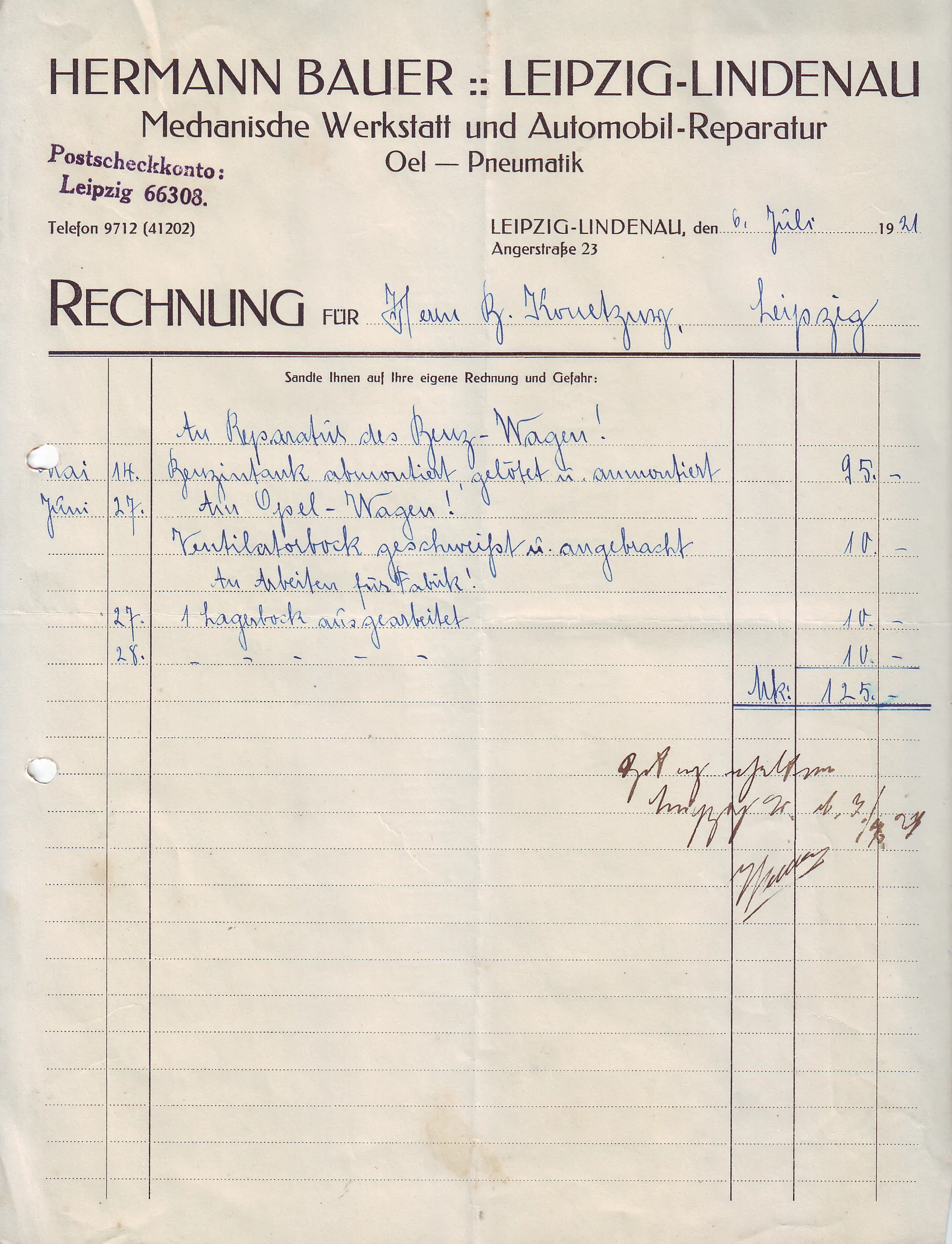

An off-white bill, two holes along the left edge. The printed header reads HERMANN BAUER :: LEIPZIG-LINDENAU, then Mechanische Werkstatt und Automobil-Reparatur, then Oel — Pneumatik. Purple type at the upper left reads Postscheckkonto: Leipzig 66308. Below it, Telefon 9712 (41202). The date line reads LEIPZIG-LINDENAU, den, with 6. Juli written in and the year written as a printed 19 and a handwritten 21, and Angerstraße 23 sits under that line. Large type reads RECHNUNG FÜR, and blue handwriting follows. Inside the table, a printed line reads Sandte Ihnen auf Ihre eigene Rechnung und Gefahr: More blue handwriting fills the ruled lines and the amount column. The file dates the bill to July 6, 1921, in Leipzig-Lindenau. The sheet is a shop bill from that year. It is not a current California invoice, a New York invoice, or a GM job card. The header does not show an odometer reading.
After the car is gone
A later warranty question does not read every one of these sheets the same way.
The 2025 Toyota Crown warranty and maintenance guide, in the section on maintaining the warranty, says to keep records of maintenance with the date, the mileage, and a description of the service and the parts installed, and to give those records to the new owner if the vehicle is sold. Toyota will not deny a warranty claim solely because those records are missing. Damage or failure caused by lack of proper maintenance is not covered. Paid maintenance and repairs may be done by you or by any automotive service provider you choose. Toyota will not deny a claim solely because that provider was not a Toyota dealer. Damage or failure caused by improper maintenance or repairs is not covered. The guide’s section on scheduled maintenance says that maintenance can also increase the vehicle’s resale value. A repair order that shows the date, the mileage, and what was done is the kind of record that maintenance section describes. The guide does not treat the sheet as proof the work was right.
Ford’s 2026 car and light truck warranty guide separates two rules that are easy to fold together. In the passage on maintaining the vehicle, failure to perform scheduled maintenance as specified in the owner’s manual invalidates warranty coverage on the parts affected by that lack of maintenance, and the receipts for completed maintenance are kept with the vehicle. That passage says proper maintenance may help the value on a sale or a trade. Under the new-vehicle limited warranty, Ford recommends keeping copies of the maintenance records and receipts for Ford to review. The California emissions warranty statement in the same guide is the other rule. Ford cannot deny that warranty solely because the receipts are missing, or solely because scheduled maintenance was not ensured. Ford may deny coverage if the vehicle or a part failed from abuse, neglect, improper maintenance, or unapproved modifications. A missing receipt and a missed service are different facts in that guide, and the two passages do not treat them as one fact.
The Ford guide uses the words repair order in one narrow place. If the vehicle is repaired in a foreign country outside the United States, its territories, or Canada, while it stays registered in the United States, and the model is sold or serviceable there, the owner may have to pay that dealer and then present the paid repair order or invoice, with the vehicle, to a United States or Canada Ford dealer for a refund under the United States or Canada warranty. The guide says reimbursement will not be considered if the vehicle does not return. That sheet is the paid bill for a job done abroad. It is not the rule for a job at a shop down the street.
The FTC’s page on auto warranties and service contracts says you do not have to use the dealer for repairs or maintenance to keep the warranty in effect. It is illegal for a dealer to deny warranty coverage because someone else did the routine maintenance or the repairs. If the warranty says the work will be done for free, the dealer or the manufacturer can require the facilities it chooses. If the warranty says the parts will be free, it can require those parts. If someone installs a defective aftermarket or recycled part, or installs a part incorrectly, and that damages a part the warranty covers, the manufacturer or dealer can deny coverage for the damaged part and charge for the repairs. The page says they must prove the aftermarket or recycled part caused the damage before they can deny the coverage. The warranty company could ask for the maintenance records. The page says to keep records of repairs and maintenance, and it names oil changes, tire rotations, belt replacement, new brake pads, and inspections. Without them, a claim might be denied. A service contract, sometimes called an extended warranty, is not a warranty as federal law defines one, because it is bought separately. The contract might require the manufacturer’s routine maintenance, and failing to follow it might void the contract. Keep the service records and the receipts for that contract too. That page says a company could ask and a claim might be denied. It is not Toyota’s sentence that a claim will not be denied solely for lack of records, and it is not Ford’s sentence that missed scheduled maintenance invalidates coverage on the parts that lack of maintenance affected.
A recall sits in a different file. NHTSA’s recall search says a search by license plate or by VIN tells you whether that vehicle needs a repair as part of a recall. If it does not, the result says “0 unrepaired recalls associated with this VIN.” The page says the search will not show a safety recall that has already been repaired. It also will not show a manufacturer customer-service campaign or other non-safety campaign, a recall on an international vehicle, safety recalls from the small manufacturers the page describes, safety recalls more than 15 years old unless the manufacturer offers more coverage, or some recently announced recalls whose VIN lists are still incomplete. The lookup is recall information the manufacturer provides. The recall notice is the owner letter. The invoice from the visit is the shop’s account of that visit. NHTSA tells the owner to contact the local dealer and have the recalled part fixed for free. These pages do not say an independent shop’s invoice closes the campaign on that lookup.
The mileage on the shop’s paper is a reading, not a sale disclosure. New York’s invoice carries the odometer when the car was left and the odometer when the invoice was prepared. California’s work order carries the reading. Florida’s estimate carries one, and the invoice carries one. That is the number the shop wrote down. It is not the odometer disclosure that goes with a transfer.
A title is the ownership record. These pages leave it alone. New York says the repair papers could increase resale value. Toyota says to give the maintenance records to the next owner, and that scheduled maintenance can increase resale value. Ford says proper maintenance may help the value when the vehicle is sold or traded, and to keep the receipts with the vehicle. The final copy is the shop’s list of the job: what was authorized, what the shop wrote as done, and the mileage it recorded. It does not establish that the diagnosis was right, that a warranty claim will be paid, or that a recall on the VIN search is closed.
Sources
- California Bureau of Automotive Repair: Write It Right — Estimate required before repairs, with the preventive-maintenance exception the page states. Tear-down estimate, then a second estimate. Authorization in writing, orally, or electronically, recorded before work. A drop-off note is not authorization. Work order carries the requested repairs, the authorized estimate, and the odometer reading. Invoice at completion itemizes services and parts, including diagnosis, warranty repairs, and no-charge work, in words a customer can understand, and states whether each part is new, used, reconditioned, or rebuilt. Records kept at least three years and tied to the transaction. This article does not repeat section numbers.
- New York DMV: Know your rights in auto repair — Written estimate if the customer requests it. No work without permission. Work-order copy, or the customer's own work order attached to the invoice. Oral authorization noted on the invoice with date, time, and name. Invoice lists each repair, each part, and both odometer readings. A shop need not warranty its work; if it does, the terms go on the invoice. Keep the papers. They are the record in a complaint and could increase resale value. The department does not investigate manufacturer or third-party warranty disputes. A repair-shop complaint is limited to 90 days or 3,000 miles, whichever comes first. The page's estimate-fee sentence is not repeated here.
- New York DMV: Motor vehicle repair shop regulations — On request, a written estimate that includes a description of the problem reported by the customer, the parts and labor, and which parts are not new parts of at least original equipment quality. No charge above the estimate without consent. Work order and oral-authorization notation. Invoice includes both odometer readings and a description of the problem reported by the customer. Fee amounts printed in the regulations are not repeated here.
- Florida Department of Agriculture and Consumer Services: Motor vehicle repair — Registration, and a posted certificate and rights sign in the customer service area. When the repair will cost more than the amount the page states, the customer signs one of three choices and cannot be forced to waive a written estimate. Estimate contents include the customer's problem or request and the odometer reading. Invoice contents include the date, an odometer reading, a description of the work, parts and labor, the nature of the parts, any guarantee, and the shop's registration number. Keep work orders and receipts. The page's dollar threshold and overrun margin are not repeated here.
- Texas Attorney General: Car repair tips — Four practices the page says are illegal: a knowing false or misleading statement about the need for parts or repair, a statement that work was done or parts were replaced when that is not true, representing second-hand or refurbished goods as original or new, and advertising goods or services with intent not to sell them as advertised. Advice to get written authorization before towing, inspection, a test drive, diagnosis, or disassembly, with separate signatures for inspection and for repair, and to keep a written explanation with the estimate and the final bill. The page does not state a duty to issue a written estimate before work.
- FTC: Auto warranties and auto service contracts — It is illegal for a dealer to deny warranty coverage because someone else did routine maintenance or repairs. If the warranty work or the parts are free, the warrantor can require its chosen facilities or parts. A defective aftermarket or recycled part, or an incorrect installation, can lead to a denial on the damaged part, and the warrantor must prove the aftermarket or recycled part caused the damage before denying coverage. Keep maintenance records; otherwise a claim might be denied. A service contract bought separately is not a warranty under federal law and may require the manufacturer's maintenance recommendations.
- NHTSA: Check for recalls — A license-plate or VIN search reports whether that vehicle needs a recall repair. No unrepaired recall produces the message that zero unrepaired recalls are associated with the VIN. The search does not show a safety recall that has already been repaired, among other omissions the page lists. The owner contacts the dealer for the free repair. Manufacturers provide the recall information.
- Toyota: 2025 Crown warranty and maintenance guide — Maintaining the warranty: keep records with the date, the mileage, and a description of the service and parts; give them to the next owner. Toyota will not deny a claim solely for lack of records, and will not deny a claim solely because paid maintenance or repairs were done outside a Toyota dealer. Damage or failure from lack of proper maintenance, or from improper maintenance or repairs, is not covered. Scheduled maintenance can also increase resale value.
- Ford: 2026 U.S. car and light truck warranty guide — Failure to perform scheduled maintenance as specified in the owner's manual invalidates coverage on parts affected by that lack of maintenance. Retain receipts with the vehicle. Proper maintenance may help value on a sale or trade. Ford recommends keeping maintenance records and receipts for review. The California emissions warranty statement in the same guide cannot be denied solely for lack of receipts or solely for failure to ensure scheduled maintenance, and may be denied if the failure was caused by abuse, neglect, improper maintenance, or unapproved modifications. A paid repair order or invoice is the paper presented for a refund after a covered repair outside the United States, its territories, or Canada, if the vehicle returns.
- GM: Warranty administration, required operating procedures, U.S. only, October 2024 — Bulletin dated October 2024, drawn from the GM service policies manual, for work performed on behalf of GM at U.S. dealers. Customer authorization on the job card before repairs, and a copy of the initial write-up. Concern, cause, and correction, with the vague wordings the bulletin rejects. A customer note, email, or early-bird drop-off form can authorize the job if it is attached to the job card. Dealers may set stricter rules for customer-pay work. Dollar figures in the bulletin are not repeated here.
References checked .