Published by HALOX Co.
What a specially constructed vehicle title actually is
How California, Texas, and Florida title a kit, a homebuilt, or a car assembled from parts when there is no manufacturer's statement of origin, and how a factory replica is a different paper.
The finished car has no manufacturer’s statement of origin. What title does the state issue?
It issues an ownership record for a vehicle a licensed manufacturer did not build complete. The state looks at the finished car, takes receipts for the major parts, and either accepts a number that came with a kit or assigns one. California’s registration page calls that vehicle specially constructed: a homemade or kit vehicle built for private use, not made by a licensed manufacturer, and not eligible for resale. Texas calls the hobbyist’s version an assembled vehicle, and it puts a custom vehicle, a street rod, a replica, and a glider kit under the same name. Florida does not use one name. A car built from a kit, a car built from parts, and a complete replica a manufacturer sold already finished are three procedures.
The paper that comes back is a title. It is not the manufacturer’s statement of origin a new car brings from the factory. It is not a certification that the finished car meets the federal safety standards that apply to a current production car.
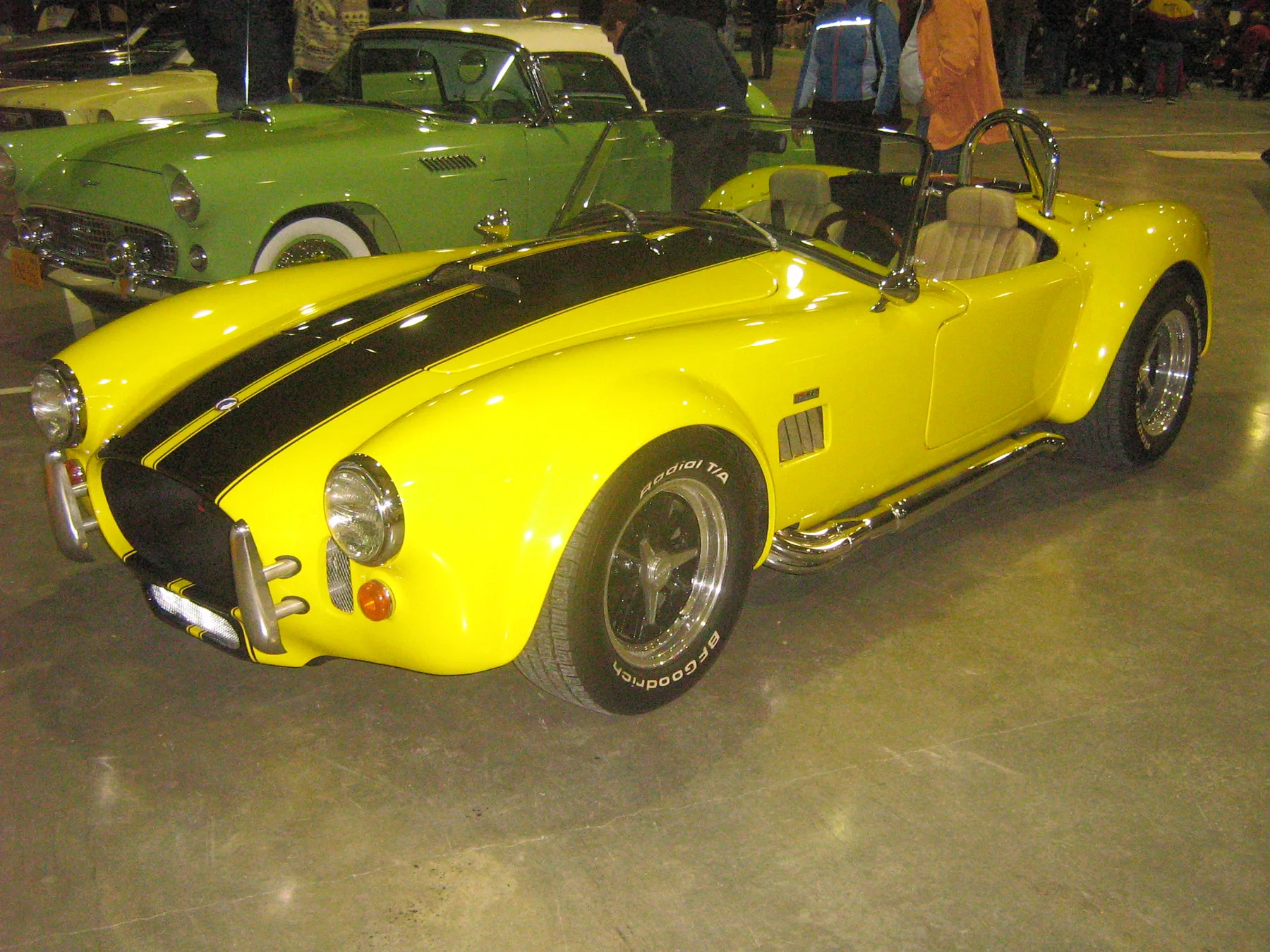

Yellow paint, two black stripes down the center, a chrome roll hoop, and side pipes, indoors, with a green 1950s car behind it. The source page says an auction sheet called this a 1966 AC Cobra and that the car is a later replica. The photograph shows the shape. It does not show a title brand.
A recognizable car is still that car
California’s registration manual defines a specially constructed vehicle as one built for private use, not for resale, and not constructed by a licensed manufacturer or remanufacturer. The build can be a kit, new parts, used parts, or both, or a vehicle that was reported dismantled and then put back together so that it no longer resembles the original make. A repair or a restoration that leaves the car recognizable is outside that definition. The manual’s example is a Volkswagen given a Rolls-Royce grille, or a Baja kit that changes the fenders, the engine lid, and the front, while the car is still a Volkswagen. A motorcycle with longer forks is still that motorcycle. A motorcycle built entirely from parts, even Harley-Davidson parts, is not registered as a Harley-Davidson. It is specially constructed, because a manufacturer did not build it.
The public page uses the same Beetle. A body change that leaves the title’s make correct is a different report. The page tells an owner whose body alteration is above the amount the page sets, or whose alteration moves the vehicle into a different weight class, to report that change on the California title the car already has.
Texas will not title an assembled vehicle that merges two vehicle classes. The stated exception is parts swapped among two-axle, four-tire passenger cars, pickups, panels, and vans, and six-tire dually pickups. The October 2025 manual also refuses a frame or body from a nonrepairable motor vehicle, any electrical or mechanical part from a flood-damaged vehicle, a design meant only for off-highway use, a design the manufacturer meant only for on-track racing, a vehicle stripped until it loses its original identity, and parts that do not meet a federal motor vehicle safety standard when a standard exists for those parts. Missing equipment does not, on that page, disqualify the vehicle when the required component parts are present.
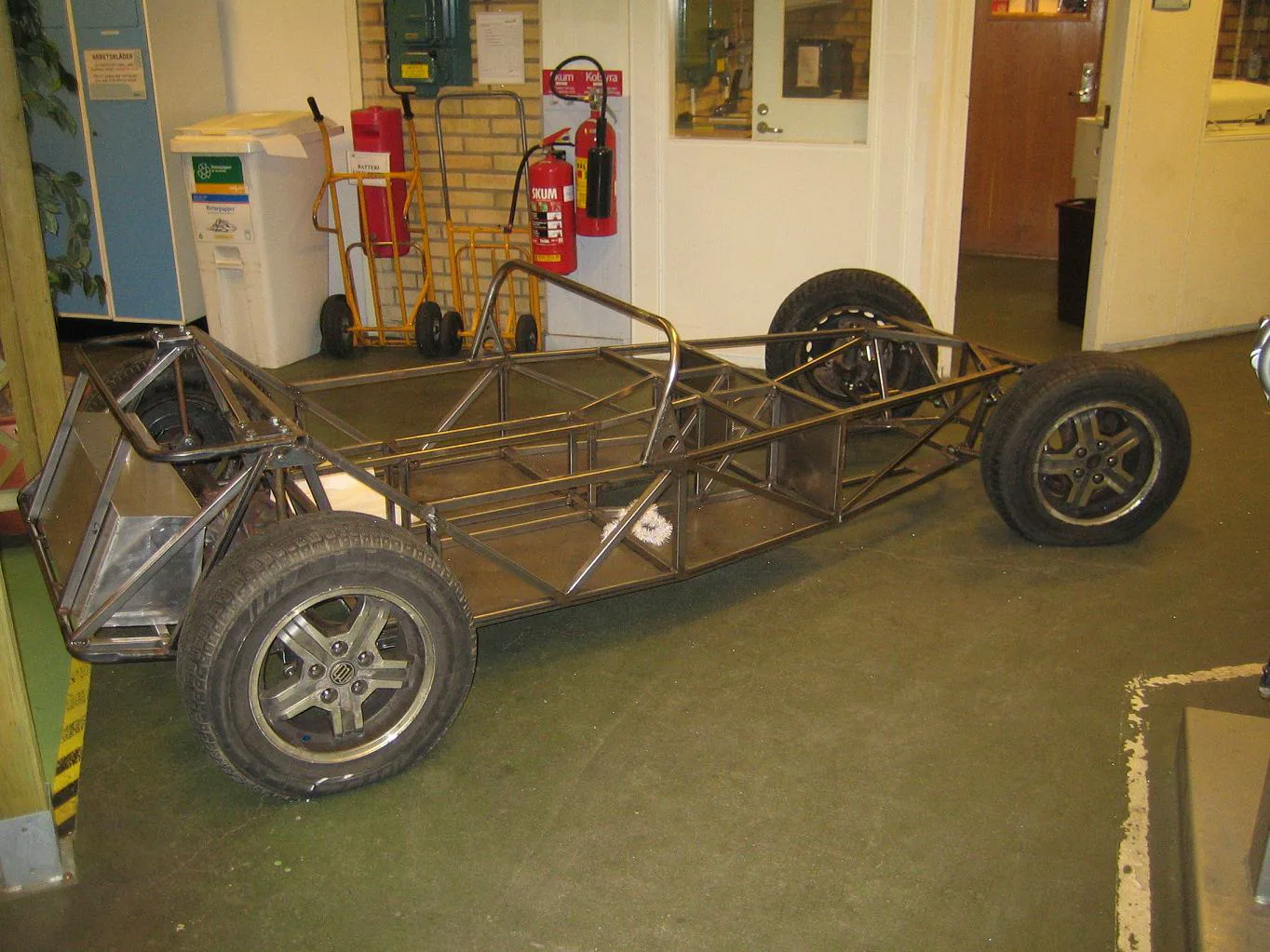


A bare steel tube spaceframe on four wheels, indoors, with no body on it. The source page calls this a Locost spaceframe built in Sweden as a school project, based on Volvo parts and designed for a Volvo V8. It is not a finished title, and it is not a manufacturer’s origin document.
The car has to be finished, and then it needs a number
California will not verify a pile of parts. The verification chapter says a verification of an incomplete or unassembled vehicle is not acceptable, and a specially constructed motor vehicle is one of the applications that always needs a physical verification. A licensed private verifier cannot do that inspection. The public registration page wants the verification done by an authorized DMV employee, with the vehicle at a DMV office. The specially constructed chapter sends motor vehicles, and trailers at 6,001 pounds unladen or more, to the California Highway Patrol for the inspection that determines the number or assigns one. A trailer under that weight, other than a logging dolly, gets its number from DMV unless an original, unaltered number is still on the frame.
A kit is a narrower file in the same manual. The kit page says the vehicle is registered on the kit manufacturer’s identification number, that those vehicles are exempt from the federal 17-digit requirement, and that no model year is shown. The make is the kit make followed by KT. A kit motor vehicle, a kit trailer at 6,001 pounds unladen or more, and any of these vehicles with more than one number, goes to the Highway Patrol for a verification or an assignment.
Texas separates the number by who stamped it. The assembled-vehicle page accepts a certificate of origin when the kit maker assigned the number, and a manufacturer’s certificate of origin when the manufacturer of a replica, a custom vehicle, a street rod, or a glider kit assigned it. A glider kit, in the October 2025 manual, is a truck tractor built from a kit that typically has a new cab, frame, and front axle, plus a used powertrain. A newly assembled vehicle without one of those numbers is inspected by an auto-theft law enforcement officer, and the department assigns a number when the inspection does not find one. The manual states the same split. The certificate establishes the number when the kit maker or the manufacturer assigned it, and every other assembled vehicle needs the law-enforcement inspection.
Florida’s kit procedure, revised June 26, 2023, takes the number on the body kit’s certificate of origin or on the manufacturer’s bill of sale. If that number was never assigned, a compliance examiner assigns one and marks it FLA. A vehicle assembled from parts, rather than from a kit, is a different file in the same revision. The make is ASPT, the year is the year it was assembled, and the examiner assigns the FLA number. Parts from a certificate of destruction can go into that build only while 49 percent or less of the parts come from a single destruction certificate. Both applications go to a regional office, and both require the vehicle to be finished before anyone applies.
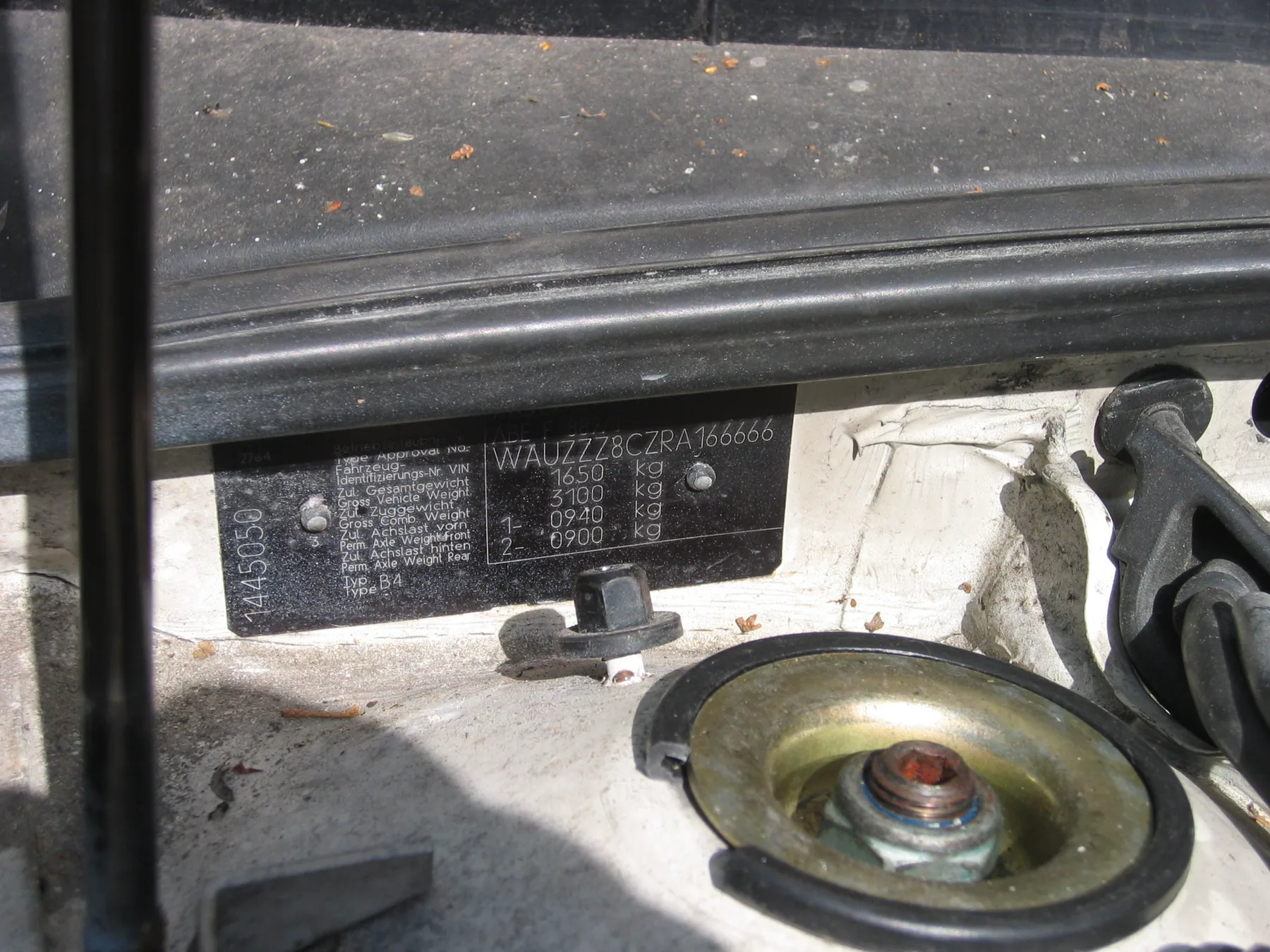

A manufacturer’s plate by the strut tower, with a VIN line and weight ratings in kilograms. The source page places it on the firewall of a production Audi and says the number was changed, so the digits are not that car’s identification number. This is the manufacturer’s plate a specially constructed car does not bring for the finished vehicle.
Receipts, and a bond when the receipts stop
California asks for bills of sale, receipts, or invoices for the body, the frame, the transmission, and the engine, plus a statement of construction from the owner. A manufacturer’s certificate of origin counts only for the parts it describes. A junk receipt can stand in for a major component. The kit page adds one exception. A certificate of origin can be the ownership evidence for a complete vehicle only when the vehicle is an unassembled trailer kit.
The specially constructed chapter requires an ownership bond when the vehicle is built from an altered vehicle, or from component parts of a vehicle that was registered in California or another state, or from materials that were not part of another vehicle and are receiving an assigned number. The bond is not required when the documents identify a verified number on the vehicle or the value of the completed vehicle, or when the body, frame, transmission, and engine that have no bills of sale stay at or under a value the manual sets. The kit page draws its own line: a bond is required when the vehicle is above the value that page sets and the receipts for those major parts are not submitted. Texas offers the same kind of fallback. The assembled-vehicle page says an owner without ownership evidence may apply for a bonded title at the regional service center, along with the rest of the documents.
The safety inspection is a separate certificate. California wants an electronic vehicle safety systems inspection. The manual says a repair shop’s statement that the brakes and lights work will not be accepted in its place when a station that inspects that kind of vehicle is far away. Texas, on the first title of an assembled motor vehicle, a replica, or a kit car, wants a master technician’s inspection. The October 2025 manual says the technician certifies that the vehicle is structurally stable, that it meets the conditions to be operated safely, and that equipment for which a federal motor vehicle safety standard exists complies with the applicable standard. The technician’s master certification has to be current across the automobile series the manual lists, A1 through A8, and the printout comes with the inspection. That inspection is not required for an assembled motorcycle, an assembled trailer, or a glider kit, and it is not required again for an assembled vehicle already titled in Texas or another state, unless that title is being used as ownership evidence for a part in a new build. Neither certificate is a federal certification label. Each one is a state paper about the vehicle in front of the inspector.
What the title writes down
California’s application shows no model year. The kit page repeats that. The make on a kit title is the kit make plus KT, and the number is the kit manufacturer’s number unless the Highway Patrol assigns one.
The October 2025 manual writes the make as ASVE, or HMDE for an assembled trailer, and the year as the year the vehicle was assembled. An original body keeps the established year and make and adds a reconstructed remark. A resemblance to an earlier model may add that year and make. Anything that is not a replica and not reconstructed is marked not for dealer resale. The manual reads that remark as notice that a licensed dealer cannot buy or sell the vehicle, and that a licensed salvage dealer or an independent dealer cannot rebuild it. The odometer line is a not-actual-mileage brand, the statement an odometer disclosure records on a transfer. The owner is the purchaser, the seller is none, and the city and state where the car was finished are the seller’s. Photographs of the front, the rear, and the side go with the application, plus a photograph of the car a replica resembles.
The regional service center letters that the vehicle is eligible and names the year, the make, and the brands before the county tax assessor-collector titles from that letter and the papers attached to it.
Florida’s kit procedure, in the June 26, 2023 revision, puts the year of assembly on the title, with two exceptions that turn on what the kit resembles. A kit manufactured to resemble a vehicle less than 25 years old is titled in the year it was assembled. A kit manufactured to resemble a vehicle 25 years old or older is titled in the year it was built to resemble, and the year it was actually assembled goes in the comments. Both are branded kit car, and later titles keep that brand. If the certificate of origin says the vehicle is a kit car and a replica, the title carries both brands. The make and the body type come from that certificate, or from the manufacturer’s bill of sale. The proof of ownership for a kit that is also a replica has to name the year and make of the vehicle the kit was manufactured to resemble. If it does not, the procedure says to get a corrected document from the manufacturer, or an affidavit if the manufacturer is out of business.
A car assembled from parts does not get that resemblance year. It is branded assembled from parts.
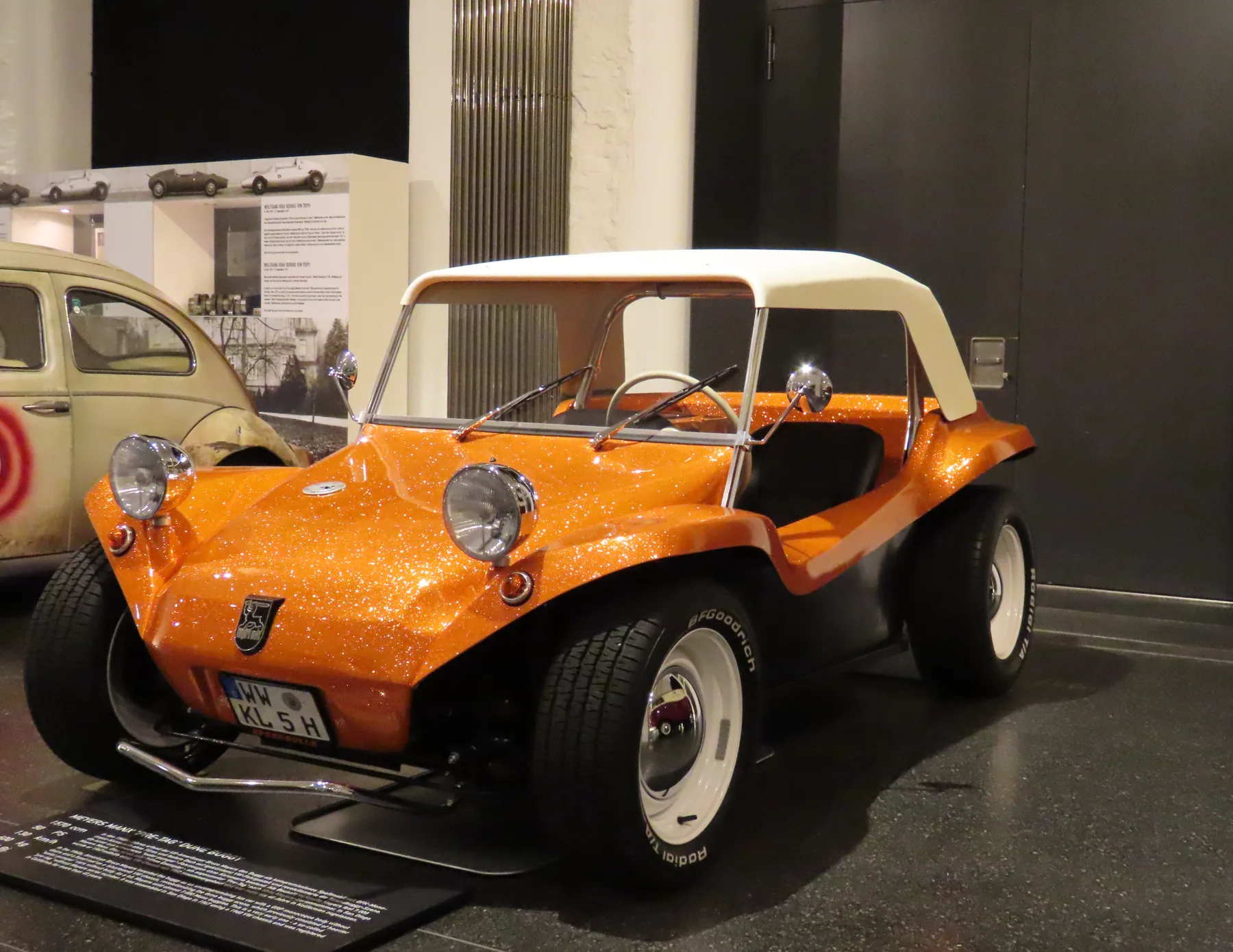

Orange metal-flake paint, a white top, and chrome headlamps, in a museum next to a Volkswagen Beetle. The engine is not in the frame. The source page calls it a Meyers Manx pre-tag dune buggy, a two-passenger kit car. It is a kit, and it is not the long-hood replica in the first photograph. The photograph does not show a title.
The emissions year is not the year on that title
California’s health and safety code sends a specially constructed passenger vehicle or pickup, when it is registered, to a referee station. The owner chooses whether that inspection follows the engine’s model year or the vehicle’s model year. For the engine, the referee compares it with engines of the era it most closely resembles, and assigns 1960 if it does not sufficiently resemble an engine that was manufactured before. For the vehicle, the comparison is the same, and so is the 1960 assignment if the vehicle does not sufficiently resemble one that was manufactured before. The referee then requires only the emission controls that apply to the year it established and that the engine, or the vehicle, can reasonably accommodate in its present form. A tamper-resistant label and a certificate record the year and the emission-control application. The department registers no more than the first 500 of these vehicles presented in a calendar year. A renewal does not count against that 500.
The registration manual describes that choice differently. Its certificate of sequence lets the owner pick the engine’s model year or the year the vehicle is being registered, for the first 500 owners in the calendar year who present a registration or who ask for the certificate on its own. After those 500, the manual says the Bureau of Automotive Repair evaluates the vehicle under its criteria for specially constructed vehicles. The vehicle code is more specific for a passenger vehicle or a pickup once that count is past: one that has not been registered before is assigned the calendar year of the application for the emissions inspection, and one that already has a registration and asks for a different model year is denied and stays on the earlier year.
The specially constructed chapter still requires the first smog certification from a referee, who affixes a label. A later inspection can be done at a licensed station while that label stays on and the emissions equipment stays the same. A smog certificate is the pass a station sends for a vehicle that already has an emissions configuration. The label is how this vehicle gets one.
CARB’s April 19, 2024 advisory says that inspection path does not change the certification requirement for a new motor vehicle or a new engine. A new vehicle, or a vehicle with a new engine, that CARB has not certified is not eligible for registration. The advisory limits the smog path to a vehicle built for private use, not for resale, and not constructed by a licensed manufacturer or remanufacturer. It names a practice that falls outside the path: selling a complete uncertified vehicle, sometimes invoiced as a chassis and an engine separately, and then registering it as specially constructed. The advisory also says the path does not apply to a competition vehicle that is not used on a public highway. CARB certifies light-duty engine packages for these builds under an executive order, and it certifies complete light-duty replica motor vehicles to the current model year’s emission standards as specially produced motor vehicles, also under an executive order. Those are certification paths. The 500-vehicle inspection is not one of them.
Texas does not offer that model-year choice. The assembled-vehicle page asks for an emissions inspection report when the vehicle will be registered in an emissions county and is not exempt. The October 2025 manual says that registration inspection does not apply to a custom vehicle or a street rod when the owner is applying for those plates. On that application, a piece of equipment is required only if state law required it as a condition of sale in the year listed as the model year, and the parts the technician inspects follow the vehicle’s model year or the year it resembles.
A replica that left a factory is a different vehicle
The October 2025 manual defines a replica as a vehicle with a manufactured prefabricated body, or a body made from materials that were not original to it, that resembles an established make of an earlier model. A custom vehicle or a street rod can fall under that term. The custom vehicle is at least 25 years old and later than 1948, or built to resemble one, and altered from the original design or given a body that was not original. The street rod is from before 1949, or built to resemble one, with the same kind of change. Only a hobbyist may build an assembled motor vehicle, motorcycle, or trailer, and a hobbyist builds for personal use, is not a kit maker or a manufacturer, and is not in continuous sale. The manual sets continuous sale at five or more assembled vehicles of the same type in a calendar year when they are not owned and titled in the owner’s name. A manufacturer may build the custom vehicle, the street rod, the replica, and the glider kit. A manufactured replica is owned, and numbered, from the manufacturer’s certificate of origin.
Florida’s replica procedure, revised June 26, 2023, says a replica is not a kit and is not titled at a regional office. The procedure defines it as a completely new motor vehicle manufactured to look like an old vehicle. The year on the title is the year it was manufactured to resemble. The actual year of manufacture goes in the comments. The make, the number, and the body come from the manufacturer’s certificate of origin. The title is branded replica, later titles keep the brand, and the title is marked new. The manufacturer has to be registered with the National Highway Traffic Safety Administration, registered with the state’s corporations division, and licensed as a manufacturer with the department. The procedure does not say the car has to be inside the federal replica-exemption program. A Florida or out-of-state title that was issued without a brand is sent to a regional office for a physical inspection.
The federal replica rules, current through September 1, 2026, are that program. The vehicle is built in a single stage by a registered low-volume manufacturer, and it is meant to resemble the body of a motor vehicle sold to consumers at least 25 years earlier. The manufacturer holds the intellectual property or a license for the product configuration, trade dress, trademark, and patent. Worldwide production, including a parent or a subsidiary, is not more than 5,000 motor vehicles, and the manufacturer does not build more than 325 replicas in a calendar year. The registration excuses the vehicle-level safety standards in effect on the date of manufacture. Equipment installed on the vehicle still has to meet the equipment standards. A temporary label on the dashboard or the steering-wheel hub says the car is exempt from current federal motor vehicle safety standards that apply to motor vehicles, and from the theft-prevention and bumper standards in effect on that date.
A homebuilt that merely looks like an old car is not that vehicle. The federal replica leaves the factory with a manufacturer’s identification. California’s specially constructed title, Texas’s assembled title for a hobbyist, and Florida’s kit and assembled-from-parts titles record a finished vehicle that never had a manufacturer’s statement of origin for the whole car. The title shows the state accepted the inspection, the number, and the receipts it asked for. It does not show a federal safety certification, and it does not show that CARB certified the vehicle as a new car. The title is the ownership record. Registration is the separate credential that lets the vehicle be driven.
Sources
- California DMV: Specially constructed or modified vehicle registration — Homemade or kit vehicle built for private use, not made by a licensed manufacturer and not eligible for resale; verification, construction statement, parts receipts, safety-systems certificate, and smog; a modified but recognizable Beetle is not specially constructed; body-alteration reporting
- California DMV: Specially constructed vehicles — Private use, not for resale, not built by a licensed manufacturer or remanufacturer; recognizable modifications versus a build from parts; Highway Patrol number assignment; referee smog and the label; parts receipts, bond, and no model year on the application
- California DMV: Kit vehicles — Kit manufacturer's identification number, no model year, make abbreviation plus KT, Highway Patrol when there is more than one number, certificate of origin limited to the parts described, and the bond when receipts are missing
- California DMV: Vehicle verifications — A specially constructed vehicle always requires a physical verification; an incomplete or unassembled vehicle is not acceptable; a licensed vehicle verifier cannot inspect a specially constructed vehicle
- California DMV: SPCNS certificate of sequence — Choice between the engine model year and the year the vehicle is being registered, limited to the first 500 owners in a calendar year, and Bureau of Automotive Repair evaluation after that
- California Vehicle Code: specially constructed vehicle — Built for private use, not for resale, and not constructed by a licensed manufacturer or remanufacturer; a kit, new or used parts, or a dismantled vehicle rebuilt so it no longer resembles the original make; a restoration by replacing parts is not included
- California Health and Safety Code: referee inspection of a specially constructed vehicle — Referee choice of engine model year or vehicle model year, the 1960 assignment when the comparison fails, the label and certificate, and the first 500 registrations in a calendar year, with renewal excluded from the limit
- California Vehicle Code: model year after the annual limit — After 500 specially constructed registrations in the calendar year, a previously unregistered specially constructed passenger vehicle or pickup is assigned the application year for the emissions inspection; a request to change an existing model year is denied
- California Air Resources Board: Advisory 296, April 19, 2024 — The smog path does not change new-vehicle and new-engine certification; an uncertified new vehicle is not eligible for registration; certified engine packages and specially produced replica motor vehicles are separate executive-order paths
- TxDMV: Assembled vehicles — Assembled vehicle including a replica, custom vehicle, street rod, and glider kit; what cannot be titled; regional service center letter before the county title; parts ownership, master-technician inspection, and which document establishes the identification number
- TxDMV: Assembled and Reconstructed Vehicle Manual — October 2025 manual; hobbyist and manufacturer, replica and custom and street-rod definitions, ineligible construction, ASVE make and year, brands, master-technician inspection, and the identification-number split
- Florida Highway Safety and Motor Vehicles: title for a vehicle assembled with a kit — Revision June 26, 2023; a finished kit titled at a regional office, assembly year or resemblance year, kit-car brand, and an assigned number when the kit manufacturer did not assign one
- Florida Highway Safety and Motor Vehicles: title for a vehicle assembled from parts — Revision June 26, 2023; assembled-from-parts designation, assembly year, assigned number, regional-office inspection of a finished vehicle, and the share of parts that may come from one certificate of destruction
- Florida Highway Safety and Motor Vehicles: title for a replica motor vehicle — Revision June 26, 2023; a complete new vehicle manufactured to look like an old vehicle, titled from the manufacturer's certificate of origin rather than as a kit, with the resemblance year and a replica brand
- 49 CFR part 586: Replica motor vehicles — Text current through the September 1, 2026 edition of the daily code, matching the October 1, 2025 Code of Federal Regulations; low-volume replica definition, the 325-vehicle exemption from vehicle-level standards, equipment standards still required, and the temporary label
References checked .