Published by HALOX Co.
What a timing belt actually does
How a toothed belt times the cams to the crank, why free-running and interference engines do not fail the same way, and why a chirp or a damp tensioner rod is not the diagnosis.
The belt with the ribs is the other one. A serpentine belt drives the accessories by the friction of those ribs. A timing belt has teeth, and the teeth keep the camshaft sprockets in step with the crankshaft. A timing chain does that job in metal. Gates’ 2010 interval guide, catalog 431-1448A, puts the timing belt inside the engine, which is why the belt people can see is so often the wrong one.
The ribs are a different belt
The toothed belt and the ribbed pulleys can sit in the same bay.
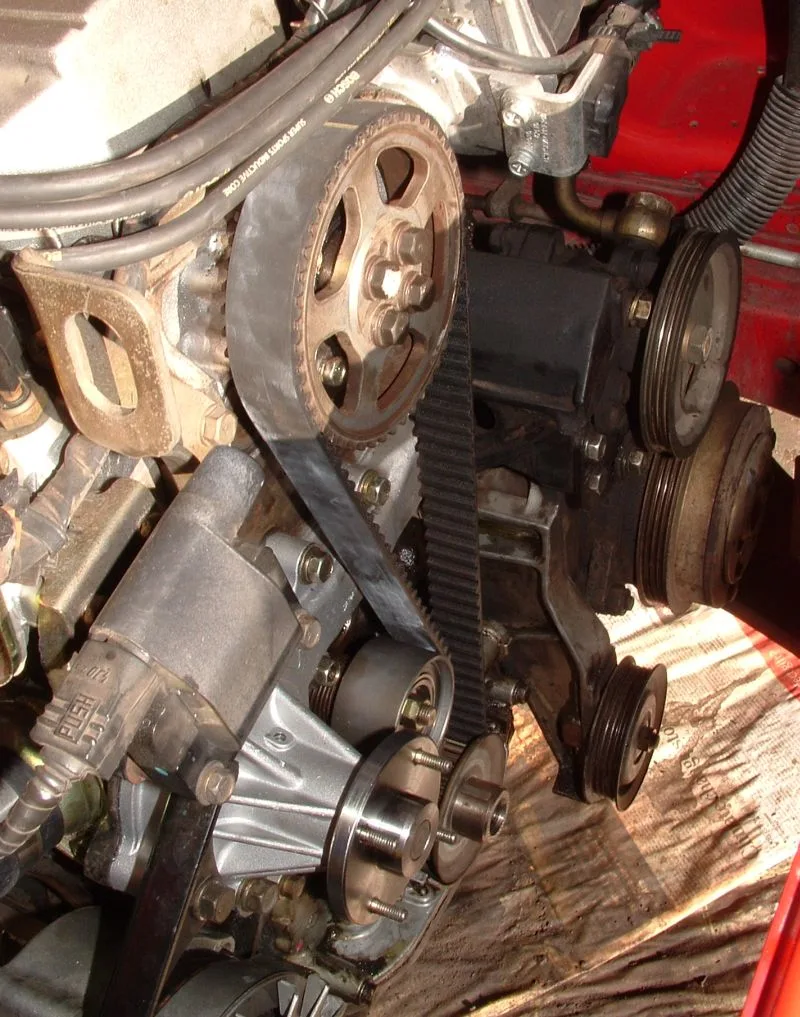


The file identifies this as a Nissan RB30E with the timing covers off. Red bodywork is at the right, and the ground is crumpled paper with print on it. A black toothed belt runs down the middle, meshed with a large rusty brown toothed metal sprocket at the top. Below the belt are a smooth silver idler pulley and a round hub with protruding studs. To the right are ribbed metal pulleys, one above another, and a smaller ribbed pulley near the bottom. Black ignition leads running across the top are printed BOSCH. At the lower left a gray housing has a connector marked PUSH. The toothed belt is the timing belt. The ribbed pulleys are the accessory drive.
Teeth, then the cam, then the valve
The belt in the guide is built in layers the outside does not show. Gates describes those belts as an aramid-reinforced nylon jacket, high-grade HNBR rubber, and high-strength tensile members. A black loop on a bench is still just a black loop.
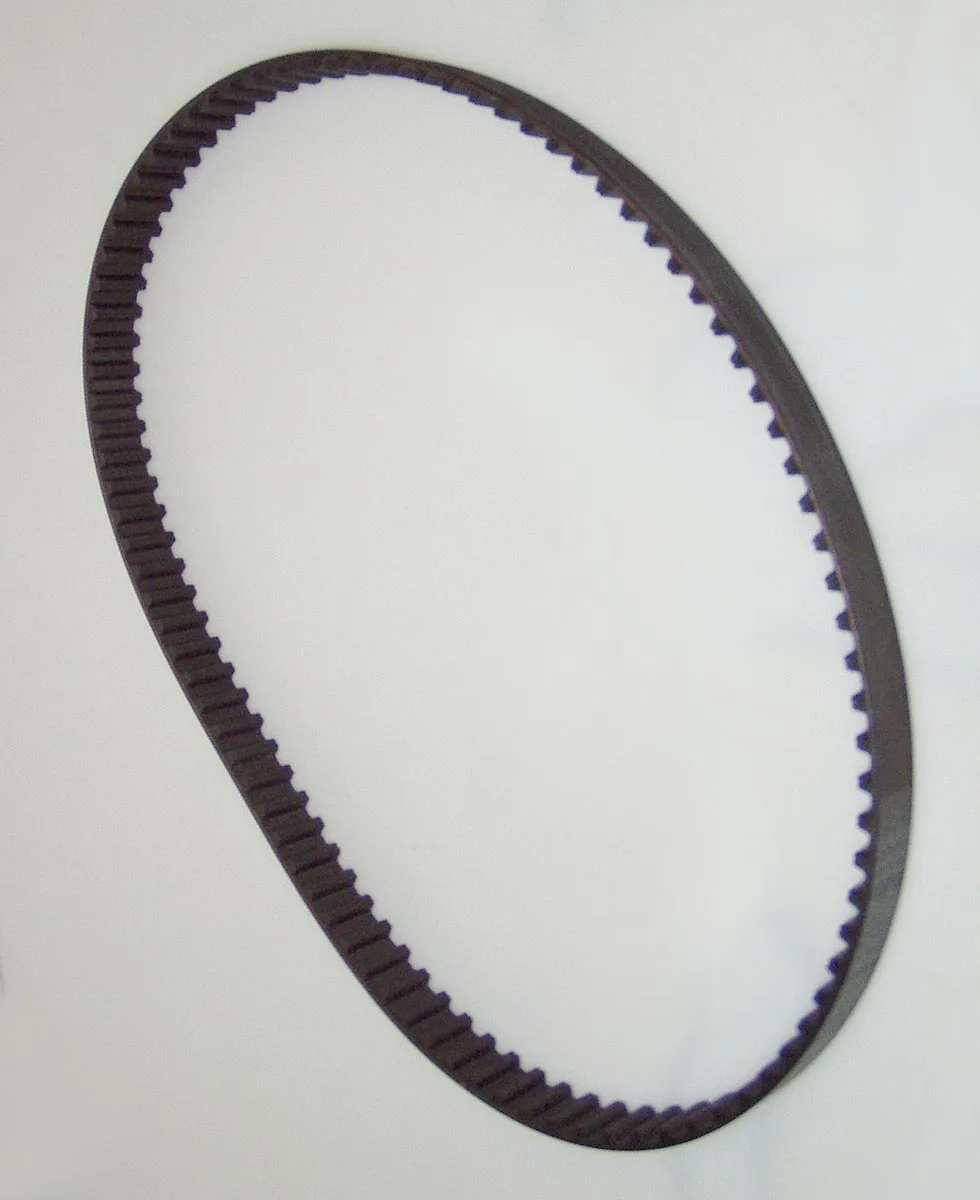


The file calls this a toothed timing belt and does not name an engine. It lies in an oval on an off-white background. The teeth are on the inner face. The outer face is smooth. No markings are visible.
On one engine the path is written out. Audi self-study 920253, August 2015, is the 1.4 TFSI in the A3 Sportback e-tron, the first use of that EA211 engine in North America. The camshafts are driven by a toothed timing belt. Audi gives that belt a Teflon coating and names a long service life, lower friction, lower mechanical stress on the timing gears, and a smoother, quieter engine. Those are the results Audi states for this engine. A guide pulley and the crankshaft sprocket keep the belt running smoothly. An automatic tensioning roller guides it with raised flanges. A three-piece cover keeps dust and dirt off the belt, and the aluminum center section of that cover is also an engine mount.
The belt turns the sprockets. It does not open the valve. On this engine the valves are operated by roller-lever cam followers, which is the cam’s work. The intake sprocket is not a plain wheel. Audi calls it a vane adjuster with a 50-degree range. The belt turns that sprocket. The adjuster is a different part.
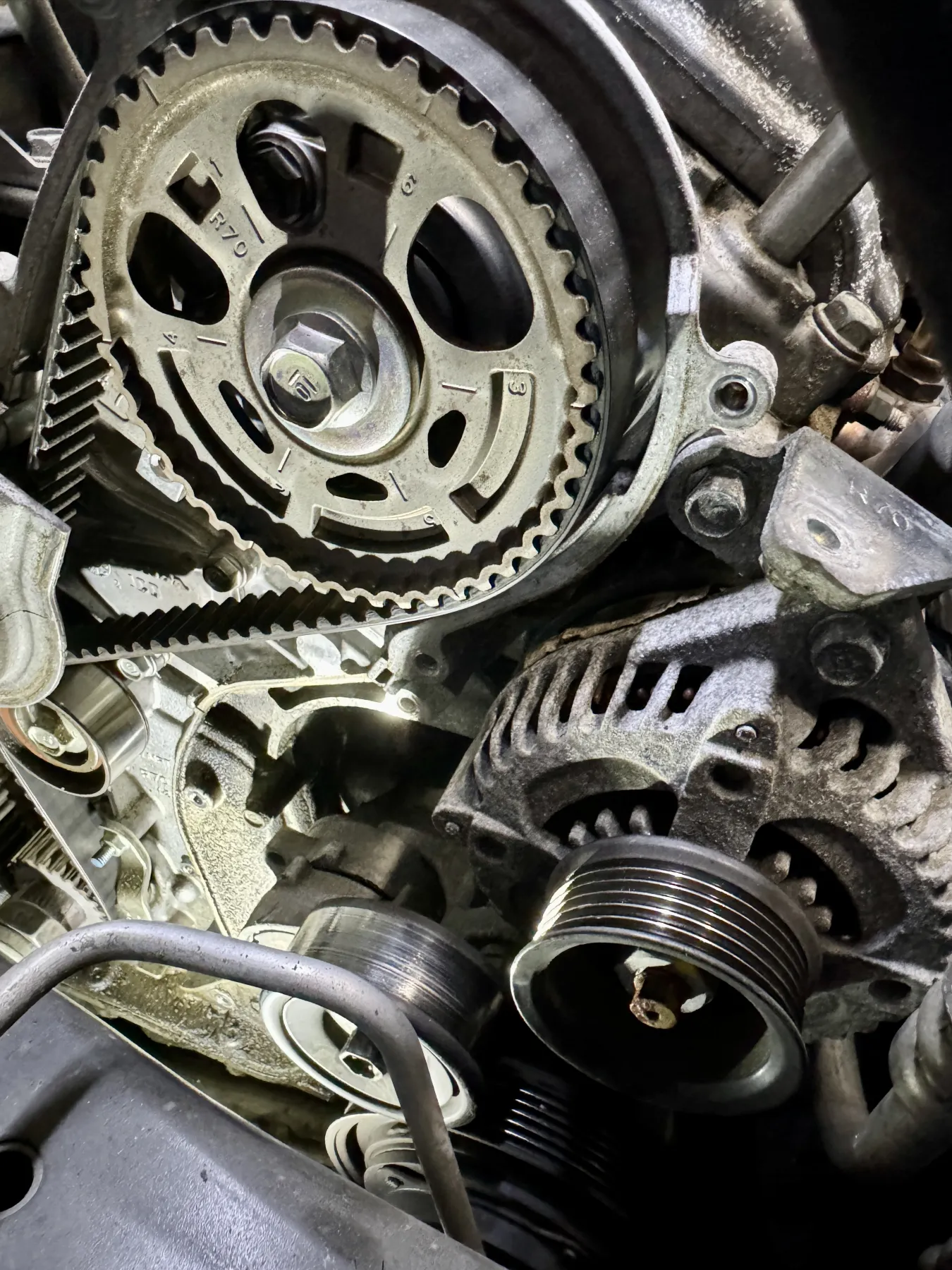

The file calls this a toothed rubber timing belt and does not name the engine. The cover is off the sprocket. A black toothed belt is meshed with a silver-gray metal sprocket, and a hex bolt sits in the center. Stamped numerals on the sprocket, including 3, 4, and 6, and the characters R70 are stamped on the face. Another numeral is partly hidden. At the lower right a ribbed metal pulley sits in front of a finned housing. The teeth are in the sprocket. The ribs are on the other wheel.
Clearance, or a collision
The same Gates guide sorts engines by what happens if that step is lost. In a free-running engine, with the crankshaft still moving, there is enough clearance between the valve and the piston even if the cam stops with a valve fully open. An interference engine does not have that clearance. The guide says those engines usually sustain damage: the piston and the valve collide, and the parts it names are valves, pistons, or heads. Its grouping, in that 2010 edition, is that most higher-compression import engines, and most car and light-truck diesels, are interference. Interference engines are marked with a star in the listings. The star is a mark in the book. It is not printed on the belt.
A lost belt is not, from the driveway, a way to tell which class the engine is. The guide says to follow the automaker’s mileage recommendation, and on that same page it says Gates recommends replacement at around 60,000 miles. The cover of the guide says the recommended interval or every 72 months, whichever comes first. The rows under those lines are per engine, and they are not all 60,000 miles. The interval is the row with the engine on it.
A chirp is a test, and a damp rod is a look
Acura bulletin 14-025, September 18, 2020, version 6, is a list of Acuras. It covers the 2014–2018 MDX, the 2019 MDX trims inside the VIN ranges it prints, the 2016–2018 RDX, the RLX years and hybrid splits it prints, and the TLX V6 years it prints, including the 2019 VIN cuts. The symptom is a chirp from the timing-belt area after the engine warms up. The cause the bulletin names is the timing belt contacting the back edge of the crankshaft pulley. The test pulls the drive belt and listens again while the engine is hot. If the chirp is gone, the bulletin does not apply. If water on the back edge of the timing belt lessens the chirp, changes its pitch, or stops it, the bulletin continues, and the repair it prescribes is an idler-pulley shim once the inspection confirms the contact. If the chirp does not change, the bulletin does not apply. A chirp, on these cars, is not yet the timing belt, and it is not a belt that has already let go.
Subaru bulletin 02-142-13, August 9, 2013, is the hydraulic adjuster on 1.8, 2.0, 2.2, and 2.5-liter EJ engines, for the tensioner part numbers the bulletin lists. Normal, in the bulletin’s photos, is no oil past the rod seal beyond a slight residual film. Failed is a significant accumulation that has leaked past the seal. The rod is compressed slowly, and it is held vertical. Too fast, or horizontal, can weaken it. A damp rod is the inspection. The wetness alone is not the failed one.
The smooth back, and the pump that may not be on this belt
Gates lists automatic, manual, and hydraulic tensioners, and idler pulleys, as separate parts. The hydraulic tensioner in that guide is for applications with high loads or angular vibration, where a mechanical automatic tensioner cannot provide the damping. On two GM cars the service note is narrower. Bulletin PI0923, March 2013, covers the 2011–2014 Chevrolet Cruze and the 2012–2014 Sonic with the 1.8-liter, RPO LUW or LWE. When the timing belt is replaced because the maintenance interval is up, the tensioner and the idler pulley are replaced with it.
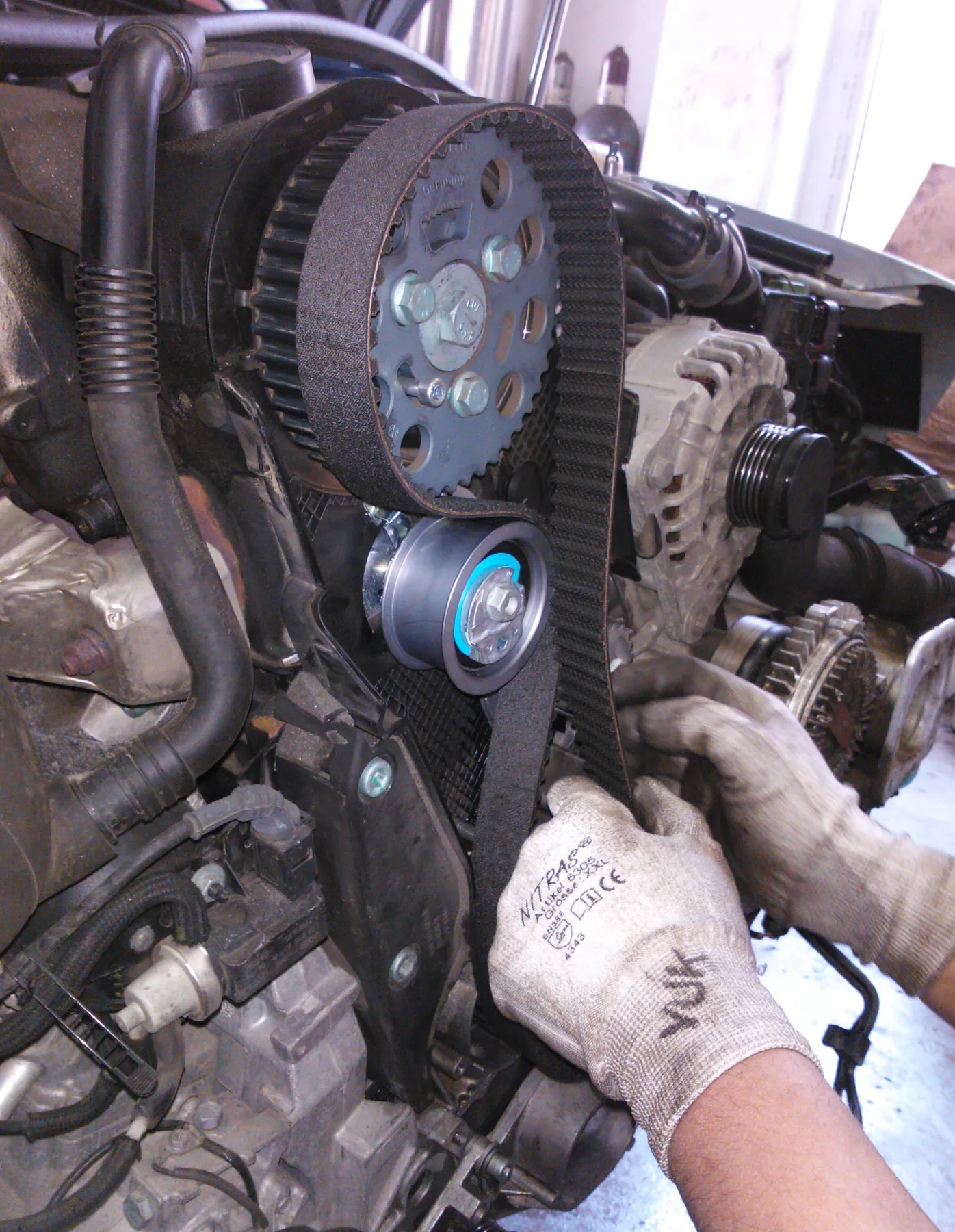

The file identifies this as a timing belt being replaced on a car, and it does not name the car. A black toothed belt runs over a blue-gray metal sprocket held by three hex bolts, and the smooth back of the belt rides a smooth pulley with a bright blue ring. Two hands in gray knit work gloves, one printed NITRAS, hold the belt. Black hoses are at the left, and daylight is in the background. The teeth are on the sprocket. The back of the belt is on the smooth pulley. The photograph does not show whether that pulley is a tensioner or an idler.
The water pump is not automatically on this belt. Gates says a water pump that is driven by the timing belt should be replaced when that belt is replaced. The sentence is about pumps the timing belt drives. On the Audi 1.4, the coolant pump is a different toothed belt, running off the exhaust camshaft, on the flywheel end of the engine. Audi calls that pump drive maintenance-free, and the belt is replaced if the pump is replaced. The oil pump on the same engine is a chain, with no tensioner, and its drive sprocket is fixed to the crankshaft. The cam belt turns neither of them.
Oil or antifreeze on a timing belt is on the Gates warranty list of damage, along with tension that is too high or too low, a belt installed wrong, and a belt used on the wrong engine. The list is what voids that warranty. It is not a way to name a noise from the driveway.
The teeth keep the cam in step with the crank. The ribs belong to the other belt. A cover, a chirp, and a damp rod are not the job.
Sources
- Gates: Timing Belt Replacement Interval Guide, catalog 431-1448A, 2010 edition — Belts described with an aramid-reinforced nylon jacket, high-grade HNBR rubber, and high-strength tensile members; timing belts inside the engine; automatic, manual, and hydraulic tensioners and idler pulleys as separate components; hydraulic tensioners for high loads or angular vibration where a mechanical automatic tensioner cannot provide the damping; timing-belt-driven water pumps replaced when the belt is replaced; free-running clearance between valve and piston if the cam stops with a valve fully open while the crankshaft is still moving; interference engines usually damaged, piston and valve colliding, damage to valves, pistons, or heads; the guide's grouping that most higher-compression import engines and most car and light-truck diesels are interference; interference engines starred in that publication's listings; the cover's recommended interval or 72 months, whichever comes first; the interference page's automaker interval or about 60,000 miles; warranty denial for oil or antifreeze contamination, over- or under-tensioning, misinstallation, and misapplication
- Audi of America self-study 920253, August 2015: 1.4 TFSI in the A3 Sportback e-tron — EA211 1.4 TFSI, first North American use in the A3 Sportback e-tron; camshafts driven by a toothed timing belt with a Teflon coating; lower friction and mechanical stress on the timing gears, and a smoother, quieter engine; automatic tensioning roller with raised flanges, a guide pulley, and the crankshaft sprocket; three-piece cover against dust and dirt, the aluminum center section also an engine mount; valves operated by roller-lever cam followers; intake camshaft sprocket with a vane adjuster, 50-degree range; oil pump driven by a separate maintenance-free toothed chain with no tensioner, sprocket fixed to the crankshaft; coolant pump driven by a separate toothed belt off the exhaust camshaft on the flywheel end, that belt called maintenance-free and replaced if the pump is replaced
- Acura bulletin 14-025, September 18, 2020: timing belt chirps — Version 6, listed 2014–2018 MDX, 2019 MDX 2WD, AWD, and Sport Hybrid inside the printed VIN ranges, 2016–2018 RDX, 2014–2018 RLX except Sport Hybrid, 2019 RLX except Sport Hybrid inside the printed VIN range, 2014 and 2016–2018 RLX Sport Hybrid, 2019 RLX Sport Hybrid inside the printed VIN range, 2015–2018 TLX with V6, and 2019 TLX 2WD and AWD with V6 inside the printed VIN ranges; chirp from the timing-belt area after warmup; cause named as the timing belt contacting the back edge of the crankshaft pulley; drive belt removed and the hot engine retested, and the bulletin does not apply if that chirp is gone; water on the back edge of the timing belt, and the bulletin continues only if the chirp lessens, changes pitch, or stops; if the chirp does not change, the bulletin does not apply; corrective action an idler pulley shim when the diagnosis says so
- Subaru bulletin 02-142-13, August 9, 2013: oil seepage from the automatic timing belt tension adjuster — All models with 1.8, 2.0, 2.2, and 2.5L EJ engines; tensioner part numbers 13033AA000, 001, 002, 13033AA040, 041, 042, and 13033AA050; normal is no oil past the rod seal other than a slight residual seepage; failed is a significant accumulation of oil past the rod seal; the adjuster compressed slowly with the rod vertical, and compressing it too quickly or horizontally can weaken or damage it
- GM bulletin PI0923, March 2013: 1.8L timing belt replacement — 2011–2014 Chevrolet Cruze and 2012–2014 Chevrolet Sonic with the 1.8L engine, RPO LUW or LWE; when the timing belt is replaced for the maintenance-schedule interval, the timing belt tensioner and the idler pulley must also be replaced
References checked .