Published by HALOX Co.
What a transfer case actually does
How a transfer case takes one transmission output and feeds a front shaft and a rear shaft, and what chain drive, gear drive, low range, a center differential, and a clutch each change.
Where does the second driveshaft get its torque?
From a transfer case. TM 9-8000, the Army manual of 25 October 1985, puts that case in an off-road driveline so it can divide engine torque between the front and rear driving axles, and so it can set the front propeller shaft off to the side of the engine. Ground clearance and a body that still sits at a usable height are the reasons that manual gives for the offset. In the conventional layout there, the high-range sliding gear is splined to the transmission main shaft, which is the input. The case can then turn a rear output and a front output. The split between the two wheels on one axle is a differential. The transfer is the split between the axles.
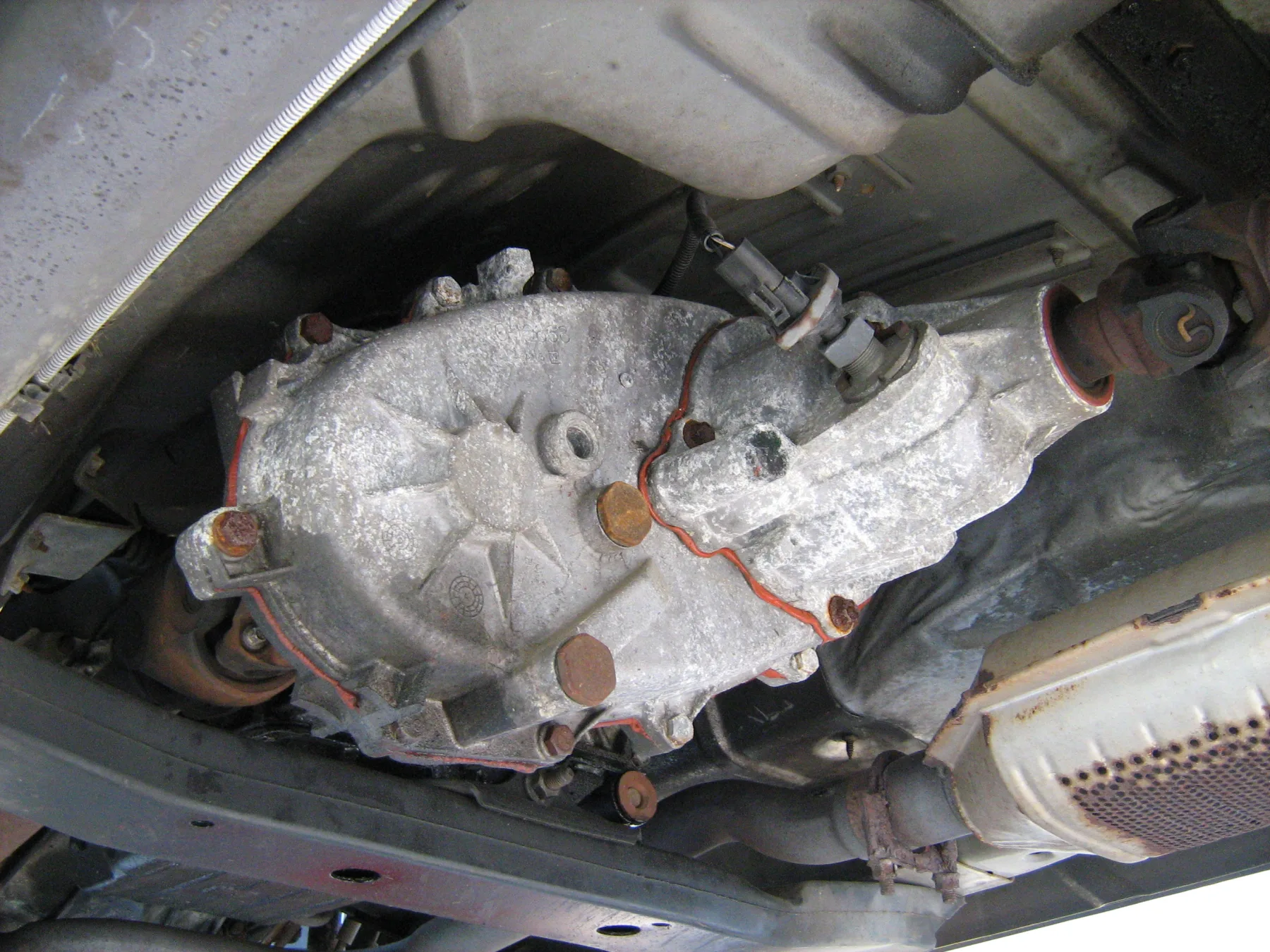


Under a 1993 Jeep Grand Cherokee the case is mounted behind the transmission. The file page identifies the truck as a Laredo on Quadra-Trac, a full-time case, so both axles stay in the drive. The output and propeller shaft leave the housing, and the exhaust and catalytic converter run nearby. That is the station the Army manual describes: after the transmission, ahead of the two axles.
Direct drive, then a reduction
High range, in that conventional Army layout, is 1:1 with both axles driven. The sliding gear’s external teeth sit in the internal teeth of the constant-mesh gear on the transmission main shaft, and the front-axle sliding gear is in mesh as well, or the sliding clutches are engaged. Pulling the front sliding gear out of mesh lets that constant-mesh gear freewheel, which is how the front axle drops out.
Low range moves the sliding gear on the transmission main shaft off the constant-mesh gear and onto the idler gear. The manual says the speed drops because that sliding gear meshes with the larger idler. On some vehicles in the same account, the linkage will enter low range only when the front axle is already engaged, so the reduction cannot be put on the rear drive alone.
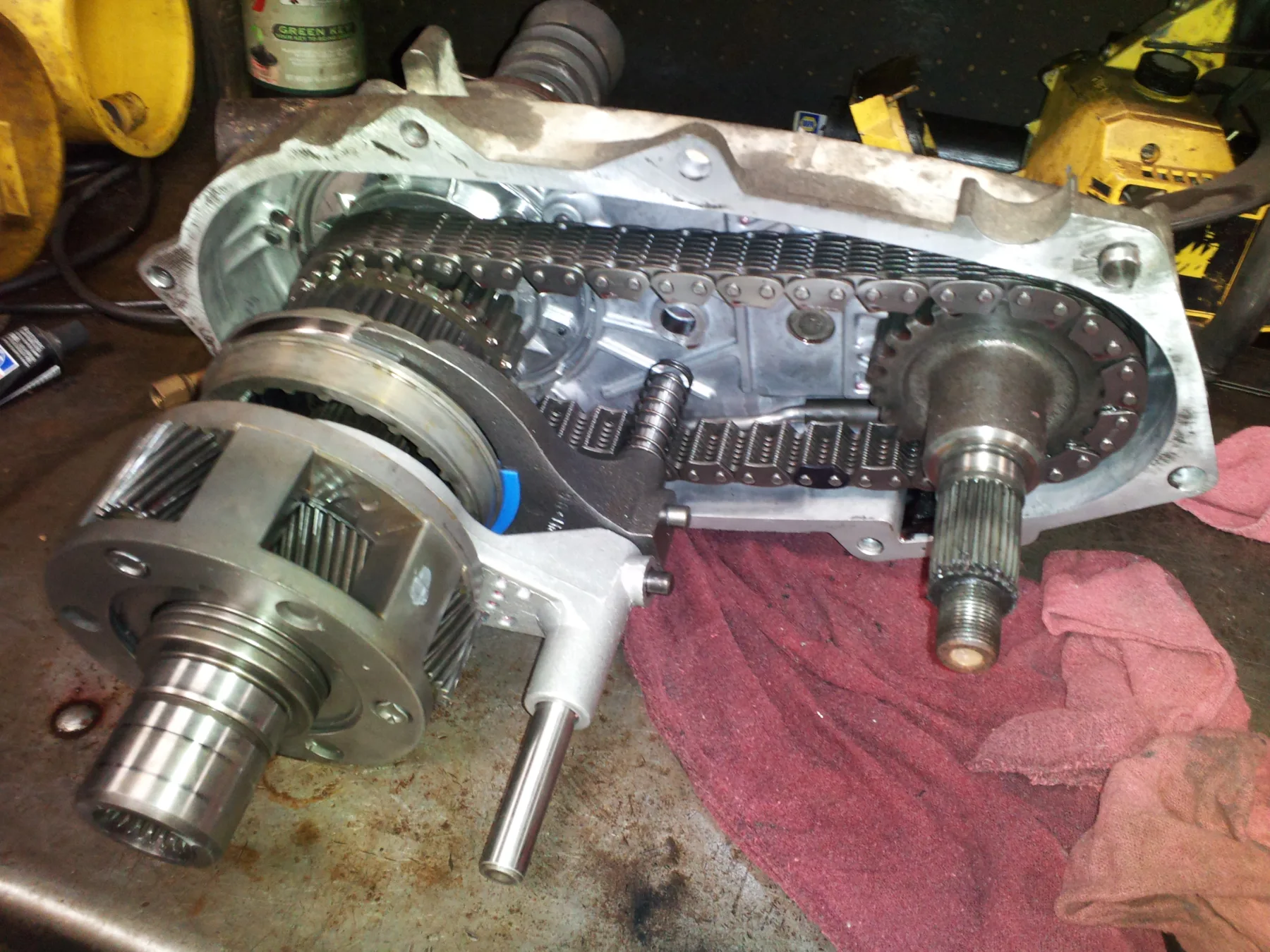

A chain-drive case opened on the bench is the same two jobs in one housing: the offset to the front shaft, and the reduction. The file identifies this one as a New Process 231, manual, shift on the fly. The case half is off. A chain runs between two sprockets. At the left front a planetary gearset, the range reduction, sits with its shaft. A shift fork and rail sit in the middle, the parts that move the case from one range to the other. A splined output shaft leaves at the right. A red shop rag is on the bench beside the housing. The Army manual’s conventional case gets the reduction from a sliding gear and a larger idler rather than from that planetary set, and 1:1 is the high-range ratio it prints for that layout.
The 1:1 figure stays with that conventional case. Ford’s August 2019 supplement for the 2020 F-150 Raptor, the U.S. and Canada printing, calls 4L mechanically locked four-wheel drive with additional gearing for increased torque multiplication, for deep sand, steep grades, or pulling heavy objects, and it does not print the ratio. The 2010 U.S. Lexus GX 460 owner’s manual calls L4 the low-speed position, for steep hills, off-road driving, and hard pulling in sand or mud, and it does not print a ratio either.
Gears, or a chain to the front shaft
Torque inside the conventional case usually goes through gears. The same section says some light-duty cases use a chain to send torque to the front driving axle. In the manual’s differential-type assembly the split is explicit: front-axle torque goes by a drive chain to the front output shaft, and rear-axle torque goes straight from the differential carrier to the rear output shaft.
BorgWarner builds both arrangements. Its transfer-case range covers one-speed and two-speed on-demand and part-time units, and it lists a HY-VO chain and compact gear drives for efficiency and packaging. The chain note on that page puts HY-VO chains in 4WD and AWD transfer cases and says those chain drives reach 99 percent efficiency and above in most conditions. That percentage is BorgWarner’s, for those chains.
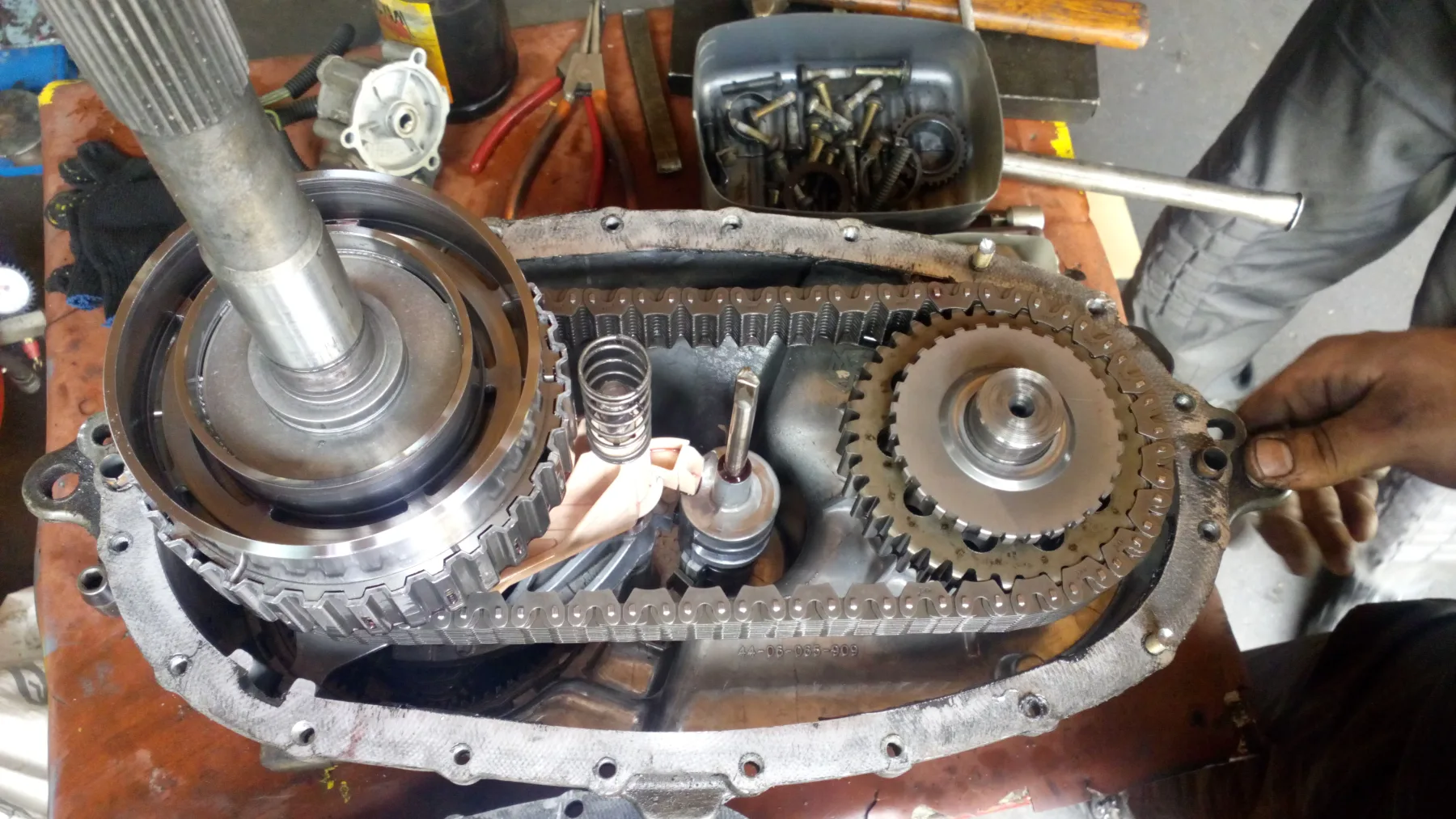

The opened BorgWarner 4406 holds the chain itself. The file page calls it a Morse chain and traces the case to a Ford Expedition with a 5.4-liter engine. The chain is wrapped on two sprockets, which is how a light-duty case in the Army manual sends torque to the front driving axle, and how the manual’s differential-type assembly feeds the front output while the rear output leaves the carrier directly. The planetary reduction and the fork that selects the range sit in the New Process case.
What lets the two outputs differ
The conventional case in the Army manual sends torque to the rear axle the whole time and sends it to the front only when the driver selects it, through linkage to a floor lever. That description has no differential between the axles. The reason the manual gives for being able to drop the front axle is driveline wear on the highway.
The differential-type assembly, later in the same chapter, is full-time four-wheel drive by putting differential gears between the front and rear driving axles. The speed difference between the axles is what lets that drive stay engaged without the wear the manual ties to the conventional case. A sliding clutch can lock the differential out, and locked, the two output shafts turn as one unit. The manual wants that lock off-road because an open differential sends the torque to whichever axle has lost traction, and the vehicle stops moving. The left-and-right version of that limit is the axle differential. The unit here is between the axles. Quadra-Trac on that Grand Cherokee is a full-time case of that kind, mounted behind the transmission.
A third arrangement in the chapter puts an overrunning sprag on the front output in place of the hand-operated sliding clutch. The transfer is built to drive the front axle slightly slower than the rear, so while the wheels turn together only the rear wheels drive. If the rear wheels lose traction and begin to turn faster than the front, the sprag locks and the front wheels drive too. That is an overrun device on the front shaft. It is not the center differential, and it is not a driver-selected clutch.
The 2010 GX 460 manual is one U.S. vehicle that hands the driver a center differential and a low range as separate controls. H4, the high-speed position, is for normal driving on all types of roads. L4 is the low-speed position. The center-differential switch locks the differential when the wheels are in a ditch or the surface is slippery or bumpy, and the lock indicator comes on. The notice for that differential says to leave it unlocked for normal driving on dry, hard-surface roads, and to unlock it after the wheels are out of the ditch or off that surface. An abrupt turn with the differential locked can feel like braking, the manual says, because the front and rear wheels then want different speeds.
BorgWarner’s on-demand cases take the other route to a speed difference: a clutch, actuated electro-magnetically, electro-hydraulically, or electro-mechanically. Magna’s UltiMax is offered as a two-speed part-time, full-time, or active transfer case, and Magna calls the shifting shift-on-the-move. The page does not say which version uses a center differential and which uses a clutch, and it does not say the move includes low range.
On the 2020 Raptor supplement, 2H sends power to the rear wheels only. 4A is electronically controlled four-wheel drive, power to the front and rear wheels as required, and the supplement says AdvanceTrac can take over the transfer-case clutch in 4A and disable it during a maneuver. 4H and 4L are mechanically locked, front and rear together, with 4L adding the gearing. The supplement says not to use 4H or 4L on dry, hard-surfaced roads. The difference between the badge, an automatic mode, and a locked mode is the subject of why AWD is not the same as 4WD. A locked pair of transfer outputs is one piece of that difference.
The shift the lever can finish
Shift on the fly, where a source describes it, is the high-range change. BorgWarner’s part-time cases list electronic mode synchronization or a manual shift on the fly. The Raptor supplement lets the driver move the control from 2H to 4A or 4H at a stop or while driving, and it says not to do that while the rear wheels are slipping or while the accelerator is applied. Low range is the other shift. The Army manual says that in most cases the range change is a sliding dog clutch and has to be made with the vehicle stopped. The Raptor supplement will not make the 4L shift above 3 mph (5 km/h). The steps it gives are that speed or less, the transmission in neutral, then the control. The GX 460 wants a complete stop, the brake held, the shift lever in N, and the four-wheel-drive switch held in L4 until the low-speed indicator comes on. If that shift lever moves before the indicator finishes, the manual says the transfer can be left between ranges, with both drive shafts disengaged, and the vehicle can roll even in park.
The transfer case is the gearbox after the transmission that can feed two axles and, when the design has a second range, slow both of them together. Chain or gears decide how the offset shaft is driven. A lock, a center differential, or a clutch decides whether the two outputs may turn at different speeds. High range is the shift those sources will let the driver finish on the move. Low range is the one that waits until the vehicle is stopped, or nearly stopped, and the transmission is in neutral, so the dog clutch can seat before either shaft is asked to pull.
Sources
- Department of the Army: TM 9-8000 — Chapter 27 of the 25 October 1985 manual, with Change 1: where the transfer sits, the transmission-shaft input, gear and chain drive, the 1:1 high range, low-range reduction, and a differential between the axles
- BorgWarner: AWD transfer cases and HY-VO chains — One- and two-speed on-demand and part-time cases, clutch actuation, manual shift on the fly, and HY-VO chain or compact gear drive
- Magna: UltiMax transfer case — UltiMax offered as a two-speed part-time, full-time, or active transfer case, with shift-on-the-move
- Lexus: 2010 GX 460 owner's manual — U.S. GX 460, OM60E69U: H4 and L4, the center-differential lock, dry-road use, and the stop-and-neutral range shift
- Ford: 2020 F-150 Raptor supplement — U.S. and Canada supplement, August 2019: 2H, 4A, 4H, and 4L on that Raptor, the transfer-case clutch in 4A, and the low-range shift at 3 mph or less
References checked .