Published by HALOX Co.
What a transfer-on-death title actually is
How California, Ohio, Texas, Virginia, and Indiana put a beneficiary on a vehicle title, how Connecticut puts one on the registration, and what the named person still has to file.
Indiana prints the words on the certificate of title. The Bureau of Motor Vehicles says a title with one owner carries a sentence like “[Owner] transfers on death to [TOD Beneficiary],” and a title with two owners carries “[Owner] and [Owner] transfer on death to [TOD Beneficiary].” California’s registration manual uses an abbreviation in place of that sentence. On the new registered-owner block of the California certificate of title, the owner’s name goes on the first line, “TOD” and one beneficiary’s name go on the second, and the owner’s address goes on the third. The owner signs. The manual says the beneficiary’s signature is not required to add, change, or delete the name.
The second line is a direction for a later title. California’s manual says the beneficiary is not a registered owner, and that the beneficiary’s signature or consent is not required for any transaction while the registered owner is alive. Virginia’s title page says the beneficiary’s signature is not required for any transaction while the owners are alive. The beneficiary form the Texas Department of Motor Vehicles posts, VTR-121 revised May 2018, says a designated beneficiary has no interest in the motor vehicle until the owner dies, or until the last surviving owner dies, and that the beneficiary does not have to consent for the designation to be valid.



A single-story tan and brown brick building with a dark brown shingled hip roof and a cream gabled entry porch. Blue letters on a white panel above the glass doors read LICENSE BRANCH. The number 720 is on the door glass. Shrubs and a small evergreen stand in front. The parking lot in the foreground is empty, with white and blue lines. The sky is blue with white clouds, and a tree branch crosses the upper left. Indiana tells an owner to bring the title to a local license branch. The photograph shows the branch. It does not show a title.
The owner can still sell, and can take the name off
California’s manual says that during the owner’s lifetime the owner may revoke a title held in beneficiary form, or change the beneficiary’s name, by selling or transferring the vehicle, or by applying for a new title with no TOD designation. The owner does not sign line 1 to add a beneficiary. Adding, deleting, or changing the name takes a transfer fee on top of any other fees. The fee schedule lists that designation at $10.
Virginia lets the owners add, change, or remove a beneficiary at any time. All owners sign a Beneficiary Transaction Request, form VSA 18. A vehicle already titled in the applicant’s name also needs the Virginia title, a Substitute Title, form VSA 67, and a $15 substitute title fee. A certificate of title with a designated beneficiary is canceled if the vehicle is sold, traded, or donated.
Texas takes VTR-121, an Application for Texas Title and/or Registration (Form 130-U), the $28 or $33 title application fee printed on the form, and valid ownership evidence, at a county tax assessor-collector’s office, before the owner dies. The form has to carry the original signatures of all owners. Changing or revoking the name takes the same form, the same application and fee, and the current Texas title. The beneficiary’s consent is not required.
Ohio’s title page starts at a different counter. The page says Ohio titles are issued by clerk of courts title offices, and that the BMV does not issue titles. A sole owner of a motor vehicle, watercraft, or outboard motor designates a beneficiary or beneficiaries with a signed and notarized Affidavit to Designate a Beneficiary, form BMV 3811, submitted to a county clerk of courts title office. The beneficiary may be an individual, a corporation, an organization, a trust, or another legal entity. The office issues a replacement title with the transfer on death on the record. That affidavit is the designation filed while the owner is alive. An affidavit of heirship is the later paper, used when a title never named a beneficiary.
Who may be written on the line changes with the office.
California allows one registered-owner name and one beneficiary name. The beneficiary may be an individual, a corporation, a trust, a partnership, an association, or another entity.
Ohio’s sole-owner paragraph allows more than one beneficiary, and it allows an entity. The same page allows joint owners who already hold the vehicle with right of survivorship to file BMV 3811 as well. The surviving owner has rights before the beneficiary. The beneficiary’s turn comes when both titled owners have died.
Virginia requires the beneficiary to be an individual. A business entity cannot be designated. The title lists the names of the owners, followed by “transfer on death” or “TOD,” and then the beneficiary’s name.
Texas applies the designation only when every recorded owner is an individual. If any recorded owner is an entity, such as a business or a trust, VTR-121 says the designation cannot be applied. Joint owners have to have a rights-of-survivorship agreement on the Texas title record, already recorded or recorded with the beneficiary form. VTR-122, revised August 2016, is that agreement. The people who sign it hold the motor vehicle jointly, and on a death the ownership transfers to the survivors who signed. VTR-121 then says the beneficiary has a claim only after the last surviving owner dies. Every owner signs the same VTR-121.
Indiana allows one beneficiary or more than one. A designation printed on the Indiana title is not valid unless the owners signed the TOD statement before they died. The owner can add the name when the vehicle is purchased, or later by applying for a new title at a license branch. After that title is issued, the owner signs and dates the TOD signature line on the face of the title.



A low cream and white stucco building in late-afternoon light. A freestanding entrance canopy at the left has DMV in blue letters. A small red-brown tile roof covers one storefront at the back left, with a sign. The number 23535 is high on the right wall. A few trees stand in front of an empty parking lot, under a clear blue sky. The file description places the office in Laguna Hills. California’s manual puts the TOD abbreviation on the certificate of title. The photograph shows the office. It does not show a title.
What the named person brings after the death
The line does not retitle the vehicle by itself. The named person still asks the office for a new title.
California wants the certificate of title. The beneficiary signs the registered owner’s name and countersigns on line 1, and completes a statement of facts, REG 256, stating the date and place of the owner’s death and that the beneficiary is entitled to the vehicle as the designated beneficiary. The manual’s note says ownership may instead go to another person. The beneficiary gives that person those documents and a bill of sale, and two transfer fees are due. The manual’s transfer section does not state a number of days.
Ohio tells the beneficiary to bring the original Ohio title, a certified copy of the death certificate, an Application for Certificate of Title to a Motor Vehicle, form BMV 3774, a government-issued driver license or identification card, and payment for the title fees.
Indiana wants the Indiana title that contains the designation and a copy of the decedent’s death certificate, taken to a license branch for a new Indiana title. The page also says the ownership has to be transferred according to the laws and policies of the decedent’s state of residence.
Virginia wants an application for a certificate of title within 120 days of the death of the owner or owners, with death certificates. The page says other documents may also be required. If the beneficiary does not apply within 120 days of the owners’ deaths, the beneficiary cannot obtain a title to the vehicle. If the beneficiary is no longer living, the beneficiary’s estate has those same 120 days. Missing them means the estate cannot obtain a title to the vehicle on this page’s route.
Texas wants the beneficiary to survive the owner, or the last surviving owner, by 120 hours, and to submit the title application no later than the 180th day after that death. The packet is Form 130-U, the $28 or $33 title application fee, the Texas title in the deceased owner’s name listing the beneficiary, and a death certificate. If that title is not available, the beneficiary may get a printout of the motor vehicle record from the county tax assessor-collector when applying. The beneficiary obtains a title in the beneficiary’s name before any later transfer. The beneficiary may disclaim the interest. If the application is not in by the 180th day, or the beneficiary disclaims, VTR-121 says the motor vehicle may be transferred through heirship or must be probated. The heirship route is the affidavit of heirship. It is the paper for a death transfer that is no longer riding on the beneficiary designation.
Missouri’s motor-vehicle FAQ describes that gap in its own words. Naming a transfer-on-death beneficiary on the title application is how that FAQ says ownership transfers after the titled owner has died without the vehicle going through probate. The FAQ says there is no ownership benefit for the beneficiary until the titled owners have died. A different beneficiary is a new title application. If the deceased owner had not designated a beneficiary, the FAQ says the vehicle must go through probate before a transfer of ownership. A surviving spouse, or an unmarried minor child, has a separate answer on that page, limited to one vehicle, and that answer does not depend on a beneficiary having been named.
New York’s page for a death in the family does not describe a beneficiary named while the owner was alive. For one vehicle with a value of $25,000 or less, the page describes a transfer by a surviving spouse, or, when there is no surviving spouse or the spouse is disqualified, by surviving children under 21. For more than one vehicle, or for one vehicle over that value, the page says the vehicle becomes part of the estate. It asks for letters from the surrogate’s court together with the title signed by the person those letters authorize. An office that has not published this designation does not create one because a will mentions the car. California, Ohio, Texas, Virginia, Indiana, Missouri, and Connecticut publish one. They are not a complete list of the offices that do, and New York’s death page is one office that describes other papers instead.
The registration can carry the name when the title does not
Connecticut’s renewal page links a beneficiary document and says to complete it to designate a beneficiary for the vehicle. The form says to attach it to the registration for the vehicle indicated on the form. The heading is for a motor vehicle owned by one person. The owner has to be an individual, not a firm or a corporation, and there is no co-owner. The form has one beneficiary block, for an individual person. That person assumes ownership of the motor vehicle after the owner’s death upon application to the DMV no later than 60 days from the date of death. The beneficiary cannot sign as the witness, and cannot be the witness. The notice tells the beneficiary to submit the completed certificate of registration, a certificate of death, proof of identity, the current certificate of title, and a completed application for registration and title together with the fees.
The name on that form is attached to the registration. A title and a registration remain two records. After the death, Connecticut’s notice asks for both: the registration certificate that carries the designation, and the current certificate of title.
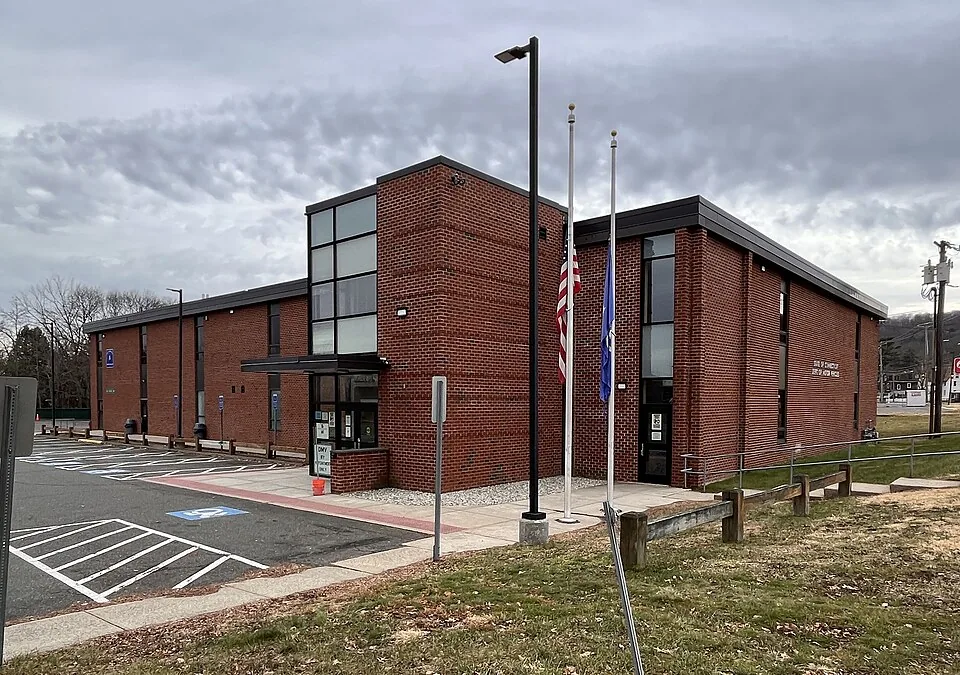

A two-story red brick building with dark flat-roof trim and a tall glass stair tower at the entrance. Two flagpoles stand in front, one with a U.S. flag at half-staff and one with a blue flag, beside a tall black lamppost. The parking lot has white stripes and a blue accessible space at the left. A wooden rail fence and brown winter grass fill the foreground, under an overcast gray sky, with bare trees. The building’s small sign is not legible. The Commons file page identifies this as the DMV office in Hamden. Connecticut’s beneficiary form is attached to the registration. The photograph shows the office. It does not show a registration or a title.
A joint line, a will, and a lien are other papers
Ohio prints the joint-owner lines on the same page as the affidavit, and they are different lines. For joint ownership with right of survivorship, the page says the names are shown as “John Doe and Mary Smith or WROS.” If both are living, each party signs. If one has died, the surviving party applies and the title is issued in the survivor’s name. A further block on that page is survivorship plus a transfer-on-death designation. The surviving owner has rights to the vehicle before the TOD beneficiary, and can keep, remove, or change the beneficiary. Keeping or changing it takes a new BMV 3811, because the ownership changed. The beneficiary receives rights only when both titled owners have died, and both certified death certificates are presented.
For joint ownership without right of survivorship, the page says the names are shown as “John Doe and Mary Smith,” with no “or WROS.” If one has died, the signature required is an executor’s or an administrator’s. The spoken “and/or” is this joint-owner line. The “or” Ohio prints is the survivorship mark, “or WROS.” The TOD affidavit is the beneficiary. California will not put a second owner on the TOD title. The manual allows one registered-owner name.
Texas splits the same two ideas across VTR-122 and VTR-121. Survivorship is the joint ownership. The beneficiary form does not make the named person a joint owner, and the named person has no interest while the owner is alive.
A will is a separate paper. The certification on VTR-121 says the owner understands that a will does not revoke or supersede the designation, regardless of when the will is made. The information page of the form repeats that note. Selling the vehicle, or filing a new designation or a revocation, is how these offices take the name off.
A lien is a separate paper, and the offices do not treat it the same way. Virginia says a beneficiary cannot be designated if a lien exists, and that the beneficiary will be removed if a lien is added. The Texas certification says the designation does not affect the interest or right of a secured or unsecured creditor, or a future creditor. A beneficiary who claims a motor vehicle subject to a lien is subject to that lien. If the current record shows a lien, VTR-121 requires a release of lien from the lienholder on record unless the lien carries forward. California’s TOD section does not say the designation removes a lienholder. An electronic lien title is still that lienholder’s record. The beneficiary line leaves the release as its own paper.
Sources
- California DMV: Transfer on death beneficiary — One registered owner and one beneficiary on the California title, the second-line TOD entry, revocation by sale or by a new title, and the countersignature and statement of facts after death
- California DMV: Registration fees — Miscellaneous fee schedule listing $10 for a transfer-on-death beneficiary designation
- Ohio BMV: Transfer a title, including transfer on death — Clerk of courts titles, sole-owner and survivorship affidavits on form BMV 3811, the printed WROS line, and what a beneficiary brings
- TxDMV: Beneficiary Designation for a Motor Vehicle, VTR-121 — Revision May 2018; who may be an owner, the survivorship prerequisite, revocation, the will note, creditor rights, the 120-hour and 180-day limits, and a lien that carries forward
- TxDMV: Rights of Survivorship Ownership Agreement, VTR-122 — Revision August 2016; joint ownership among the people who sign, transfer to the survivors, and the survivorship remark on the Texas title
- Virginia DMV: Designate a beneficiary on a vehicle title — TOD wording on the Virginia title, an individual beneficiary, a lien, cancellation on sale, VSA 18, and the 120-day application
- Indiana BMV: Transfer on death — The sentence printed on an Indiana title, the owner’s signature on the face of the title, and the death-certificate copy at a license branch
- Connecticut DMV: Renew your car registration — Renewal page pointing to the beneficiary document for a Connecticut vehicle
- Connecticut DMV: Beneficiary designation for a motor vehicle — Form attached to the registration for a vehicle owned by one person, one individual beneficiary, the witness limit, and the 60-day application
- Missouri Department of Revenue: Motor vehicle titling and registration FAQ — A transfer-on-death beneficiary named on the Missouri title application, a later change, and probate when no beneficiary was named, with a separate spouse or minor-child answer
- New York DMV: If a family member has passed away — Death transfers by a surviving spouse, surviving children under 21, or surrogate’s court letters, with no beneficiary designation filed in advance
References checked .