Published by HALOX Co.
What a USDOT number actually is
What the USDOT number lettered on a power unit identifies, when a pickup and trailer cross FMCSA's line, and how Texas, California, and Illinois treat in-state carriers.
Does my pickup need a DOT number on the door?
Not from the cab alone. The number is the identifier the Federal Motor Carrier Safety Administration keeps for a company, and when the marking rule applies it is lettered on the power unit with that company’s legal name or one trade name. A pickup hauling for a business meets the federal test when the trip is interstate commerce and the truck, or the truck and trailer together, reaches the weight, passenger, or hazmat line in FMCSA’s commercial-vehicle definition. Some states also require the number for work that never crosses a line. The letters identify the registrant. They are not a license to drive, not the operating authority an MC number stands for, not a safety rating, and not proof that an insurance filing is in force.
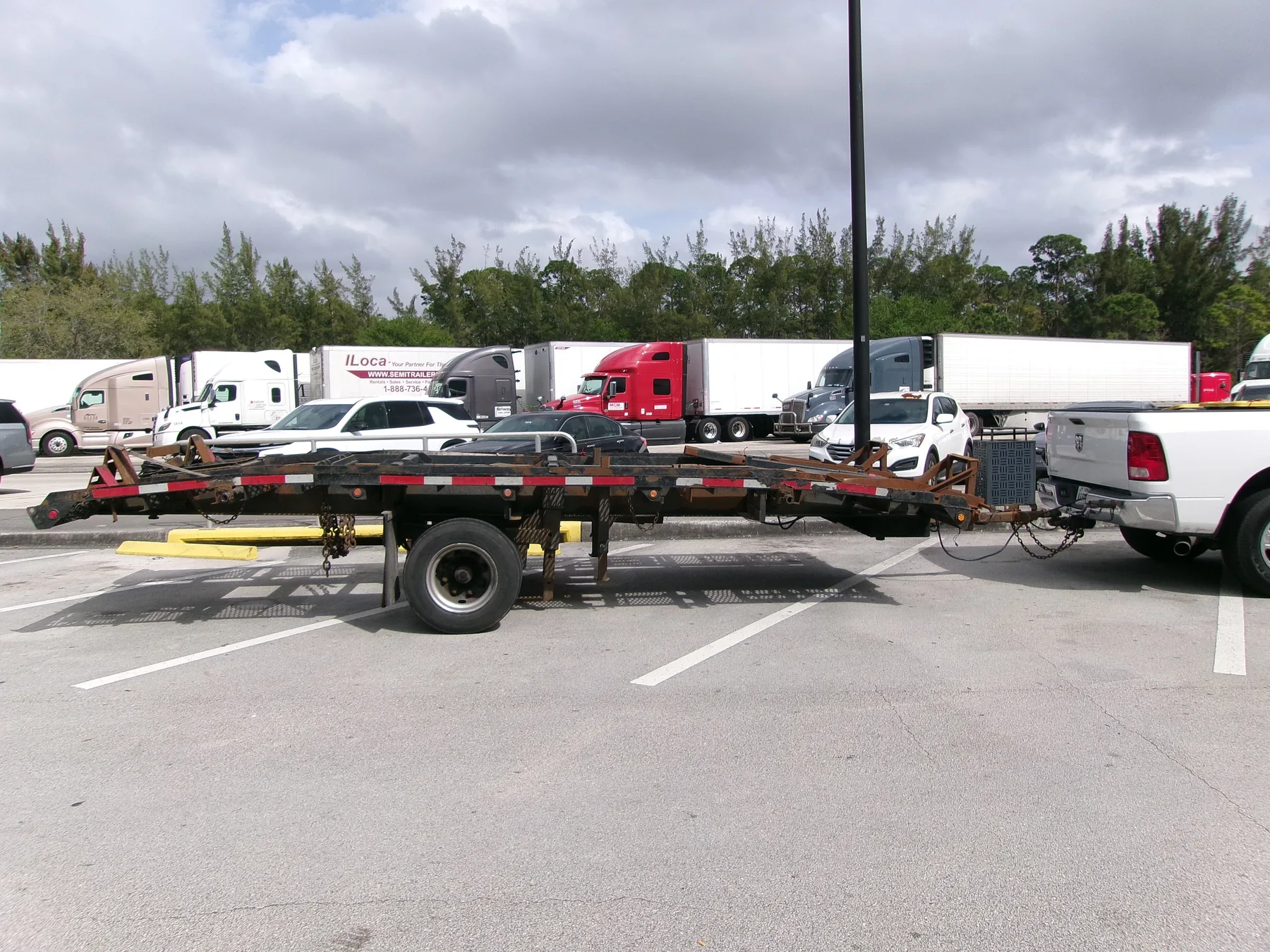

A pickup and a construction trailer in a service-plaza lot. The ratings and the loaded weight that decide the combination are not in the photograph.
What gets lettered on the power unit
FMCSA’s registration page describes the USDOT number as a unique identifier for the safety information collected in audits, compliance reviews, crash investigations, and inspections. A new number, and the upkeep of an existing one, now goes through Motus, the registration system FMCSA has put in place of its older portals. A company that already has a number claims that same number there. The record’s biennial update, and a request to inactivate or reactivate the number, are handled in that system as well. FMCSA’s account of the change says newly issued numbers are randomized, to make fraud harder, and that numbers already issued do not change. A new number can carry a suffix inside the company account so the account can tell the entity type and the registrations apart. That suffix is not a vehicle marking requirement.
The marking rule calls for two things on both sides of the self-propelled vehicle: the legal name, or a single trade name, of the motor carrier operating it, and the identification number FMCSA issued, preceded by the letters USDOT. The letters have to contrast with the background and stay readable in daylight from 50 feet while the vehicle is stationary. They can be painted on, or carried on a removable device that holds that legibility. If some other name is already on the vehicle, the operating carrier’s name is preceded by the words “operated by.”
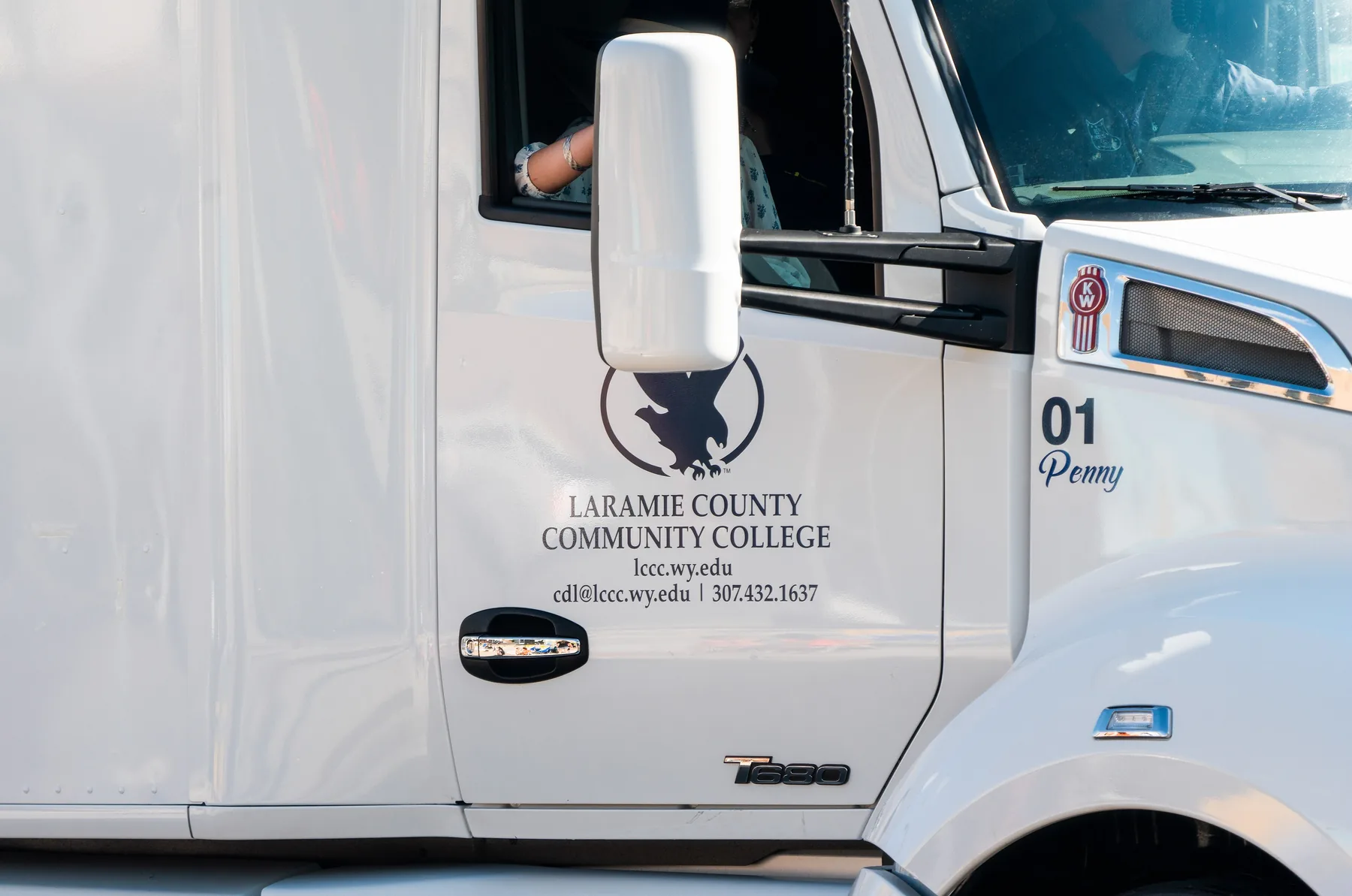

The door carries the college’s name, with a web address and a phone line under it. A USDOT number is not readable in this photograph. Extra lettering is allowed when it does not conflict with the required name and number. It does not stand in for them, and a parade truck is not a reading of whether this operation needs the number.
When a pickup and a trailer cross the line
The definition counts a vehicle used on a highway in interstate commerce to transport passengers or property. Interstate, in the words of FMCSA’s registration page, is trade, traffic, or transportation between a place in a state and a place outside it, between two places in a state through another state, or between two places in a state as part of a trip that begins or ends outside the state. The same definition calls a private motor carrier a person who transports property or passengers by commercial motor vehicle and is not for-hire, and it calls for-hire the carriage of goods or passengers for compensation. A business moving its own goods is the private case. FMCSA’s operating-authority answer does not require an MC number for private carriers that transport their own cargo. Hauling someone else’s freight for pay, or carrying passengers for compensation in interstate commerce, is the for-hire case that adds operating authority on top of the USDOT number. Motus still issues those docket numbers, and the prefixes stay MC, MX, and FF.
The weight line is 4,536 kilograms (10,001 pounds) or more, whichever is greater among the gross vehicle weight rating, the gross combination weight rating, the gross vehicle weight, and the gross combination weight. GVWR is the manufacturer’s maximum loaded weight for a single vehicle. When the power unit is towing, gross combination weight rating is the greater of two figures: a value the power-unit manufacturer specifies, if that value is displayed on the certification label, or the sum of the power unit’s and the trailer’s ratings or actual weights, taking whichever mix of those produces the highest number. The power unit’s combination rating is not used to define a commercial motor vehicle when the truck is not towing. A pickup whose own rating is under 10,001 pounds, driven without a trailer, sits outside the weight line. Hitch a trailer for the business and the combination is judged on that greater figure, and on the actual loaded weight of the combination if that weight is higher still.
Passengers are a separate way into the same definition. The vehicle is covered if it is designed or used to transport more than eight passengers, including the driver, for compensation, or more than fifteen, including the driver, and is not used to transport passengers for compensation. Hazardous materials count, at any vehicle size, when the quantity requires placards and the carriage is interstate. Separately, FMCSA’s registration page requires a USDOT number for intrastate carriage of hazardous materials in the types and quantities that need a safety permit. That intrastate case does not depend on which states, below, have added a number of their own.
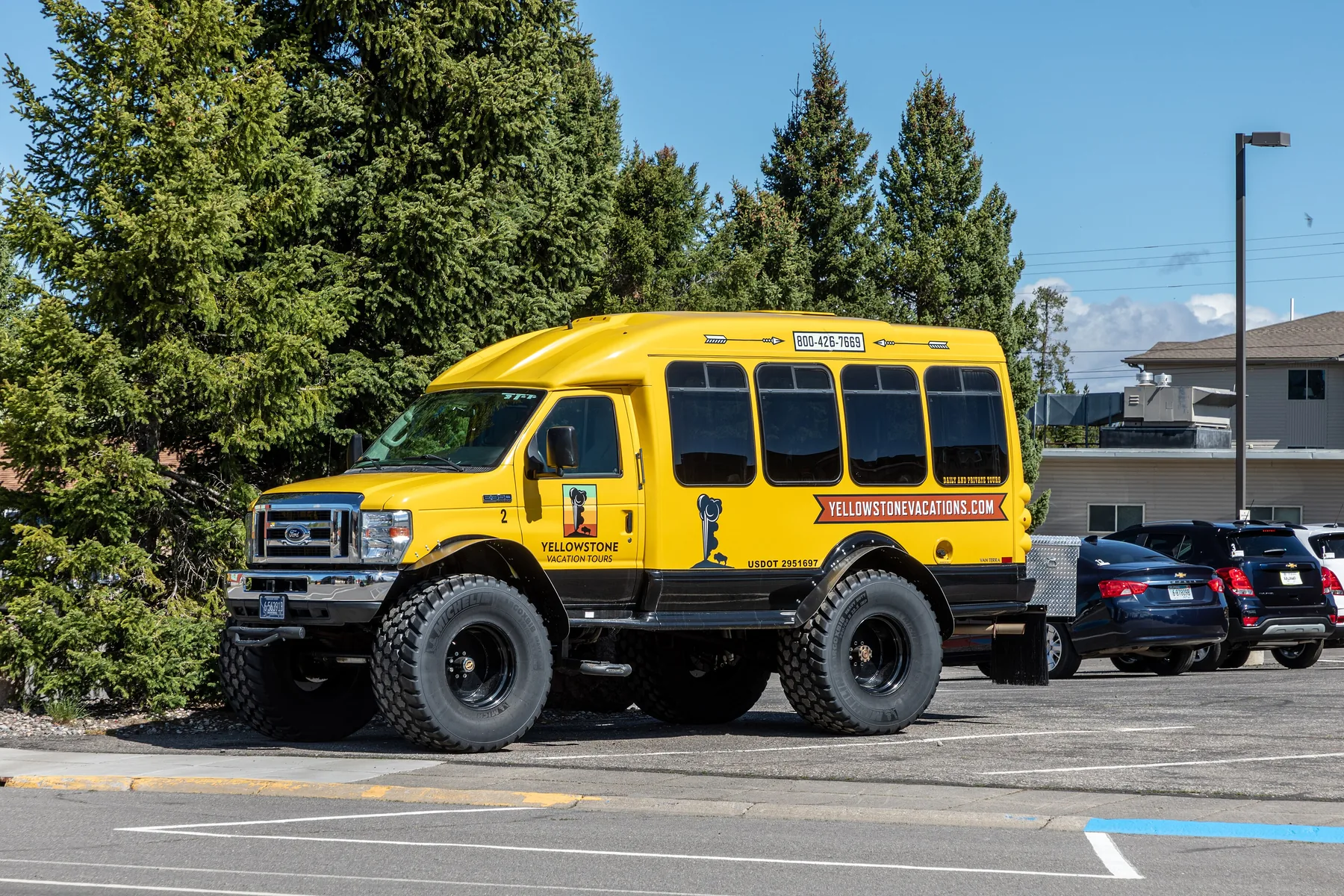

A motor coach is the passenger case, a vehicle built for far more than eight or fifteen people. The photograph does not show a number on the side, and it does not show whether anyone is being carried for compensation.
What the letters do not settle
A safety rating is an evaluation FMCSA may issue after a rated investigation, the compliance review: Satisfactory, Conditional, or Unsatisfactory. Not every investigation produces a rating. The USDOT number is how the company’s safety record is filed. Issuing the number is not that rating, and a company can hold a number with nothing in the rating field because it has not been evaluated that way.
Operating authority is the separate registration. FMCSA’s answer says companies that operate for-hire, or that transport passengers or federally regulated commodities in interstate commerce, need that authority in addition to a DOT number. The authority is what the agency calls an MC, FF, or MX number, and the same answer says the type of authority sets the level of insurance the company has to maintain. TxDMV makes the practical point on the state side of a filing: buying a policy is not enough, because the insurer’s filing has to reach the agency before authority is granted. The marking rule asks for the name and the USDOT number. It does not put an insurance filing on the door. The letters name the carrier and give the identifier. They do not show whether authority is active, whether a rating exists, or whether an insurance filing is current.
Where the states split
FMCSA’s list, on a page updated September 3, 2025, names the states that require their intrastate commercial registrants to get a USDOT number. Texas and California are on it. Illinois is not. The federal rule for intrastate hazardous materials that need a safety permit still applies in every state, list or no list.
Texas, on TxDMV’s page for becoming an intrastate carrier, starts that carrier at FMCSA for a USDOT number, then says the number is not operating authority, only an identifier. Staying inside Texas means a TxDMV certificate, which the page still describes as the former TxDOT number. Crossing a state line means interstate operating authority, an MC number, from FMCSA. Work that does both needs both. Driver licensing sits in a different office. TxDMV says it does not handle licenses or safety audits, and that those belong to the Texas Department of Public Safety. The number on the door is not the license to drive.
California splits the same two ideas under different names. The CHP’s permit FAQ says a motor carrier of property needs a carrier identification number, the CA number, which the CHP issues and which the DMV uses as the identifier for the motor carrier permit. The same FAQ says California law requires a USDOT number before that CA number can be issued, even when the carrier is not in interstate commerce and is not transporting hazardous materials. On the vehicle, a valid USDOT number may be displayed in place of the CA number, along with a PUC or Cal-T number, and a property carrier in interstate commerce must display the USDOT number. DMV’s permit FAQ matches the issuing split: the CA number comes from the CHP and is the permit’s identifier.
Illinois is the third pattern. It is absent from FMCSA’s intrastate list, and the Illinois Commerce Commission police say an intrastate carrier displays its commission license number on both sides of the power unit, while an interstate carrier displays a USDOT number. Household-goods carriers still display the commission number even when they also run interstate. The commission’s property-carrier FAQ says an intrastate-only carrier cannot operate unless the name, or a logo in place of the name, and the license number are on both sides of the cab or power unit, and that those intrastate-only rules give way to federal identification when the same carrier also operates interstate. That is the for-hire property carriage the commission licenses. It is not a finding about every pickup in the state.
Where the marking is required, the door is the company’s name and its USDOT number. Reading one pickup means the ratings, the trailer, whether the trip is interstate commerce, and which state’s rule applies when it is not.
Sources
- FMCSA: Do I Need a USDOT Number? — Identifier purpose, interstate commerce, intrastate hazardous-materials safety permit, and states that require a USDOT number for intrastate registrants; page updated September 3, 2025
- 49 CFR 390.5T: Definitions — Commercial motor vehicle thresholds, gross combination weight rating, interstate commerce, and private motor carrier
- 49 CFR 390.21T: Marking of self-propelled CMVs and intermodal equipment — Name, USDOT number, both sides of the power unit, legibility, and the operated-by line
- FMCSA: Move into Motus — Current registration system for a new USDOT number, operating authority, and biennial updates; page updated May 18, 2026
- FMCSA: About FMCSA Registration Changes — Randomized new numbers, suffixes that are not a vehicle marking, and MC, MX, and FF docket prefixes
- FMCSA: What is operating authority (MC number) and who needs it? — Operating authority in addition to a DOT number, private carriers hauling their own cargo, and insurance levels tied to authority
- FMCSA Safety Planner: Safety ratings — Satisfactory, Conditional, and Unsatisfactory ratings after a compliance review, and investigations that do not produce a rating
- TxDMV: Becoming a Texas Motor Carrier (Intrastate) — USDOT number as an identifier, TxDMV certificate formerly called a TxDOT number, interstate MC number, and insurer filing
- California Highway Patrol: Motor Carrier of Property Permit FAQ — CA number, USDOT number required before it, and display of a USDOT number in place of the CA number
- California DMV: Motor Carrier Permit FAQs — CA number issued by the CHP and used as the motor carrier permit identifier
- Illinois Commerce Commission Police — Intrastate display of the commission license number, USDOT display for an interstate carrier, and household-goods carriers
- Illinois Commerce Commission: Motor carrier property FAQ — Intrastate-only name and license number, and federal identification when the carrier also operates interstate
References checked .