Published by HALOX Co.
What a valve spring actually does
How valve-spring force loads the follower on the seat and at full lift, why a warm-up tick on a hydraulic valvetrain is the adjuster refilling, and what the Subaru, Bentley, and Hyundai papers actually check.
A tick from the top of a warming engine gets called a valve spring. The September 2012 Schaeffler Automotive Aftermarket brochure is about hydraulic lash adjustment, the INA parts that take up clearance on their own. In the majority of cases, that brochure says, noise during warm-up is not grounds for complaint. With the engine shut off, some valves can remain open, and valve spring force is what the adjuster is working against. Oil is forced out of the high-pressure chamber and comes back as the engine warms. The tick is the air cushion in that chamber being compressed.
The load, on the seat and at full lift
The layouts in the brochure are driven by the camshaft. A pushrod engine, which the brochure calls overhead valve, sends the cam stroke through a plunger, a pushrod, and a rocker. One camshaft in the head is an overhead cam. Two are a double overhead cam. The cam can work a rocker or a finger follower. A bucket tappet is the direct layout: the cam stroke passes through the bottom of the bucket, and no rocker sits between the cam and the valve. While the cam is on the lift, the brochure says the bucket is loaded by the engine valve spring force and by inertia forces.
COMP Cams’ valve-spring notes ask for the correct spring pressure in two positions, the valve on the seat and the valve at maximum lift. A cam that will run to 8,000 rpm, those notes say, does no good without the springs that match it. The page is about choosing the spring with the rest of the valvetrain.
This head shows the springs under a set of rockers.
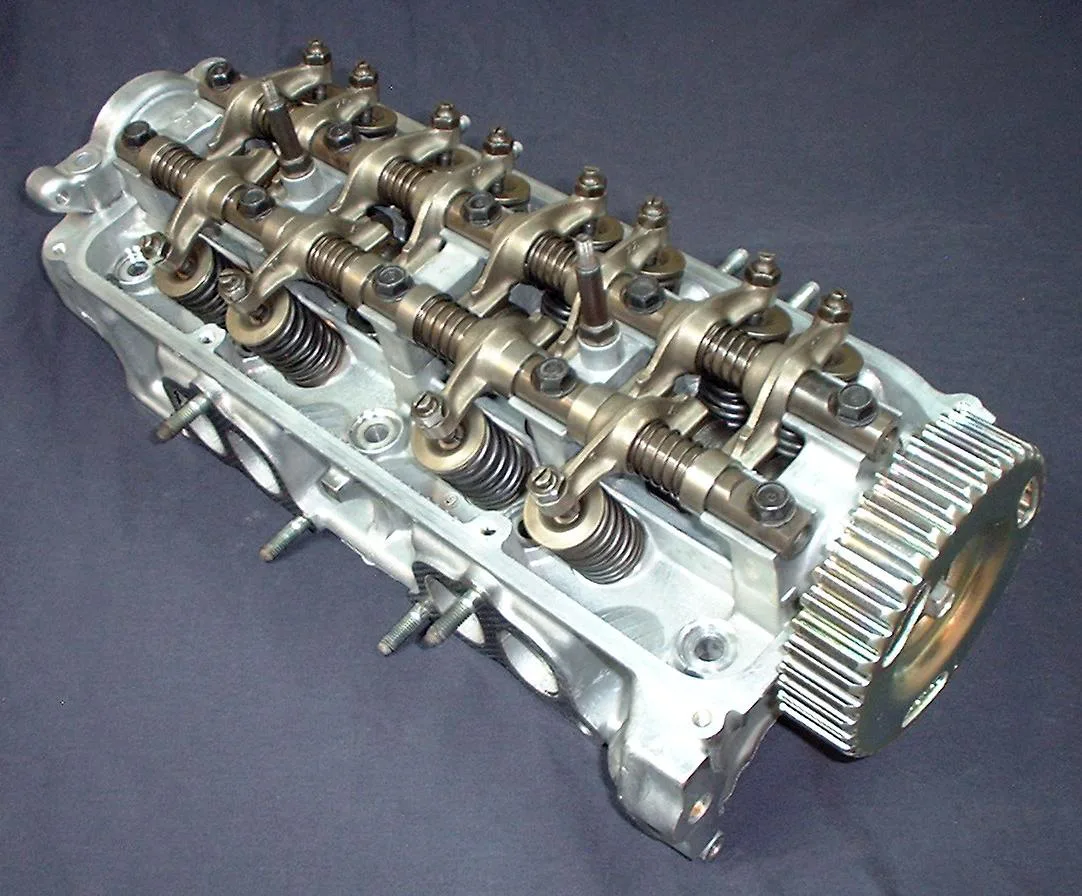

A silver cast-metal cylinder head rests on a dark blue cloth. Two shafts run the length of it, carrying the rocker arms with their screws and nuts, and a large toothed pulley sits at the right end. Dark coil springs sit under the rocker arms. Threaded studs stick out of the near side, and round ports are open along the lower face. No printed text is visible. The rockers are the pieces between the cam and the springs.
A cutaway is the direct layout, a cylinder between the lobe and the spring.
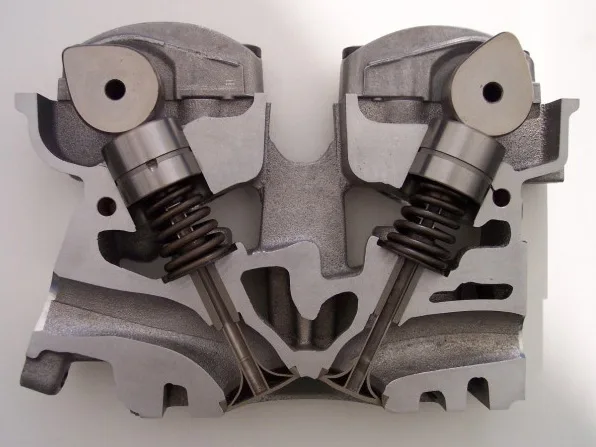

The section is a metal head on a light background. Two lobes sit at the top, and each lobe has a round hole. Under each lobe is a silver cylinder, and under each cylinder a dark coil spring surrounds a stem. The stems angle down to two valve heads. No words are printed on the piece. The spring is under the cylinder. The lobe is above it.
Keepers, a painted end, and the tight coils
On the cars in the next two bulletins, a retainer and the locks that hold it are what keep the spring on the stem.
Subaru bulletin WTY-84R, January 4, 2019, revised March 29, 2019, is NHTSA campaign 18V-722. It covers certain 2013 BRZ and XV Crosstrek cars and certain 2012–2014 Impreza cars, 139,324 vehicles in the United States, inside the production ranges the table prints. The complete ranges in that table are the 2013 BRZ from December 9, 2011, through July 2, 2013, the 2013 XV Crosstrek from May 17, 2012, through July 2, 2013, and the 2012–2013 Impreza from January 17, 2012, through June 13, 2013. The 2014 Impreza line is dated October 3, 2013. Coverage for every affected vehicle has to be confirmed on subarunet. The springs may fracture. Subaru’s result is an abnormal noise or an engine malfunction, a stall while driving, and an engine that may not restart. A stall while driving, the bulletin says, could increase the risk of a crash. The replacement springs are the ones with improved durability strength. Kit X1321AA110 is the FA engine in the BRZ. Kit X1321AA140 is the FB engine in the Impreza and the Crosstrek.
On the FA procedure and on the FB procedure, the new spring goes in with the blue painted end up, toward the retainer. Two keepers lock that retainer to the stem. The bulletin’s own failed assemblies are a keeper upside down, a keeper that has missed the groove in the stem, and a keeper that is missing. Steel spring seats stay against the aluminum head. Oil usually holds them there, and the step is to confirm they are still in place. The bulletin does the job with that piston at top dead center. If the retainer is off and the valve drops, the piston at the top of the stroke keeps the valve from falling into the cylinder. With the piston at the bottom, the valve can drop through the guide, and the head has to come off to retrieve it.
Bentley campaign EC24, transaction 2065472/5, is a different engine and a different mark on the wire. The cars are the new Continental GT, the GTC, and the new Flying Spur, in the 2021 and 2022 sales types the bulletin lists, chassis numbers 090579 through 093477. Sixteen intake springs, part 06E109623AD, and sixteen outlet springs, part 0P2109623. The bulletin says the two parts are different, and each spring goes on the valve it belongs to. Three white lines on the upper face of the intake spring face upward. Four blue lines on the upper face of the outlet spring face upward. Every spring, inlet and exhaust, also goes in with the tightest coils closest to the cylinder head. The bulletin’s word for getting that direction wrong is catastrophic valvetrain failure. The cap and the valve keys come off together. If the air supply to that cylinder is lost while they are off, the valve can drop into the cylinder.
COMP measures installed height before the spring is on the head. The valve, the retainer, and the valve locks go in, the retainer is pulled tight against the locks, and the distance is taken from the spring seat to the outside step of the retainer. That distance is from the bottom of the retainer to the surface the spring will sit on. The shortest height on the head becomes the installed height. The other valves are shimmed to it, and 0.020 inch either way is what the page allows. A dual or a triple spring has to leave room for the inner steps of the retainer. The gap from the bottom of the retainer to the top of the valve seal has to be greater than the valve lift. Short of that, the guide is machined. COMP calls the short gap a very common cause of early camshaft failure.
Coil bind is the measurement at the other end of the lift. With the valve fully open, the page wants at least 0.060 inch between the coils of the inner spring and between the coils of the outer spring. A spring that dances on the head or on the retainer, the same page says, makes harmful harmonics and wears the parts. A spring forced onto a retainer is likely to fail at that coil. A vise, pliers, or a hammer nicks the surface, and COMP says that nick is how a spring fails. A matched set of new springs may still vary by 10 percent either way.
A fracture is its own list
Schaeffler’s notes on noise from what the brochure calls inflation are a different list from the warm-up tick. A defective, fatigued, or wrong valve spring, including wrong parts mounted together, is one cause. A defective valve guide or stem is another. An overrev is the third. The valvetrain parts separate at the contact surfaces. The result the brochure states is a valve that does not close properly, a loss of performance, a burned valve, and valves that can hit the piston crown. That result belongs to this list.
Hyundai bulletin 24-01-039H-1, June 2024, recall 255, supersedes bulletin 24-01-039H. It covers certain 2024 Palisade LX2 vehicles produced from August 21, 2023, through October 12, 2023. The valve springs may fracture while driving, from fatigue cracking after the supplier damaged them in manufacturing. A fractured spring may bring a sudden loss of motive power. In rare cases a broken valve enters the combustion chamber and leaves a hole in the block. The repair in the bulletin is a replacement engine sub-assembly.
Subaru’s fracture, on the cars and the ranges in WTY-84R, is the noise, the malfunction, and the stall, and the repair is the spring of improved durability. Hyundai’s fracture is the supplier damage, the loss of power, and the rare hole, and the repair is the engine sub-assembly. The blue end and the tight coils are installation rules on the cars those bulletins name.
The head on the table uses a different arrangement of wire.
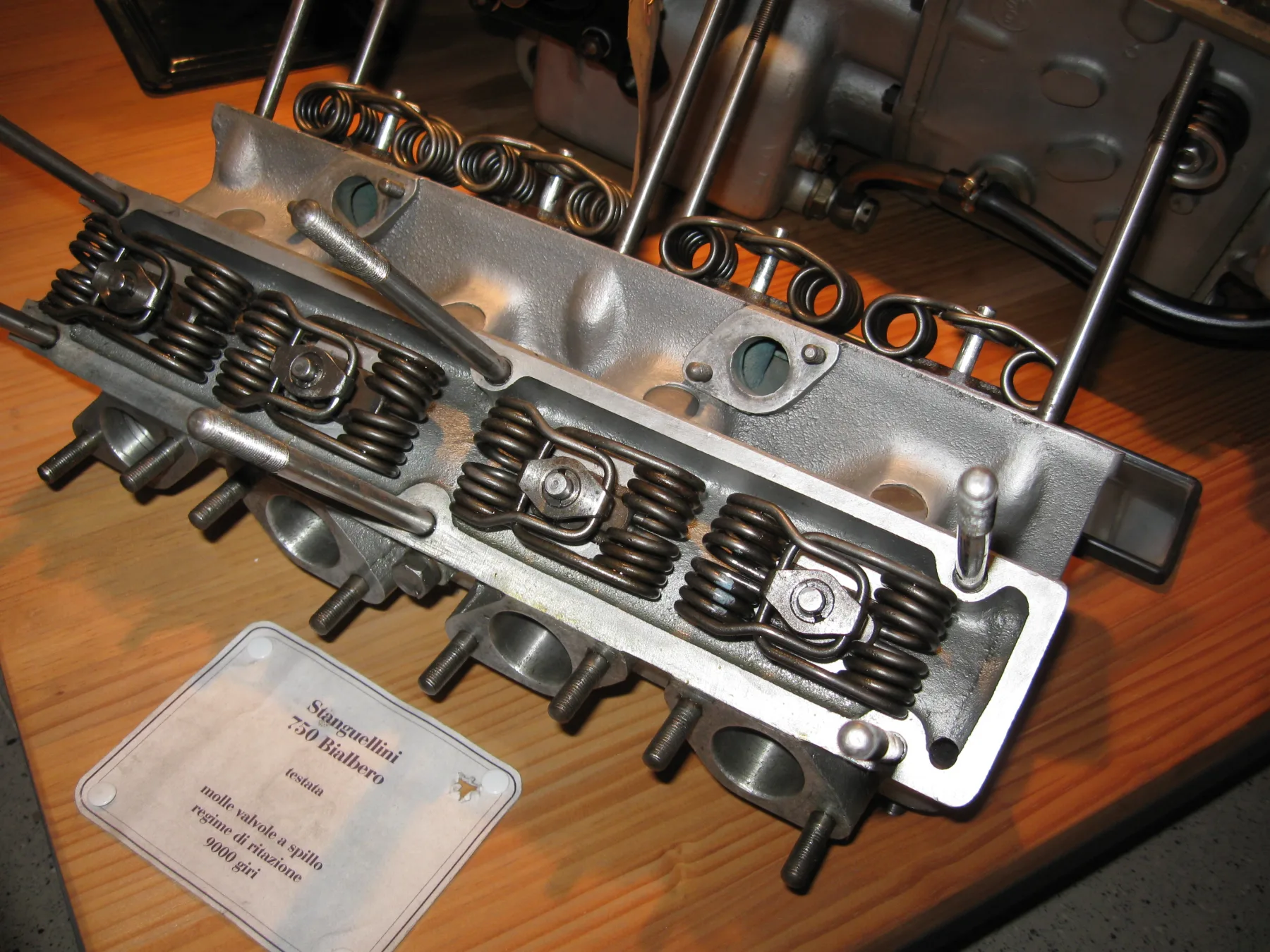

A cast-metal head sits on a light wooden table. The springs are dark wire, several coils each, with long arms, clamped under small plates and bolts. More of the same springs sit in a row along the far side. Long metal rods stand up from the casting, and two lie across it. A card in front, held with white pins, includes the lines Stanguellini, 750 Bialbero, testata, molle valvole a spillo, and 9000 giri. COMP’s 0.060 inch is the clearance between the coils of an inner spring and an outer spring, measured at full lift. Bentley’s tightest coils are the installation rule for the intake and outlet springs in campaign EC24. The wires under these plates are the springs in the photograph.
Spring force is the load the brochure puts on the bucket during the lift, and the pressure COMP wants on the seat and at full lift. The cam is what drives the layouts. A warm-up tick, a painted end, and a fractured coil are three findings, each one on the paper that describes it.
Sources
- Schaeffler Automotive Aftermarket, September 2012: Valve Train Components — Brochure on INA hydraulic valve-lash parts, information only and not legally binding; charge exchange by intake and exhaust valves; OHV with a plunger, pushrod, and rocker, OHC, and DOHC, all driven by the camshaft; direct bucket actuation with the cam stroke transmitted through the bottom of the bucket and no mechanism between cam and valve; during cam lift the bucket loaded by engine valve spring force and inertia forces; warm-up noise in the majority of cases not grounds for complaint, some valves remaining open with the engine off while valve spring force adjusts lash and oil leaves the high-pressure chamber, the tick from the air cushion; inflation noise from a defective, fatigued, or wrong valve spring including wrong parts mounted together, a defective guide or stem, or an overrev, with the contact surfaces separating and the valve failing to close properly, performance loss, a burned valve, and valves hitting the piston crown
- COMP Cams: Valve Springs 101 — Correct spring pressure with the valve on the seat and at maximum lift; a cam that will rpm to 8000 doing no good without the matching springs; a spring that dances on the head or retainer causing harmonics and wear; a spring forced onto a retainer likely to fail at that coil; steel and titanium retainers, hardened spring-seat cups, and inside-diameter locators; nicks from a vise, pliers, or a hammer as a cause of failure; double and triple springs separated with plastic to protect the shot-peened surface; new springs in a matched set allowed to vary by 10 percent either way; installed height from the bottom of the retainer to the spring seat, measured with the valve, retainer, and valve locks to the outside step of the retainer; the shortest height used for the head, other valves shimmed within 0.020 inch, inner retainer steps allowed for on a dual or triple; retainer-to-seal distance greater than valve lift or the guide is machined, called a very common cause of early camshaft failure; at full lift at least 0.060 inch between the coils of the inner spring and of the outer spring
- Subaru bulletin WTY-84R, revised March 29, 2019: 2.0L engine valve spring fracture — NHTSA ID 18V-722; certain 2013 BRZ, 2013 XV Crosstrek, and 2012–2014 Impreza vehicles, 139,324 in the United States, inside the production ranges the table prints, with coverage confirmed on subarunet; fracture may cause abnormal noise or engine malfunction, a stall, and an engine that may not restart, and a stall while driving could increase the risk of a crash; remedy springs of improved durability strength; FA kit X1321AA110 for the BRZ and FB kit X1321AA140 for the Impreza and Crosstrek; blue painted end up toward the retainer on the FA and FB procedures; two keepers on the retainer, with the bulletin’s failed assemblies a keeper upside down, a keeper missing the stem groove, or a keeper missing; steel spring seats confirmed against the aluminum head; the piston at top dead center so a dropped valve is stopped, and at bottom dead center the valve can fall through the guide
- Bentley campaign EC24, transaction 2065472/5: V8 valve spring replacement — New Continental GT, GTC, and new Flying Spur in the 2021 and 2022 sales types the bulletin lists, chassis range 090579 through 093477; 16 intake springs 06E109623AD and 16 outlet springs 0P2109623, the two parts different and fitted to the matching valves; three white lines on the intake spring’s upper face upward, four blue lines on the outlet spring’s upper face upward; tightest coils of every inlet and exhaust spring closest to the cylinder head, with the bulletin’s result for getting that wrong named catastrophic valvetrain failure; valve-spring cap and valve keys removed together; loss of air pressure to the cylinder while they are off allowing the valve to drop into the cylinder
- Hyundai bulletin 24-01-039H-1, June 2024: Lambda 3.8L engine sub-assembly, recall 255 — Supersedes 24-01-039H; certain 2024 Palisade LX2 vehicles produced from August 21, 2023, through October 12, 2023; valve springs may fracture while driving from fatigue cracking after the supplier damaged them in manufacturing; a fractured spring may cause a sudden loss of motive power; in rare cases a broken valve enters the combustion chamber and leaves a hole in the block; the repair is replacement of the engine sub-assembly
References checked .