Published by HALOX Co.
What an apportioned plate actually is
What IRP, Inc. means by one plate and one cab card, and how Wisconsin, Oregon, Washington, and California count the plates, list the cab card, and set the weight line.
The plate says Apportioned. Which registration is that?
IRP, Inc. describes the International Registration Plan as a registration reciprocity agreement among the 48 contiguous states, the District of Columbia, and ten Canadian provinces. A commercial motor vehicle with a combined gross vehicle weight of more than 26,000 pounds (11,794 kilograms), traveling in two or more of those jurisdictions, is likely registered under the plan. The vehicle is registered in its base jurisdiction. Fees are based on the percentage of distance traveled in each jurisdiction, according to that jurisdiction’s fees. The base jurisdiction issues an apportioned license plate and a cab card, and IRP, Inc. says those credentials allow the vehicle to travel through all member jurisdictions.
The Plan’s page states the same credential from the other direction. License fees are paid on the basis of total distance operated in all jurisdictions, and still only one license plate and one cab card are issued for each fleet vehicle. That vehicle is an apportionable vehicle. So far as registration is concerned, it may be operated both between jurisdictions and inside a jurisdiction.
The state pages are where that credential becomes a plate, and they do not all issue the same number of plates or describe the cab card the same way. The photographs below are plates. None of them shows a cab card.
Wisconsin issues one plate
Wisconsin’s IRP page registers fleets that travel in two or more member jurisdictions. The members on that page are the states except Alaska and Hawaii, the District of Columbia, and the Canadian provinces except the Northwest Territories, Nunavut, and Yukon. The carrier registers the vehicles in its home, or base, jurisdiction. Wisconsin issues one registration cab card and one license plate for each vehicle in the fleet.
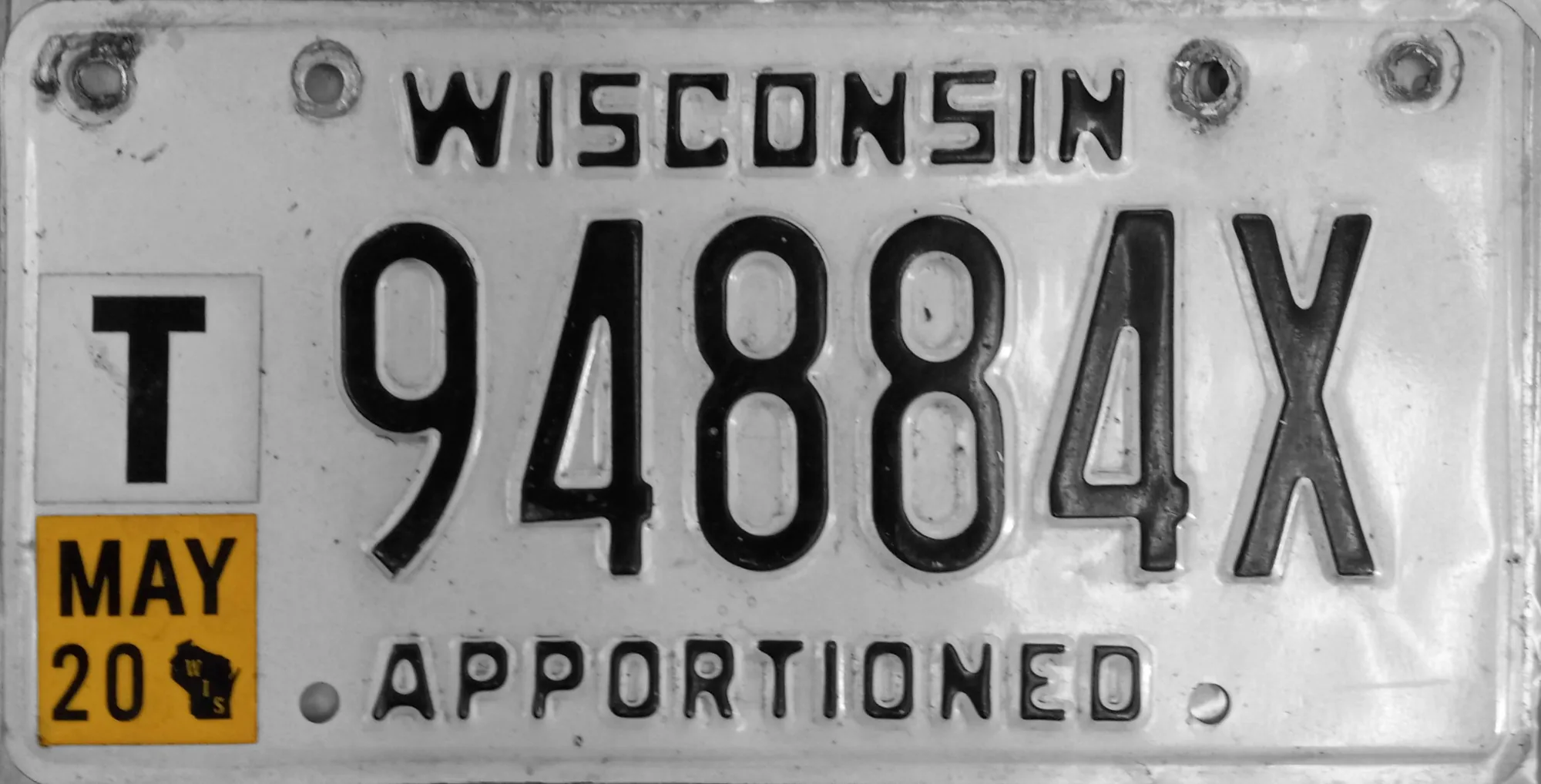

Wisconsin at the top, Apportioned along the bottom, and the number 94884X in the center. Registration stickers sit at the upper right and the lower right. This photograph does not resolve a month or a year on them. The plate count in the photograph is the one plate the page names.
Vehicles registered under IRP are registered for vehicle registration purposes only. The same page says the registration does not stand in for operating authority, for vehicle size and weight limits, for motor fuel or road tax licensing and reporting, or for an insurance filing.
A qualified motor vehicle on that page transports persons or property, travels in two or more IRP jurisdictions including Wisconsin, and meets one of three tests. The registered gross vehicle weight or the actual weight is in excess of 26,000 pounds, for a property-carrying vehicle. Or the power unit has three or more axles regardless of weight, and that line includes buses. Or the vehicle is used in combination and the actual weight of the combination exceeds 26,000 pounds. Those figures are a registered weight or an actual weight. GVWR is the manufacturer’s rated loaded weight for a single vehicle, and this page does not use that term.
A vehicle that weighs less than 26,001 pounds, and that operates intrastate in a jurisdiction other than the base, still needs registration for that jurisdiction. The page says carriers often register that vehicle through IRP instead of taking a separate non-apportioned registration in each place.
Charter buses have their own line. Beginning in 2016, a charter bus carrier engaged in interstate travel uses IRP credentials for its qualified motor vehicles. The page says the earlier exception is no longer valid, and that all states and provinces have implemented the change.
The exempt list, which the page says may operate statewide in all jurisdictions, includes government-owned vehicles, trailers and semi-trailers, and recreational vehicles such as motor homes that are not used in connection with a business. It also includes vehicles displaying restricted plates. The examples are equipment plates, dealer plates, and farm plates. Minnesota does not recognize Wisconsin’s farm plates, and Wisconsin does not recognize Minnesota’s farm plates.
A 72-hour trip permit, bought online or from a permitting service, can be used instead of an IRP registration. The apportioned plate is the registration. The trip permit is the temporary substitute the page names.
Wisconsin participates in the federal Performance and Registration Information Systems Management program. If a carrier receives a federal out-of-service order for unsatisfactory safety compliance, IRP and IFTA are suspended until that order is lifted.
The application asks for a USDOT number in the exact legal name of the registrant. Current, on this page, means the MCS-150 has been updated on the two-year schedule FMCSA requires. That number is the identifier in the USDOT post. The word Apportioned on this plate is the registration.
Oregon prints the word on the bottom
Oregon’s IRP page registers fleets that travel in two or more member jurisdictions and issues one registration cab card and license plates for each vehicle. Vehicles registered under IRP are registered for vehicle registration purposes only. The carrier is based in Oregon, with a physical address in Oregon. A qualified vehicle operates in two or more states or provinces, including Oregon, and meets one of three tests: registered gross vehicle weight or actual weight in excess of 26,000 pounds for a property-carrying vehicle, a power unit with three or more axles regardless of weight including buses, or a combination whose actual weight exceeds 26,000 pounds. Charter bus carriers engaged in interstate travel use IRP credentials for qualified motor vehicles.
The Commerce and Compliance Division manual, revised October 2024, describes the plate. Oregon’s IRP plates have the word Apportioned imprinted at the bottom. A power unit that can carry a load without a trailer, a solo truck or a dump truck, is issued two plates. A power unit that cannot carry a load without a trailer, a tractor, is issued one plate, placed on the front of the vehicle.
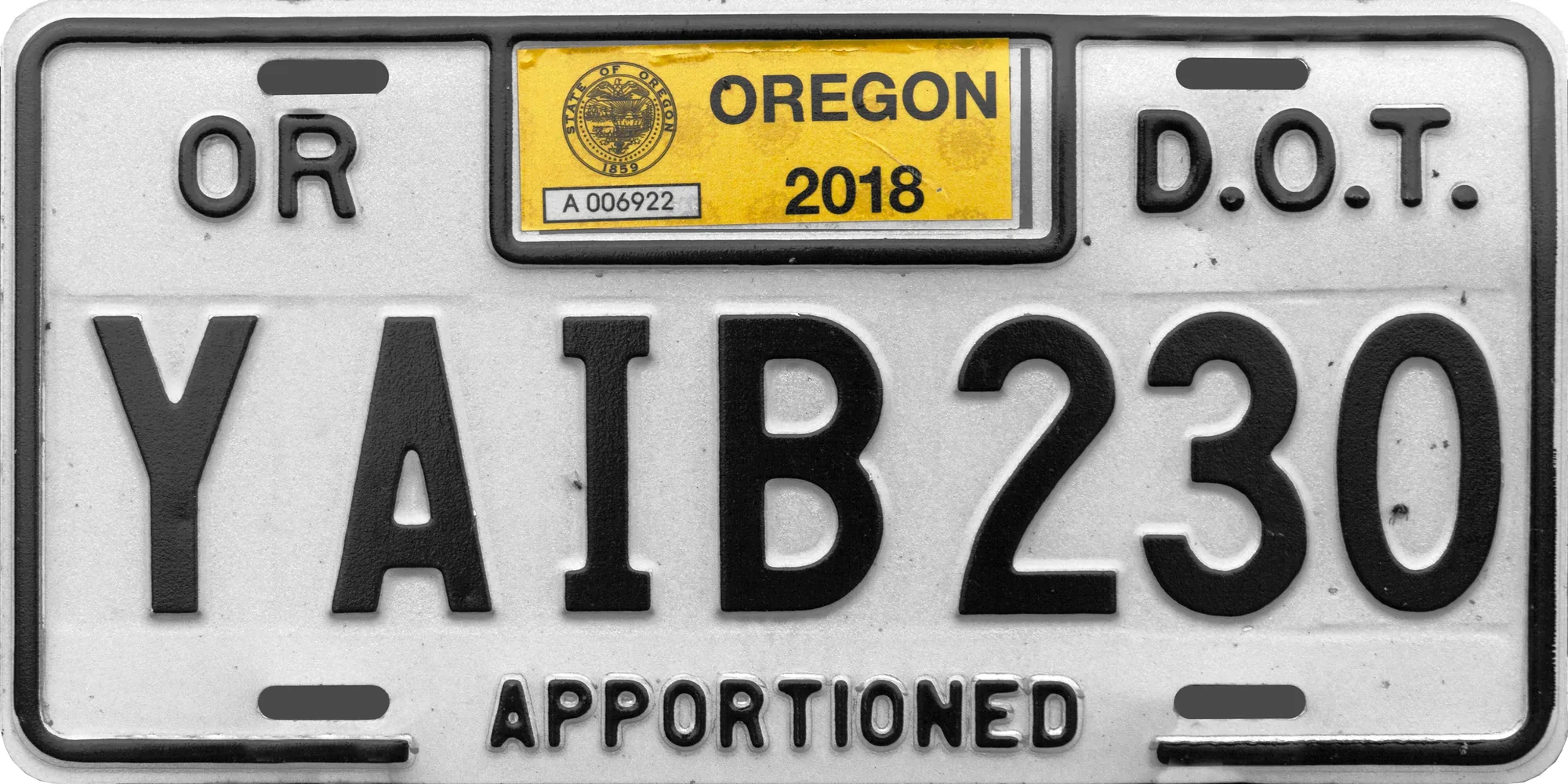

Oregon at the top, Apportioned at the bottom, D.O.T. in the upper right, and stickers that read DEC and 2019. The word at the bottom is the imprint the manual names. The manual does not describe the D.O.T. corner or these stickers. The 2019 sticker is the validation in the photograph. The manual’s revision date is October 2024.
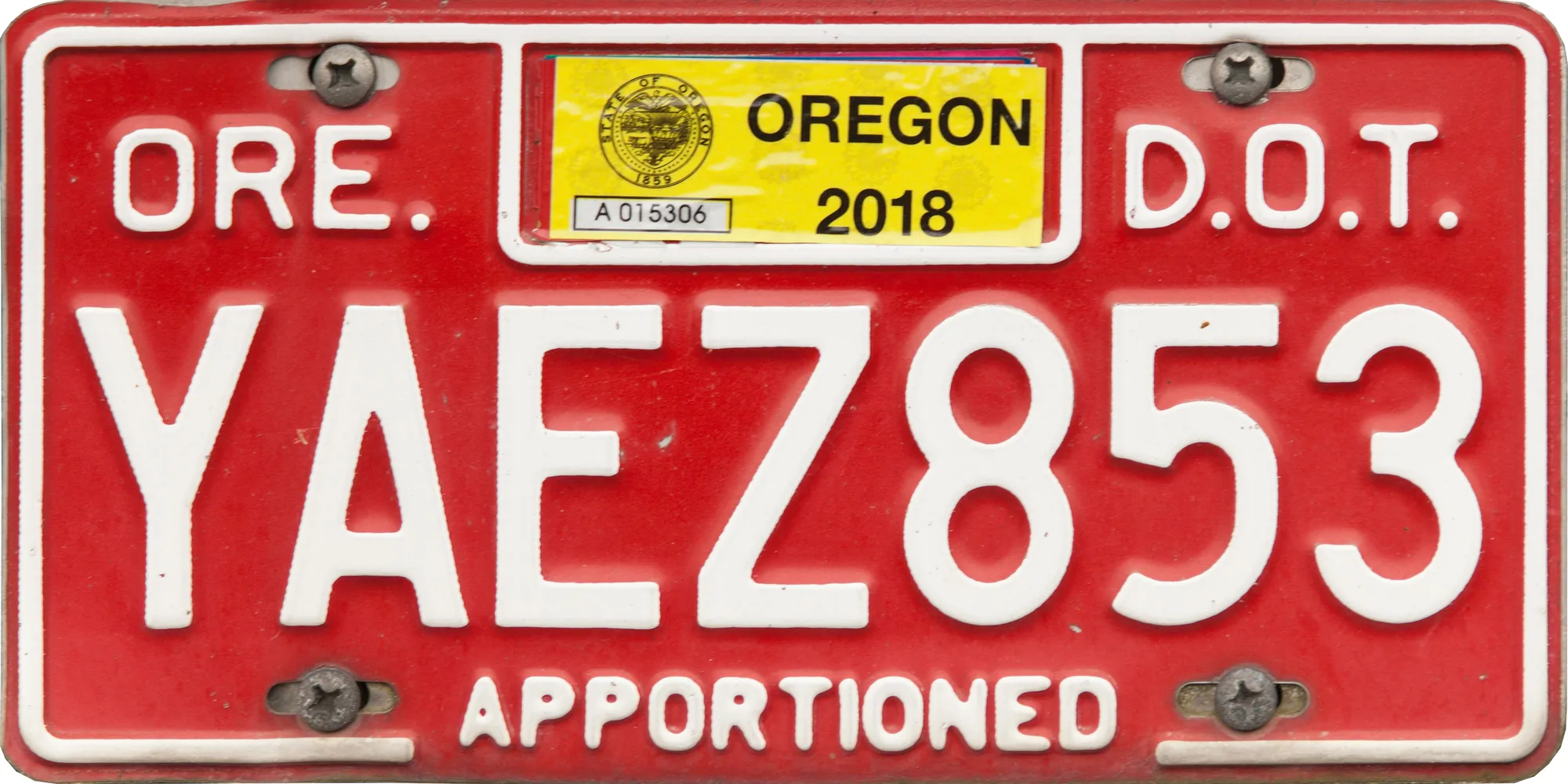

The same word at the bottom, in white on red, with the number 12345. This plate has no D.O.T. in the corner. The manual does not sort the red plate from the black-on-white plate. Neither photograph shows the plate mounted, so neither one shows the single front plate for a tractor or the pair for a solo truck or a dump truck.
Under that manual, Oregon issues one cab card and a single plate or a pair of plates, with decals, for each vehicle. The plate or plates, the decals, and the cab card are the registration credentials for the member jurisdictions. The cab card, which the manual also calls a registration card, lists the weights requested for each jurisdiction. The manual’s member exceptions are Alaska, Hawaii, the Northwest Territories, Nunavut, and Yukon. The District of Columbia is on the member list in that manual.
The same section says apportioned registration does not waive operating authority in a state or province where the vehicle travels, does not replace the International Fuel Tax Agreement, does not allow the vehicle to exceed maximum length, width, height, or axle limits, and does not exempt a carrier from filing proof of liability coverage where a jurisdiction requires it. Oregon’s IRP page adds a separate stop under PRISM. A federal out-of-service order for unsatisfactory safety compliance suspends IRP registration until the order is lifted.
Washington issues a pair, and the card names every member
Washington’s Department of Licensing calls IRP the way to license commercial vehicles in more than one state or province. Each registered vehicle gets one set of apportioned license plates, for the front and the back, and an original cab card. The plates are not transferable when the vehicle is sold. They are returned to the department. That return is a different transaction from a California plate transfer, which reassigns a special plate to another vehicle.
The cab card on this page displays all states and Canadian provinces participating in IRP, and it authorizes travel in those jurisdictions. The carrier is charged for jurisdictions where the vehicle has actual travel. The original cab card must be in the vehicle at all times. A fax and a photocopy are not valid. Oregon’s October 2024 manual describes a card that lists the weights requested for each jurisdiction. Washington’s page describes a card that names every participating member.
The page’s list of who may apply has four lines. Commercial vehicles over 26,000 pounds gross vehicle weight, in two or more jurisdictions. Vehicles with three or more axles, regardless of weight. A combination whose total weight exceeds 26,000 pounds gross vehicle weight or registered gross vehicle weight, and that line sets aside recreational vehicles, restricted farm plates, government-owned vehicles, and school buses. And vehicles titled in Washington that operate in two or more jurisdictions. The MCS-150 on this application is updated every two years.
California keeps one plate from the base state
California DMV calls IRP an option for a commercial vehicle used in two or more states. Interstate operation is under a single registration plate and a registration certificate, the cab card, issued by the base state. The fees are pro-rated from the percentage of highway mileage traveled in each jurisdiction.
Most California-based commercial vehicles operating at a gross vehicle weight or combined gross weight of 26,001 pounds or more must have either IRP registration or alternative commercial trip permits from the other jurisdictions when they operate outside California. A vehicle at 26,000 pounds or less, operating strictly interstate, may be exempt from IRP or from those temporary permits under reciprocal agreements. The page still says to contact the other jurisdiction when the carrier does not file for IRP. California’s line at 26,001 pounds, Wisconsin’s line in excess of 26,000 pounds, and IRP, Inc.’s line at more than 26,000 pounds combined are three statements. Each page prints its own.
The base jurisdiction on the California page is the jurisdiction where the registrant has an established place of business. That place is a physical location, owned, leased, or rented by the registrant, with a street number or road location, open during normal business hours. Mileage is accrued from it, and the fleet’s operational records are kept there or can be made available. At least one person employed by the registrant conducts the business there. A rented desk in a building the registrant does not own, lease, or rent does not qualify. The address of a registration service does not qualify. For an owner-operator, the established place of business may be the home address.
An IRP registration is good for 12 months, starting on the first day of the assigned month, and the fleet is renewed annually. The application asks for the USDOT number of the person responsible for the safe operation of the vehicle, and for an MCS-150 updated within the last 12 months. That interval is the one California prints. Washington and Wisconsin print a two-year update. The number is the USDOT number.
The plate and the cab card are the registration. A title is the ownership record. Reading one truck means which jurisdiction issued the plate, how many plates that jurisdiction puts on the vehicle, the weight test that jurisdiction prints, and the separate papers for operating authority, fuel-tax licensing, and insurance.
Sources
- International Registration Plan, Inc. — Reciprocity among the 48 contiguous states, the District of Columbia, and ten Canadian provinces; combined weight over 26,000 pounds in two or more jurisdictions; base-jurisdiction plate and cab card
- IRP, Inc.: The Plan — One license plate and one cab card for each fleet vehicle, the apportionable vehicle, and operation between jurisdictions and inside a jurisdiction
- Wisconsin Department of Transportation: International registration plan (IRP) — One cab card and one plate, qualified-vehicle tests, exemptions including restricted farm and dealer plates, charter buses, the 72-hour trip permit, PRISM suspension, and the USDOT number on the application
- Oregon Department of Transportation: Oregon IRP Registration — Oregon basing, qualified-vehicle tests, charter buses, registration for registration purposes only, and PRISM suspension of IRP
- Oregon Commerce and Compliance Division: Motor Carrier Registration and Tax Manual — October 2024 manual; Apportioned imprinted at the bottom of the plate, one plate or two, cab card weights, member exceptions, and what apportioned registration does not replace
- Washington State Department of Licensing: Register for IRP (prorate) — A front-and-back plate set, plates returned on sale, a cab card naming every member jurisdiction, the original card in the vehicle, and who may apply
- California DMV: International Registration Plan — One plate and cab card from the base state, the 26,001-pound line, the 12-month credential, the established place of business, and the USDOT number on the application
References checked .