Published by HALOX Co.
What an engine mount actually does
How a mount holds a shaking, twisting engine off a quiet body: rubber that springs and damps, fluid for the larger shake, an active mount that cancels, and a torque rod that limits roll.
The block is a mass that shakes, and a mass that tries to twist every time a cylinder fires. The body around it is where someone is trying to hold a conversation. The mount is the piece that has to hold both of those at once.
Sumitomo Riko’s explainer gives the rubber two roles. One is support. The other is cutting the vibration and shock that come from the engine and from the road. Take that rubber away and the same account is blunt about the result: the vibration is transmitted straight into the cabin, and the car stops being usable as a car. Vibracoustic’s 2018 note walks one mount through the day. Sitting still, it bears the engine’s static weight. On start-up it reduces the noise of the combustion engine, isolates low-frequency vibration, and supports the drive torques. On a rough road it damps what comes up from the surface. In braking and cornering it keeps the engine’s dead weight from shoving the car’s dynamics around. In a crash it has to keep the engine stable in position.
Rubber that has to spring and to damp
The motor-mount page builds the part the same way under the engine or under the transmission: a support arm, an isolation element, and a connection on the body. The isolation element is a rubber spring. It dampens vibration, it supports drive torque, and it isolates noise while the engine is starting. That page is where the mount is credited with stopping the boom, and with taking the shock when the load changes.
Sumitomo Riko’s account of the rubber itself is a spring and a damper in the same piece. It expands and contracts the way a coil does, and it damps a force coming in from outside. A coil on its own leaves the body shaking after the hit. A damper on its own passes more of the road, and more of the engine, through into the structure. The rubber is asked for both, and the rate can be different fore and aft, side to side, and up and down, so a small part can be tuned to the car it is in. The limit in that explainer is the one the hydraulic mount is built to get past: rubber by itself only goes so far toward a soft rate and a high damping force at the same time. Most of what you see from the outside is metal, because the mount is holding an engine that the same note puts between 100 kg and 300 kg. It also has to keep that mass from striking something else when the wheel is turned hard or the brakes come on in a hurry. In a collision, Sumitomo Riko says, the rubber is meant to break, so the nose still has a crushable zone. Holding the engine, and then getting out of the way, are both drawn into the part.
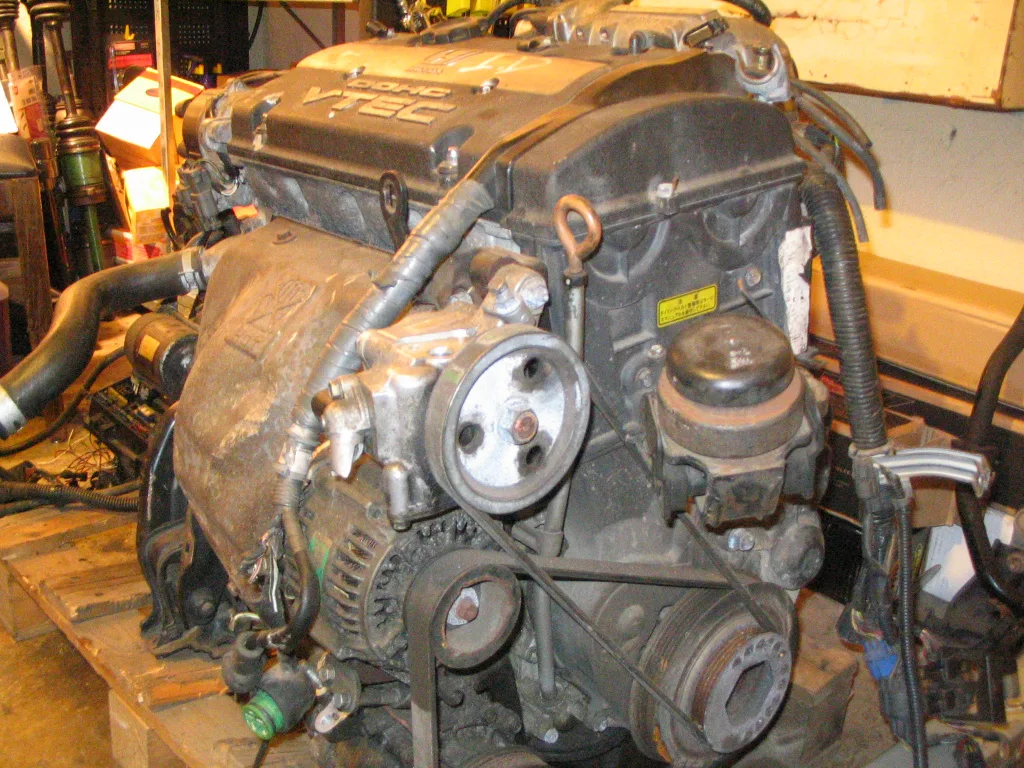

The mount on this engine is the black round-topped block on the bracket at the timing-belt side, next to the yellow warning label.
The other end of the same connection is on the body. On a transverse engine that end often sits up on the frame rail, where a bracket bolts the rubber to the structure.
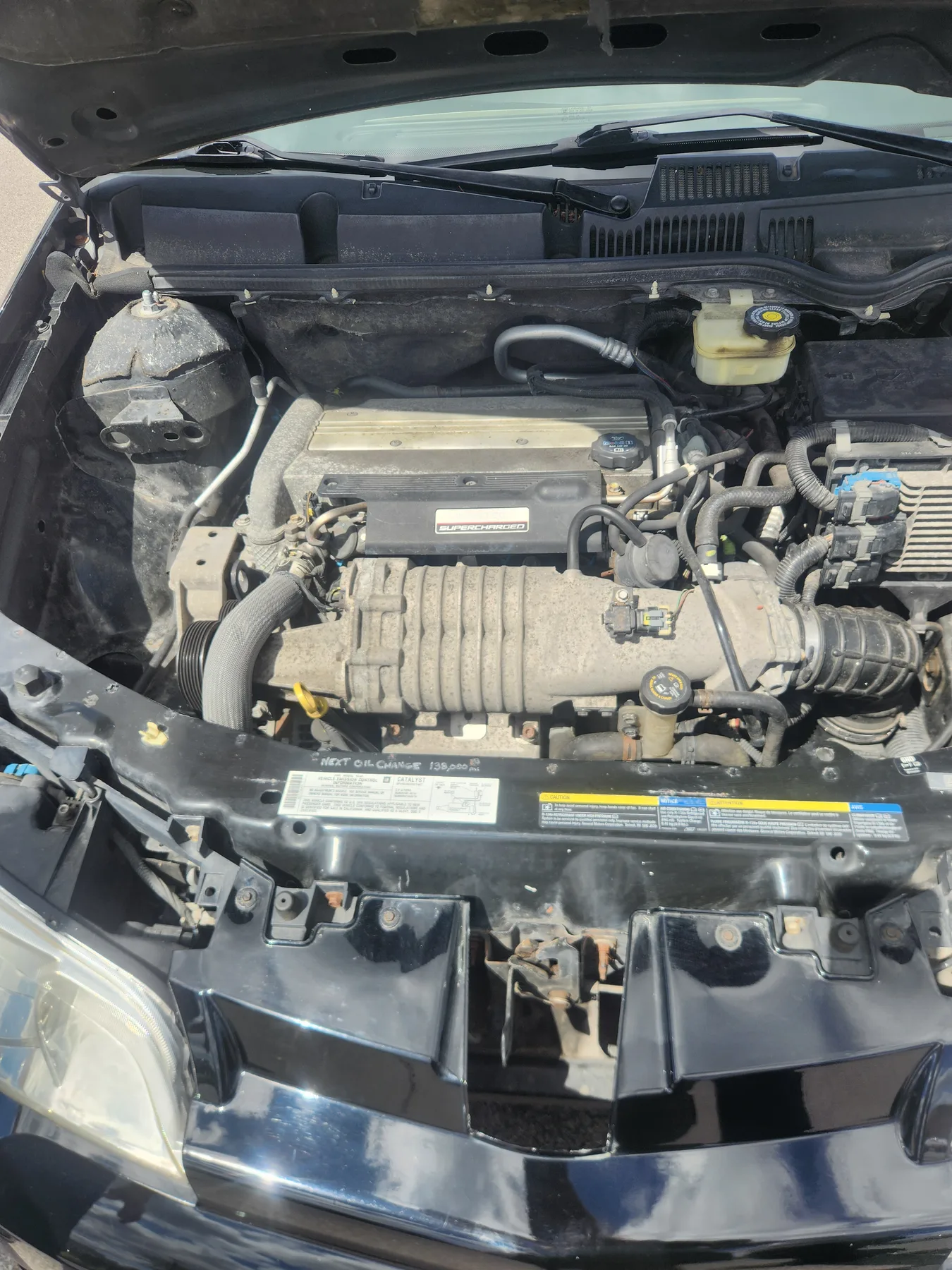

In this bay that body-side piece is the black round mount at the upper left, with a three-hole bracket, on the frame rail.
Fluid, and then a signal
Idle and a broken road are not the same shake. One is small and quick. The other is larger, and it arrives from the tires. Sumitomo Riko’s way past the rubber’s limit is liquid in the mount, in what they call an adaptive hydraulic engine mount: the low rate of the rubber, plus damping from the fluid as it moves. The hydro-mount page draws that as hardware. The mount keeps the acoustic isolation of a conventional rubber mount and adds the damping of a hydraulic fluid. An upper chamber and a lower chamber are tied together by channels, with a rubber membrane sitting in a cage between them. At the small amplitudes of idle the membrane moves, and the mount stays very soft. When the shake from the road is larger, the cage stops that membrane and the fluid is sent through the main channel. The flow is the damping. A vertical stopper in thermoplastic elastomer, with a corrugated face, is there so a hard impact stops short of metal on metal.
Driving wants the other setting from a quiet idle. The switchable-mount page opens a central bypass, electrically or pneumatically, to drop the dynamic stiffness while the engine is idling. On the road the bypass closes, and the main channel does the damping. The main rubber spring is still what sets the stiffness in the radial direction.
A passive mount has the tune it was given. The systems page ties a rise in vibration to downsized engines, to cylinder deactivation, and to higher combustion pressure, because the time between ignitions gets longer. A conventional mount, that page says, is not always able to take the disturbance out.
The active version on the active hydro-mount page is still a hydraulic mount. Added to it are an actuator, an analog acceleration sensor, and a control unit. The sensor reads the excitations coming off the engine. The control unit works out a compensation movement in real time, at the same frequency as the vibration, and sets the phase so that movement is not passed into the chassis. It hands the movement to the actuator. The road and the engine still split. At low frequency and high amplitude, the input that comes off the road, the liquid damps the engine the way a conventional mount would. At high frequency and low amplitude, from idle through full load, the inertia of the fluid keeps a conventional hydro mount from following. The actuator then moves, changes the pressure in the fluid, and changes the dynamic stiffness. The page puts that work between 20 and 200 Hz. The reduction it states is up to 20 dB under partial load and up to 15 dB under full load.
Sumitomo Riko’s active control mount comes at the same job from the signal. An electrical signal follows the engine’s revolutions. An actuator in the bottom of the hydraulic mount adds a vibration opposite the engine’s, so the shake is cancelled on the way to the driver’s seat. The drawing in that explainer is the seat moving with the engine, and then the seat still. The mount is programmed for the vehicle, and it responds to the situation the car is in. The systems page places this kind of control most often on a three-point or four-point longitudinal installation, and also on a pendulum or a central mount, wherever the excitation is strongest. The same page says that control can be applied to the high-frequency vibration of a hybrid or an electric motor.
The rod that limits the roll
Set the engine in sideways and the torque tries to roll it in the bay. The torque-rod page says most transverse drivetrains are hung as a pendulum of up to three torque rods. A torque rod, which that page also calls a torque roll restrictor, restricts the motor’s roll while torque is being transferred. On a hybrid, recuperation rolls the motor the other way, so the rod has to take the roll in both directions. The rod is also a path for vibration and noise into the chassis. A tuned mass on it is there for the rod’s own resonance: when the engine excites that resonance, the mass is what the page says keeps the boom out of the cabin. Sumitomo Riko points at the part, a shape like a dumbbell, and calls it a torque rod. When the engine starts, the rolling force moves the block back and forth, and the rod is what reduces that movement. The systems page treats the mounts and the rods as one tune.
A clunk, or a boom in gear, is a check a bulletin writes for the vehicles it names.
On the 2007–2012 CX-7, Mazda bulletin 01-011/14 is about a clunk from the engine compartment over a rough road or a speed bump, the kind that can show up when the ambient temperature is high. The cause it gives is heat. Lubricant inside the No. 3 engine mount rubber may stop working, so the casing and the rubber stick and slip. The bulletin says there is no seepage from the mount. It is a check for that noise, on those vehicles.
Chrysler bulletin 09-003-14 is the 2014 Cherokee with the 2.4L and two-wheel drive. The condition it names is a strong vibration and a loud boom in reverse, on a cold high idle above 1,100 rpm with coolant under 70°F (21°C). The part it points at is the rear engine mount, at the nut that fastens the mount to the torque strut bracket.
Between a powertrain that shakes and twists and a body that is supposed to stay put, the mount is the compliant piece. The rubber holds the weight and takes the drive torque. The fluid is what lets that mount stay soft for a small idle shake and damp the larger shake from the road. The actuator is the next step, when the gap between firings gets long enough that a passive mount cannot finish the job. The torque rod is the link that limits the roll once the engine is sitting sideways.
Sources
- Vibracoustic: lightweight engine mount — 10 September 2018 note: stationary, the mounts bear the engine's static weight; on start-up they reduce combustion-engine noise, isolate low-frequency vibration, and support the drive torques; on the road they damp vibration from an uneven surface; in braking and cornering they keep the engine's dead weight from moving the driving dynamics; in a crash they keep the engine stable in position; a traditional mount is an engine support arm, a rubber isolation element, and a body-side mount
- Vibracoustic: motor mounts — A motor or transmission mount is a support arm, an isolation element, and a body-side connection; the rubber spring dampens vibration, supports drive torque, and isolates start-up noise; the mount prevents booming and load-change shocks
- Vibracoustic: hydro motor mounts — A hydro mount keeps the acoustic isolation of a conventional rubber mount and adds hydraulic-fluid damping; upper and lower chambers, channels, and a rubber membrane in a cage; soft at small idle amplitudes as the decoupler membrane moves; at larger road-shake amplitudes the cage stops that membrane and fluid goes through the main channel; a thermoplastic-elastomer stopper keeps a hard impact from becoming metal on metal
- Vibracoustic: switchable hydro motor mounts — Electrically or pneumatically switchable mounts; an open central bypass lowers dynamic stiffness at idle; the bypass is closed while driving so the main channel damps road shake; the main rubber spring sets radial stiffness
- Vibracoustic: active hydro motor mounts — Compensation movement at the same frequency, phased so the vibration is not passed into the chassis; at low frequency and high amplitude the liquid damps as in a conventional mount; at high frequency and low amplitude, idle to full load, fluid inertia keeps a conventional hydro mount from following, and the actuator changes fluid pressure and dynamic stiffness; 20 to 200 Hz; up to 20 dB at partial load and up to 15 dB at full load; a hydraulic mount, an actuator, an analog acceleration sensor, and a control unit; the sensor measures excitations from the engine
- Vibracoustic: motor mount systems — Mounts and torque rods are tuned together; longer gaps between ignitions from downsizing, cylinder deactivation, and higher combustion pressure, which a passive mount is not always able to remove; active systems most often in a three- or four-point longitudinal installation, and also on a pendulum or central mounting; the same control applied to high-frequency hybrid and electric motors
- Vibracoustic: torque rods — Most transverse drivetrains use a pendulum of up to three torque rods; a torque rod or torque roll restrictor limits motor roll during load transfer and in both directions under recuperation; it also limits vibration and noise into the chassis; a tuned balancer mass is for boom when the engine excites the rod's resonance
- Sumitomo Riko: Anti-vibration rubber for automobiles — Company explainer: the rubber supports the engine and reduces vibration and shock from the engine and the road; without it that vibration is transmitted directly inside the vehicle; rubber springs like a coil and damps, and rubber alone is limited at combining a low rate with high damping; an adaptive hydraulic engine mount uses liquid so moving fluid supplies that damping; mounts support engines of 100 to 300 kg, keep engine vibration out of the cabin, settle shake from the road, and keep the engine from hitting other parts in a sharp turn or a sudden stop; the outside is mostly metal; a torque rod, the dumbbell-shaped part, reduces the back-and-forth movement from rolling force when the engine starts; in a collision the rubber is meant to break so there is a crushable zone; the active control mount sends an electrical signal with engine revolutions to an actuator in the bottom of the hydraulic mount, adding an opposite vibration, and is programmed for the vehicle
- Mazda bulletin 01-011/14, April 15, 2014 — 2007–2012 CX-7: a clunk from the engine compartment over a rough road or a speed bump, which may show up in high ambient heat; heat may make the lubricant in the No. 3 engine mount rubber ineffective so the casing and the rubber stick and slip, with no seepage
- Chrysler Group bulletin 09-003-14, August 13, 2014 — 2014 Cherokee with the 2.4L Multiair and two-wheel drive: strong vibration and a loud boom in reverse during a cold high idle over 1,100 rpm with coolant under 70°F (21°C); the repair the bulletin names is the rear engine mount and the nut fastening it to the torque strut bracket
References checked .