Published by HALOX Co.
What an impound release actually is
What a police or city impound release authorizes, who signs it, what a tow yard checks against identification, registration, title, and insurance, and how that paper differs from the tow bill, a private-property tow, and a lien sale of a car nobody claimed.
An impound release is the permission that gets a towed car handed back. On the pages below it is a copy an agency signs, a form a police records window issues, or the set of papers a storage yard accepts before it opens the gate. The tow and storage bill is a second payment. A car taken from a private lot is a different call from a car the police had towed off a street. A car that stays long enough can be sold, and in California that sale is a lien sale.
The pages do not use one name, and they do not check one packet. A 30-day hold, a car stored after a crash, and a recovered stolen car can all sit in the same kind of yard and still leave on different terms.
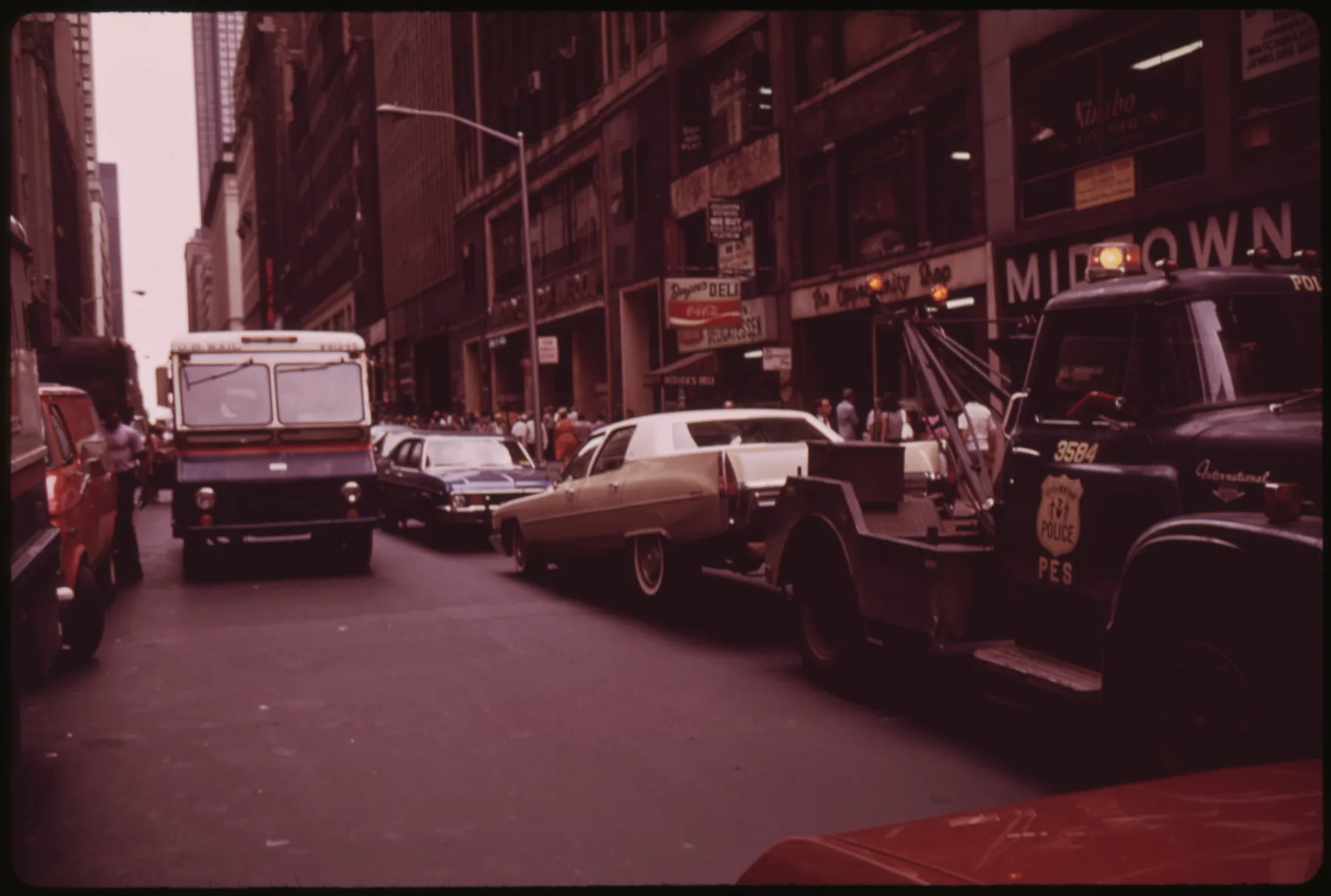


A city street between tall buildings. A dark tow truck is at the right, an amber light lit on the cab roof, partial lettering at the roof’s right edge. The door shows 3584, a shield with the word POLICE, and the letters PES under the shield. Script on the hood reads International. A pale sedan behind the truck has its rear raised and a whitewall tire. A box truck faces the camera in the left lane. People stand on the sidewalk. The lettering on a storefront sign is hard to read, and large letters behind the truck read MIDTOWN. The file page titles the photograph as a New York police tow truck removing an illegally parked Cadillac, names the photographer Dan McCoy, and dates it to August 1973. The photograph shows the truck, the shield, and the pale sedan with its rear raised. It does not show a readable marque on that sedan, and it does not show a release.
The copy an agency signs
Chapter 1 of the California Highway Patrol’s vehicle-report manual, revised April 2013, is the patrol’s procedure for a vehicle one of its officers removed, impounded, or stored. The release depends on the requirements of the authority that took the car. The registered owner of record, the legal owner of record, or their agent has a right to a post-storage hearing on whether that storage was valid.
When the patrol does release the car, the employee signs the box for the person authorizing the release. The owner or the agent gets a copy of that signed report to present to the tow company that is storing the car. The copy is what the company is given. The supporting papers stay with the patrol’s file. The chapter names what those copies include: current registration, ownership papers, a Department of Motor Vehicles printout of the driver license, a copy of the license itself, court documents, and current proof of insurance. When the person’s identity is in question, the chapter says a legally recognized photo identification should be requested. When the person’s authority to take the car is in question, it says a notarized written certification should be requested from the registered or legal owner, stating that the person is their agent.
The Salinas Police Department issues the paper under the name vehicle release form, for a car towed as a stored vehicle, an impounded vehicle, or a recovered stolen vehicle. The registered or legal owner has to be present to get it. A person acting for the owner brings a power of attorney, or a notarized letter that authorizes that person to take the car and that includes the vehicle information. The car needs current registration or a temporary operating permit. The owner shows proof of insurance and a valid driver’s license. An owner who does not have a license brings a licensed driver.
A Salinas 30-day impound, for a driver who was unlicensed or whose license was suspended, can end before the 30th day if that driver gets a valid driver’s license from the DMV. If the driver cannot get one, the registered owner can ask for an administrative review. The owner has to be present, the request is completed in English, and the page says to allow five to seven days for the review.
The Los Angeles Police Department writes the 30-day hold as its own wait. The owner waits until the 30 days are over before asking for a release. The registered owner then goes to the area auto detectives. Releases are given only to the registered owner. An owner who does not have a valid California driver’s license brings a person who does.
The same page lists reasons an area auto-detective supervisor can release the car before the hold ends. The owner can show the car was driven by an unlicensed driver without the owner’s knowledge or permission. The owner can show the 30-day hold was not authorized. There can be sufficient proof the car was stolen. The driver can get a valid license, or have a license reinstated, and get proper insurance, while the registered owner provides a valid driver’s license and proof of current registration. There can be sufficient proof the driver was licensed, with a valid license issued before the impound, or that the driver had an expired license. The owner can present a court order.
A forfeiture is a different letter on that page. When the car is impounded as a forfeiture and more than one person owns it, the owner from whom the car was not taken follows the notice of forfeiture that arrives by certified mail.
What the window checks
The yard, the pound, and the police window do not ask for the same three cards.
At an NYPD tow pound, the person retrieving the car brings a current registration certificate, a valid driver’s license, and a current insurance card for that vehicle. An insurance identification card is the insurer’s card. It is not the release. The pound releases the car to the registered owners, their spouses, or their authorized representatives. A representative needs authorization in writing with the registered owner’s notarized signature. A spouse is named on that page separately from a representative. The car is not released if parking judgments stand against it. Those judgments are paid to the parking violations bureau before the car is redeemed. The parking ticket that led to the tow cannot be paid at the pound.
The city’s finance department splits the tow before any of those papers matter. A car towed for illegal parking, or because it did not have valid registration or insurance, was towed by the police. A car towed for parking or camera violations in judgment, above the amount that page states, was towed by a city marshal or the sheriff. An NYPD tow for a DMV offense is a trip to a finance business center, with a valid driver’s license and the original title in the person’s name on the front. Someone who is not the titleholder brings a notarized authorization from the titleholder and the titleholder’s driver’s license. The page says the car cannot be retrieved without valid registration or insurance. The judgments and the fees are settled there, and the page then says the person is told where to get the car.
A marshal or sheriff tow uses the words vehicle release form. After an in-person payment, the person asks for that form. A payment by phone does not need one. If the car is financed or leased, the page says to bring a notarized authorization and a certified copy of the title.
Chicago’s streets and sanitation department releases the car to the owner of record, or to a representative of that owner. The representative brings an original notarized letter giving permission to act for the owner. Every person claiming the car presents a valid photo identification. If the car is driven out of the pound, the driver has a current valid driver’s license. The ownership proof is a valid title, a current registration card, or a bill of sale not more than 30 days old. A lessee brings the lease agreement. A title and a registration are already two records. On this page either one can be the ownership proof, and a recent bill of sale can stand in that spot as well. The car also has to be current on registration and the related requirements, including current state plates and a Chicago vehicle sticker if one is required.
Some Chicago impounds do not leave the pound on that packet alone. The page names a set of reasons, among them narcotics, driving under the influence, and a suspended or revoked license, and says a car impounded for one of the reasons on that list is not released until the owner goes to the vehicle impoundment office and pays the fines and fees. A car impounded for unpaid parking violations, which the page calls a booted vehicle, is a call to the department of finance.
Seattle’s page on redeeming a vehicle releases the car to the registered owner. Besides the fees, the person needs proof of ownership, a current registration or a title or a lease agreement, the license plate number or the vehicle identification number, and a valid picture identification, which the page illustrates with a driver’s license or an identification card. A licensed driver has to drive the car off the lot. Otherwise the car can be towed out. Parking citations that apply are handed over when the car is released, and they are paid to the city.
Someone who is not the registered owner can pick the car up, or take property out of it, with a notarized statement from the registered owner. The statement includes the authorized person’s name and telephone number, a legible copy of the owner’s identification card or driver’s license, the plate number or the vehicle identification number, and the vehicle’s make and year. The page sends that statement to the company the city’s find-a-towed-car page names as the contractor for police-authorized impounds.
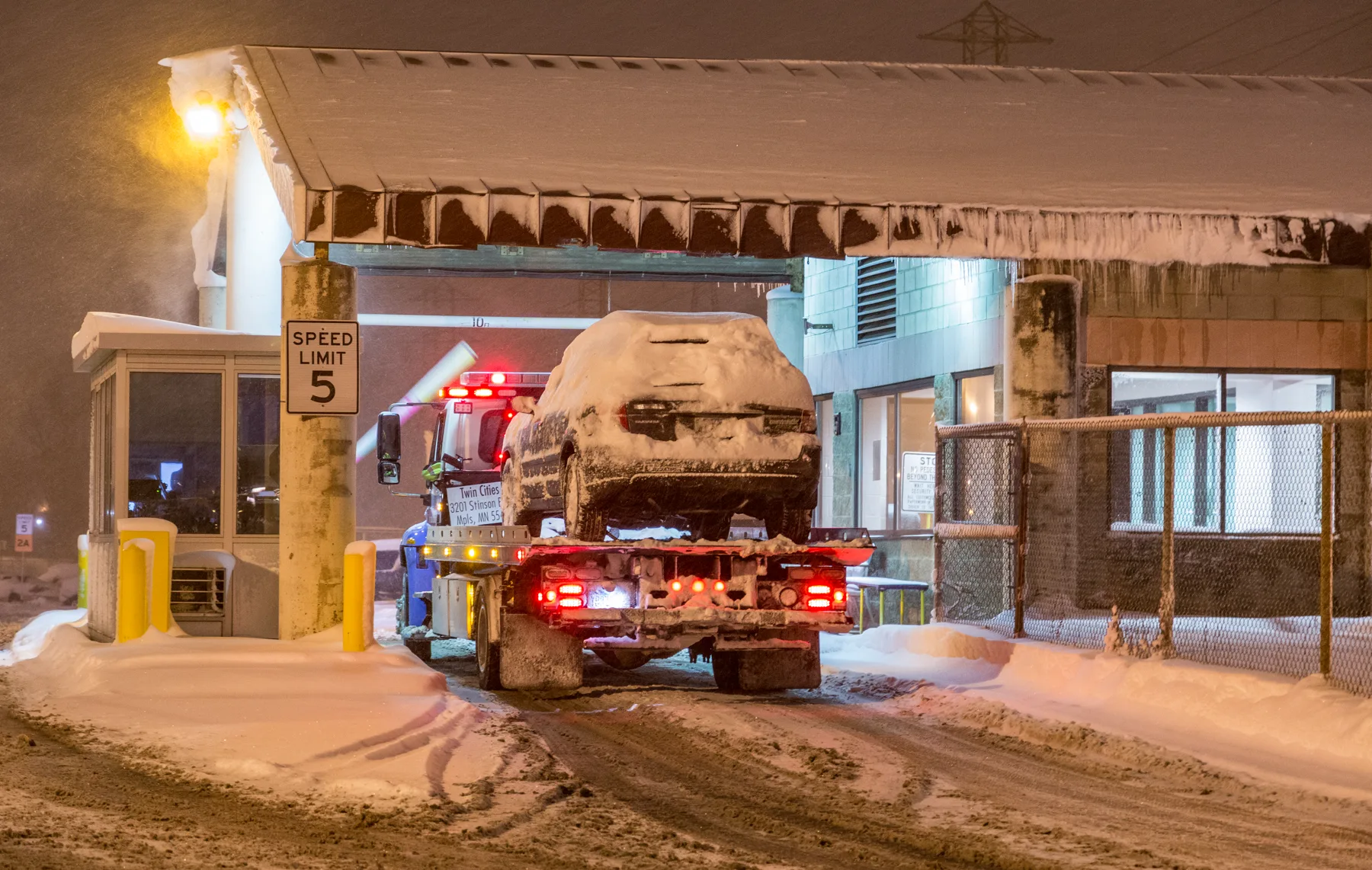

At night, in falling snow, a flatbed tow truck sits under a snow-covered canopy with icicles along the edge. A dark sport-utility vehicle, coated in snow, rests on the bed. Red lights glow at the back of the truck and on the cab roof. A small booth and yellow posts stand at the left. A sign on a concrete column reads SPEED LIMIT 5. A chain-link fence runs along the right. The pavement is snow and slush, marked with tire tracks. Lettering on the truck’s door is partly hidden by the vehicle on the bed. The file page says a tow truck is bringing a vehicle to the Minneapolis city impound lot during a snow emergency, names the photographer Tony Webster, and dates the photograph to February 3, 2016. The photograph shows the truck, the vehicle on the bed, the speed-limit sign, and the fence. It does not show a release, and it does not show a readable city name.
Texas puts the check on the vehicle storage facility, which is the yard, and it uses the words instrument of release. The facility is paid every fee for the delivery or the storage before it releases the car, and it has to accept at least one electronic payment, including a debit card and a credit card. The person also needs a valid state or federally issued identification. The page says that identification can be from another country, and it names Mexico as an example.
With that identification and with the fees paid, any one of the instruments on the page requires the facility to release the car. A notarized power of attorney is one, and a notarization done outside Texas has to be accepted even when its form differs from a Texas notarization. A court order is one. A certificate of title is one, and the facility has to accept the title even when the person presenting it is not the name on the front or the back. A tax collector’s receipt together with the registration renewal card is one, accompanied by a conforming identification. Name and address information that matches the Texas Department of Motor Vehicles’ files is one. A current automobile lease or rental agreement is one. Identification of a state or federal law enforcement representative is one. The current form the department publishes for this purpose is one. Proof of financial responsibility, which the page calls an insurance card, is one, as identification that the person owns the car or has the right to possess or control it.
The same page then forbids the demand. A storage facility is not required to ask for proof of insurance, and it is not allowed to demand that proof before it releases the car. If the person has an instrument of release, a state or federal identification, and payment of the charges, the facility must release the car. A local police department or a sheriff may not require the facility to demand insurance. An insurance card can be the instrument. It cannot be an extra card the yard insists on after a title, a court order, or one of the other instruments is already in hand.
When the facility does release the car, it gives the person a notice of the towed vehicle owner’s right to a hearing, and the name, address, and telephone number of every justice of the peace in the county where the car was towed, or the court directory the page links. That notice leaves with the person. It is the hearing notice. It is not the instrument that got the car out.
The bill is the other paper
The release and the charges move on different pages, including inside one department.
The Los Angeles hearing is about probable cause: whether the officer was authorized to remove the car. The owner, or another person entitled to possession, can ask for it before or after paying the impound and storage charges to the official police garage that has the car. The person has to establish ownership or some other right to possession. If the hearing officer finds there was no probable cause, the car is released without charge, or the charges already paid to the garage are repaid by mail. If the officer finds the impound was proper, the person pays the impound and storage charges, or the garage acquires a lien against the car. The page says the hearing does not affect a related traffic citation or a criminal case. Those are challenged in court. The request has to reach the station that impounded the car within 10 days of the date on the written notice, by telephone, in writing, or in person. Missing that window ends the right to the hearing.
The highway patrol’s hearing chapter, revised October 2014, gives the registered owner, the legal owner, or an agent 10 days from the date on the notice to ask, in person, by telephone, or by mail. A commander has discretion to hear a request that arrives later. The hearing officer is a lieutenant or a sergeant, and not the officer who stored the car. The question is whether the information supports that officer’s authority to store or impound it. When the storage is found valid, and the car has not already been retrieved, the owner can pay the towing and storage fees and retrieve it, or allow the car to be sold to satisfy the lien. The chapter also describes an appeal of the decision. The signed release in the vehicle-report chapter is how a car that is being retrieved is presented to the tow company. The payment, or the sale, is the choice this hearing chapter puts next to a storage it has found valid.
Salinas separates the department’s release from the company’s bill in one paragraph. The registered owner is responsible for the towing, the storage, the lien, and the release fees, and the fees are due at the time of service. The page says to ask the towing company what it charges. The department lists its own charges on the same page. This article does not repeat the amounts.
Seattle’s redeeming page puts the documents in addition to the fees. Chicago will not release the car until the charges and fines are paid in full. Texas will not release the car until the delivery and storage fees are paid. On each of those pages, a signed permission or a complete set of ownership papers still leaves the bill to be paid, and a paid bill still leaves the papers to be shown.
New York keeps the ticket that caused an NYPD tow off the pound counter. That ticket is paid or disputed with the finance department, online, by mail, or in person, within 30 days of the ticket date. A judgment is the other stop. The police page will not release a car that has parking judgments until the judgment amount is paid to the parking violations bureau. For an NYPD illegal-parking tow, the finance page requires the judgment debt to be paid at the pound when it reaches the amount that page states, along with the tow fees. An owner who catches an NYPD tow while it is still in progress can stop it by signing what the finance page calls a field release agreement and agreeing to pay within 30 days. That agreement stops a tow that has not finished. It is not the packet the pound asks for after the car is already there.
A private lot is a different call
Seattle’s find-a-towed-car page starts with the place the car was parked. A car towed from a Seattle street is looked up with the company the city contracts for police-authorized impounds. A car towed from a private parking lot is looked up from the signs posted on that lot, which carry the tow company’s telephone number, or by asking the property owner. The police non-emergency number is the step the page gives if the car still cannot be found. The redeeming instructions, and the notarized statement they describe, are addressed to the company that holds the police-authorized impounds. A private-lot tow does not begin as a request for a police release.
The finance department in New York draws the same kind of line between agencies. Illegal parking, or a missing registration or a missing insurance, is the police tow, and the pound’s list is the registration, the license, and the insurance card. Judgment debt above the amount that page states is the marshal or the sheriff, and the vehicle release form is what an in-person payment at finance produces. One car can be towed by the city and still not be a police impound.
The Texas page is a rule for storage facilities, not a desk at a police station. A city or a county law-enforcement agency appears on it as a limit: that agency may not make the facility demand insurance. The instrument of release can be a title or a court order the owner already has. The page does not describe a slip the police must sign before the facility may open the gate.
If nobody comes for the car
A release is the way the car leaves while the yard still has it. The pages that describe an unclaimed car describe a sale.
On the highway patrol’s hearing chapter, a storage found valid can end with the owner allowing the car to be sold to satisfy the lien, if the car has not been retrieved. Los Angeles, when the hearing finds the impound was proper, says the official police garage acquires a lien if the impound and storage charges are not paid. The lien is the claim. A lien sale is the California process for selling a car to enforce specified unpaid repair, tow, or storage charges, with its own notices and buyer papers. That article’s forms and periods are California’s. They are not the rule in the other cities on this page. A lien release is a lender’s paper, the one that says the loan interest is satisfied. The garage’s lien, and the sale that can follow it, are not that lender’s release.
Chicago stores a car for no less than 21 days from the date the city mails notice to the registered owner. The owner has a right to one extension of 15 days before the car is sold or otherwise disposed of. If the car is not claimed, the page says it may be disposed of or sold at auction. Disposal does not wipe the fines and fees. The owner is still responsible for them.
A New York car a marshal or the sheriff towed, and that nobody retrieved within 72 hours, may be auctioned as soon as 10 days after the tow. The police page does not put that auction clock on an NYPD pound car. The finance page puts it on the marshal and sheriff tows.
Salinas uses the word release for a second paper that does not get the car out. A person who receives a notice of stored vehicle and no longer owns the car files a release of liability with the DMV. That filing tells the department the car was already handed off. It is not the vehicle release form the department issues so a tow company will give a stored car back.
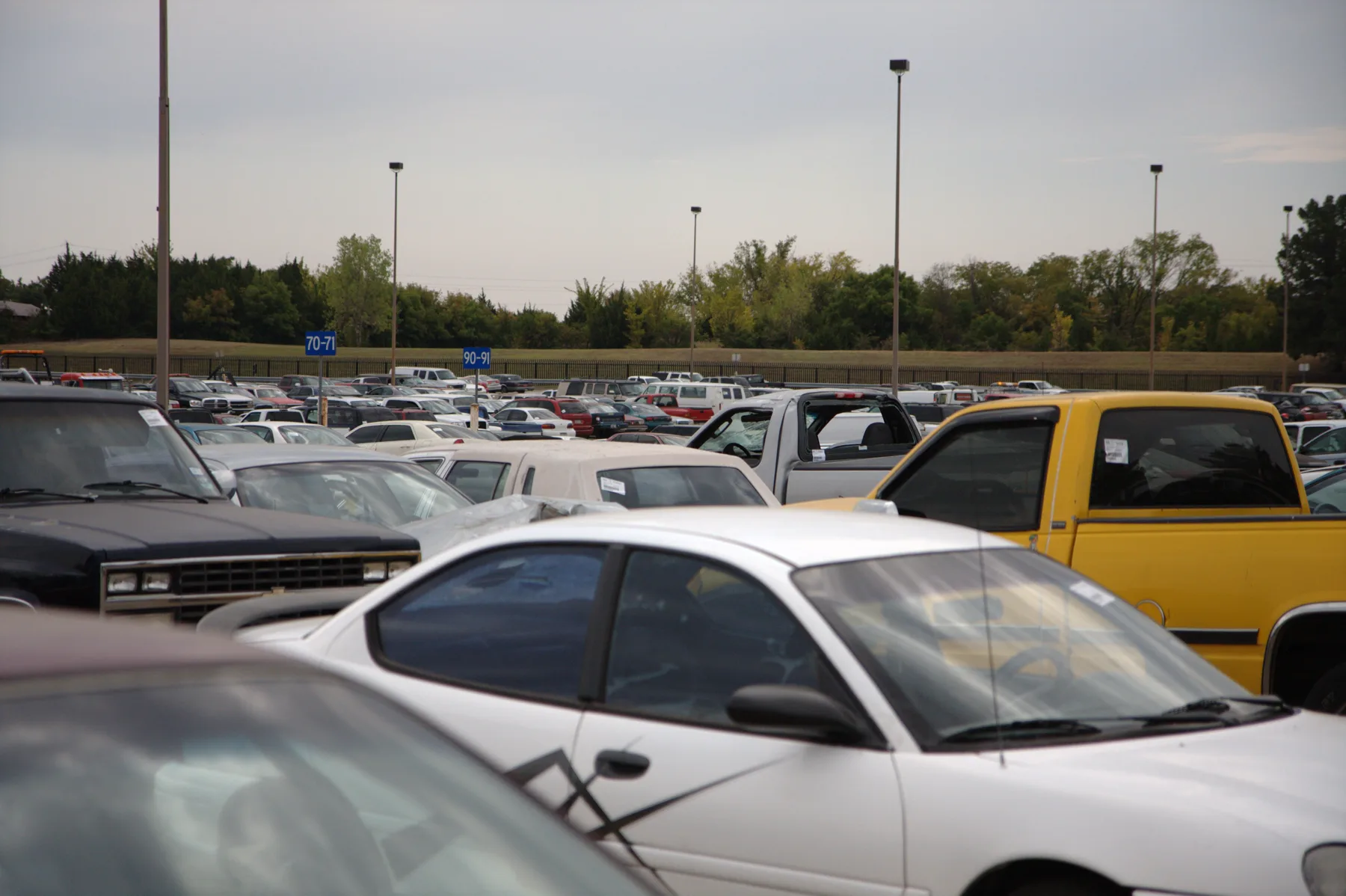

Rows of parked cars under a gray sky, trees and a dark fence behind them. A yellow pickup sits at the right, a white sedan fills the foreground, and a dark vehicle is at the left. White papers sit on some windshields and side windows. The writing on those papers is not readable. Two blue signs on poles read 70-71 and 90-91. Tall light poles rise above the cars. The file page calls the photograph a car impound lot in the United States, names the photographer Steve Rainwater, and dates it to October 3, 2008. The photograph shows the parked cars, the papers on the glass, and the row signs. It does not show a release, a tow truck, or a city name.
An owner holding an impound release is holding the permission these pages describe: a signed copy for the tow company, a police release form, or the identification and the instrument of release a storage facility is required to accept. The permission establishes that the agency signed, or that the yard’s required papers were presented. It does not establish that the hearing will find the tow was authorized, that the ticket is dismissed, or that the towing and storage are paid. A car that is never retrieved can leave by sale. In California, the papers for that sale are the lien-sale papers. They are not the release.
Sources
- California Highway Patrol: HPM 81.2, chapter 1, vehicle report, revised April 2013 — Release of a vehicle the patrol removed or impounded. The registered owner, the legal owner, or an agent may have a post-storage hearing on whether the storage was valid. Papers kept with the report include current registration, ownership papers, a driver-license printout, a copy of the license, court documents, and current proof of insurance. A photo identification is requested when identity is in question, and a notarized certification when the person's authority is in question. The employee signs the release authorization and gives a copy to the owner or agent to present to the storing tow company. Form numbers and statute section numbers in the chapter are not repeated here.
- California Highway Patrol: HPM 81.2, chapter 4, post-storage hearings, revised October 2014 — A hearing request within 10 days of the date on the notice, in person, by telephone, or by mail, with discretion to hear a later request. The hearing officer is not the officer who stored the vehicle. The hearing asks whether the information supports that officer's authority to store or impound. If the storage is found valid and the car has not been retrieved, the owner can pay the towing and storage and retrieve it, or allow the vehicle to be sold to satisfy the lien. Dollar figures and form numbers in the chapter are not repeated here.
- Los Angeles Police Department: How can I get my car out of impound? — A 30-day hold runs before the registered owner asks the area auto detectives for a release. Releases go only to the registered owner. An owner without a valid California driver's license brings a person who has one. Early release before the hold ends, including a stolen car, a court order, and a driver who gets a valid license and proper insurance while the owner shows a valid license and current registration. An impound hearing decides probable cause. No probable cause means release without charge or repayment. A proper impound means the impound and storage charges, or a lien in favor of the official police garage. The hearing does not decide the related citation. A forfeiture notice to another owner is a different paper. Statute section numbers, area telephone numbers, and the hearing-request number on the notice are not repeated here.
- Salinas Police Department: Obtain a vehicle release — A vehicle release form from the department for a stored, impounded, or recovered stolen vehicle. The registered or legal owner is present. An agent brings a power of attorney or a notarized letter that includes the vehicle information. Current registration or a temporary operating permit, proof of insurance, and a valid driver's license. An owner without a license brings a licensed driver. A 30-day impound for an unlicensed or suspended driver can end early if that driver gets a valid license, or the owner can ask for an administrative review. The registered owner pays towing, storage, lien, and release fees. A notice of stored vehicle sent to someone who no longer owns the car is handled with a release of liability at the DMV. Dollar amounts and telephone numbers on the page are not repeated here.
- New York City Police Department: Towed vehicles — At an NYPD tow pound, a current registration certificate, a valid driver's license, and a current insurance card. Release to the registered owner, a spouse, or an authorized representative with the owner's notarized written authorization. A car with parking judgments is not released until those judgments are paid to the parking violations bureau. The parking ticket that led to the tow cannot be paid at the pound. Dollar amounts on the page are not repeated here.
- New York City Department of Finance: Towed vehicles — An illegal-parking tow, or a tow for a lack of valid registration or insurance, is an NYPD tow. A tow for judgment debt above the amount the page states is a city marshal or sheriff tow. An NYPD tow for a DMV offense is handled at a finance business center with a valid driver's license and the original title, or a notarized authorization and the titleholder's license, and the car is not retrieved without valid registration or insurance. A marshal or sheriff tow paid in person produces a vehicle release form. A phone payment does not. A car from a marshal or sheriff tow that is not retrieved within 72 hours may be auctioned as soon as 10 days after the tow. An NYPD tow caught in progress can be stopped with a field release agreement. Dollar amounts on the page are not repeated here.
- City of Chicago, Streets and Sanitation: Common towing questions — Release to the owner of record or a representative with an original notarized letter. All charges and fines are paid first. Current state plates and a Chicago vehicle sticker if one is required. Photo identification for the person claiming the car, and a valid driver's license if the car is driven out. Proof of ownership is a valid title, a current registration card, or a bill of sale not more than 30 days old. A lessee brings the lease. A listed set of impound reasons, including narcotics, driving under the influence, and a suspended or revoked license, waits on the vehicle impoundment office. Unpaid-parking boots go to the department of finance. Storage runs at least 21 days from the mailed notice, with one 15-day extension, and an unclaimed car may be disposed of or sold at auction while the owner still owes the fines and fees. Dollar amounts and municipal-code section numbers on the page are not repeated here.
- City of Seattle: Find a towed car — The first step is whether the car was towed from a public street or from private property. A street tow goes to the company the city contracts for police-authorized impounds. A private-lot tow starts with the company named on the posted signs, or with the property owner. The police non-emergency number is the step if the car still cannot be found. Fee schedules linked from the page are not repeated here.
- City of Seattle: Redeeming your vehicle — Release to the registered owner, in addition to the fees. Proof of ownership, a current registration, title, or lease, the plate number or the vehicle identification number, and a photo identification. A licensed driver drives the car out, or the car is towed out. Parking citations that come with the release are payable to the city. Someone other than the registered owner brings a notarized statement with the authorized person's name and telephone number, a copy of the owner's identification, the plate or the vehicle identification number, and the vehicle's make and year. The page sends that authorization to the city's contracted towing company. Telephone numbers on the page are not repeated here.
- Texas Department of Licensing and Regulation: Release of vehicles by vehicle storage facilities — The facility is paid the delivery and storage fees before release, and it accepts a debit card or a credit card. With a valid state or federal identification, any one listed instrument of release requires the facility to release the car. Those instruments include a notarized power of attorney, a court order, a certificate of title even when the presenter is not the name on it, a tax collector's receipt with the registration renewal card, name and address information matching Texas DMV files, a current lease or rental agreement, law-enforcement identification, a department-published form, and an insurance card as identification of ownership or the right to possession. The facility is not allowed to demand proof of insurance, and a city or county law-enforcement agency may not require it to. At release the facility gives notice of the right to a tow hearing. Statute section numbers on the page are not repeated here.
References checked .