Published by HALOX Co.
What an insurance ID card actually is
How California, Texas, New York, and Virginia use an insurance identification card at registration, a stop, and a crash, and why the card is not the electronic record those offices already check.
Is the card in the glovebox the insurance?
No. It is a card an insurer issues so the person named on it can show that a liability policy was written for the vehicle the card describes. The policy is the coverage. The card is what gets handed across, or held up on a screen. New York’s liability page says the insurance identification card alone does not prove you have coverage. The company has to file that coverage with the Department of Motor Vehicles electronically.
The lines on the card
Texas’s prescribed card, effective April 2014, is titled Texas Liability Insurance Card. One side carries the name and address of each insured, the insurance company and a toll-free number, the agent and a phone number when there is an agent, the policy number, the effective date, the expiration date, and the year, make, model, and vehicle identification number of each covered vehicle. The card then says the policy provides at least the minimum liability amounts the state requires for the specified vehicles and the named insureds, and that it may cover other people and other vehicles as the policy itself provides. A named-driver policy adds a warning, in the form’s words, that the policy does not provide coverage for individuals residing in the insured’s household who are not named on the policy. That warning is a limit printed on the card. It is the card saying who the policy leaves out.
California’s renewal manual is pickier about some lines and looser about others. For a customer who still has to show evidence, an insurance card or a binder needs the insured’s name or the vehicle owner’s name, and the insurance company’s name. The document does not have to be dated. A future effective date can be valid. If an expiration date is printed, it has to cover the registration period being renewed. A description of the vehicle is not required. If one is printed, it has to match the registration. A master policy that is not tied to one vehicle can be accepted when several vehicles are renewed together. The insurance requirements page calls the ordinary item DMV may ask for a document or identification card from the insurance company. The same page says comprehensive or collision insurance does not meet the financial-responsibility requirement. A card for that other coverage is not this card.
New York’s proof page says the insurance identification card shows the effective date of the liability coverage, the policy number, and a three-digit code for the insurance company. The requirements page says the name on the card and the name on the registration have to be the same name, exactly, and that the vehicle information on the card has to match the registration. A registration can carry one name or two. Both names go on the card. The coverage has to be New York coverage, from a company licensed by the Department of Financial Services and certified by DMV. Out-of-state insurance is not accepted. Virginia’s requirements page does not itemize a card. It says drivers should keep proof of insurance in the vehicle. When Virginia’s electronic check finds nothing, the verification transaction asks for the company name and the policy number exactly as they appear on the policy.
Where it has to come out
California’s insurance page says the evidence stays in the vehicle and is provided when law enforcement asks for it, when the registration is renewed, and when the vehicle is in a traffic collision. The driver handbook adds the drive test, and it says that in a collision the proof is shown to the other drivers. The same handbook says the driver’s license, the registration card, the insurance information, and the current address are shown to the other driver, to law enforcement, and to anyone else involved.
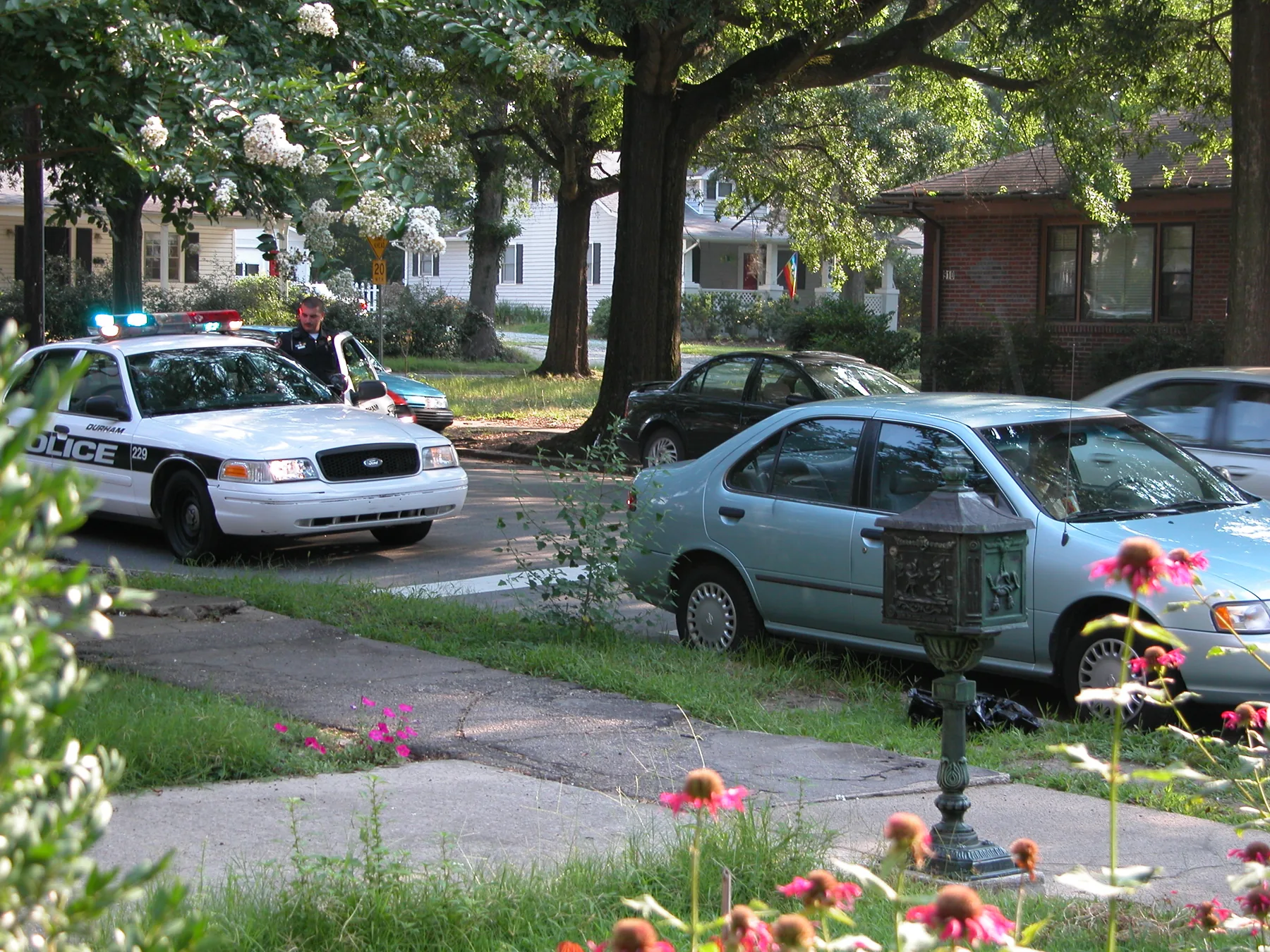

It is daytime, seen from across a residential street behind a front yard. Pink coneflowers and a dark lantern-style post are in the foreground. A white Ford sedan marked DURHAM POLICE, number 229, is parked at the left with its blue and red light bar lit. An officer in a dark uniform stands beside the cruiser’s open driver door. A light blue-green sedan is parked at the curb in the right foreground with a person in the driver’s seat, and a black sedan is parked behind it. A brick house, white houses, and large trees with white blossoms are behind. The file places the stop on Gregson Street in Durham, North Carolina, in July 2003. North Carolina is not one of the pages above. The photograph shows the cruiser and the cars at the curb. It does not show a card.
The back of Texas’s prescribed card tells the holder to keep it, and to show the card or a copy of the policy when applying for or renewing a motor vehicle registration or a driver license, and for a motor vehicle safety inspection sticker. It also says the card or the policy may be asked for after an accident, or when a peace officer asks to see it. The Department of Public Safety notice of January 3, 2025 says that as of January 1, 2025, a non-commercial vehicle no longer needs a safety inspection before it is registered. Commercial vehicles still do, in every county. The inspection-sticker line is what the April 2014 card still prints.
New York’s requirements page says that in the vehicle you have the paper insurance ID card, or you can generate the electronic one. Anyone who operates the vehicle has to be able to provide proof. The registration has to be made within 180 days of the effective date printed on the card. You bring one card. The office keeps the paper card. The other paper card stays with the vehicle. DMV will take a copy or a fax, and it will not take a card whose barcode the reader cannot read. The insurer also sends an electronic notice of coverage. An agent or a broker cannot file that notice. The page says the cards and the electronic notice together verify the coverage, and that DMV needs both. The April 29, 2015 notice says proof is still produced whenever the vehicle is operated, and that an electronic card can be used for a registration at a DMV office, during a traffic stop, and when a judge, a justice, or a magistrate is answering a summons.
Virginia’s requirements page says drivers should keep proof of insurance in the vehicle at all times. Buying the plates or the decals requires a certification that the vehicle is covered. If the liability coverage ends while the registration is still in effect, the owner reinsures the vehicle, deactivates the plates, or surrenders them. Florida’s insurance page says that before a vehicle with at least four wheels is registered, the owner shows proof of personal-injury-protection and property-damage-liability coverage. The coverage continues through the registration period, including when the vehicle is not being driven. The plate is surrendered before that insurance is cancelled. Florida’s letter page says a crash, or a citation for driving without proof of insurance, can also produce a letter asking the owner to verify coverage. That letter is a different paper from the card.
A phone is not the file the state is reading
New York’s 2015 notice allows the insurance ID card on a portable electronic device. It has to be legible, and for a registration it has to scan on a two-dimensional barcode reader. The insurer needs the named insured’s approval before it provides the electronic card. Printed cards may still be delivered. Electronic proof cannot be used for a temporary card, a self-insured entity, or a fleet, dealer, or transporter transaction. The requirements page adds its own exclusions: an all-owned policy, an all-owned-and-non-owned policy, a dealer garage policy, a self-insured vehicle, and one further policy type that page names. The liability page says the electronic version has to be displayable on a portable device, and that the company’s electronic filing is what puts the coverage on DMV’s record.
Texas’s November 22, 2013 bulletin says a driver may show proof of auto liability insurance to a peace officer on a wireless communication device, and that the change was effective immediately. The prescribed card’s own instruction for a registration is still the card or a copy of the policy. The phone and the database are separate. TexasSure is the verification program local, county, and state law enforcement and vehicle registration offices use to check whether a vehicle registered in Texas has auto insurance. It is a partnership of the Department of Insurance, the Department of Public Safety, the Department of Motor Vehicles, and the Department of Information Resources. After a policy is issued, the company reports it. The program’s page says to check that the VIN on the policy is the VIN on the registration.
The consumer questions say only law enforcement and vehicle registration offices can look. TexasSure will not tell a driver, a lienholder, a dealership, or a law firm whether a vehicle is insured. The file is replaced weekly, and it does not keep a history. A new policy, or a changed one, can take about three weeks to appear. A name, an address, or a VIN that does not match, an out-of-state policy, or a commercial or fleet policy the company does not have to report, can make an insured vehicle look uninsured. The driver does not report the change. The company does. The page for insurance companies says the companies still issue the cards, because the motorist has to show evidence of financial responsibility. The people who can look up one driver are the authorized users, including law enforcement and the county tax assessor-collector offices.
California splits the same job a different way. The insurance requirements page says insurers electronically report private-use vehicle information and, as of January 1, 2023, commercial and fleet vehicle information. If DMV does not receive proof, the registration is suspended. The renewal manual still says commercial policies and the alternative forms of financial responsibility are not reported electronically. On that page, a renewal notice for a customer whose insurance is already on file does not ask for evidence of liability insurance, and the manual says not to ask for a card in that case. A customer with no renewal notice shows evidence, and for most of them that evidence is an insurance card or a binder. The December 2019 fast facts say law enforcement and court personnel have electronic access to the insurance status on DMV records. That brochure is the older account of which policies are reported. The insurance requirements page is the later one on commercial and fleet vehicles.
When the insurer tells DMV the policy is cancelled, or the insurance has not arrived within 30 days of registration issuance on an original or a transfer, the renewal manual says the registration is suspended until the owner sends satisfactory proof. The insurance page says the owner notifies DMV before cancelling, or the registration can be suspended.
Virginia runs its own electronic verification with the insurance industry. If no insurance is found for a registered vehicle, the owner furnishes policy information. The online transaction compares the owner and the vehicle on DMV’s file with the liability information the carriers send, and it asks for the company name and the policy number as they appear on the policy. Florida has the insurers report the start of a policy and a cancellation electronically. If the company reports a cancellation, or that a vehicle was removed, and no other active Florida policy is reported, the department sends a letter. A crash, or a citation for driving without proof of insurance, can produce that letter too.


A multi-story white and gray building under a clear blue sky. A blue New York State outline logo sits on the facade beside the words Department of Motor Vehicles. Tall narrow dark windows, a black iron fence, and shrubs run along the front, and a sidewalk is at the left. At the right, a large painted mural of a face covers a yellow wall, with an older red-brick building behind and a bare young tree in front. The file places the office in Yonkers and dates the photograph to July 23, 2023. New York’s requirements page says a DMV office keeps one paper card at registration, and that the cards and the electronic notice together are what the department uses. The photograph shows the building. It does not show a card.
What the card leaves unsettled
The card records what the insurer printed. New York’s liability page says that printing is not proof of coverage. The company reports the coverage when it starts and when it ends. If the company tells DMV that the proof handed in was not valid, the registration is suspended for invalid proof. Paper and email are not that filing. An agent or a broker cannot make it. Only the insurance company can. The proof page says that after a lapse, the card is submitted online or by mail, and DMV verifies it with the company. If the company does not verify the information, or denies it, the suspension or revocation stays. The record can take 48 hours to update. That clearing step cannot be done by phone or at a DMV office. The name and the vehicle on the card still have to match the registration. A card from a new company is given to DMV, and that company files its own electronic notice.
TexasSure can disagree with a card that was just issued. The consumer page allows about three weeks before a new or changed policy shows up, and the weekly file replaces the one before it. An expiration date still in the future is the date the insurer printed on the card. It is not a reading of a cancellation the company reported this week. A VIN that does not match the registration can make the same card look like no insurance at all.
In California, the card in the vehicle is what gets produced for an officer, for a renewal that still asks, and at a collision. The registration follows the electronic report, or the lack of one. The December 2019 fast facts say officers and court personnel can see the insurance status on DMV’s records. The card is not that status. Virginia’s requirements page keeps the proof in the vehicle, and it treats the end of coverage as a question about the plates. Reinsure, deactivate them, or surrender them. The card does not hold the registration open.
The certificate an insurer files with the state, in what an SR-22 actually is, is a different paper. Texas DPS says an insurance card or the policy will not be accepted in its place. A title is the ownership record. These pages leave it alone. The card does not register the car. New York wants the card and the electronic notice. California can renew without asking for the card when the electronic report is already on file. Texas offices can see TexasSure and still take the evidence the motorist shows.
Read the name, the vehicle, and the dates on the card, and then the record the state is actually checking, before you treat the card as a policy that is still in force.
Sources
- California DMV: Insurance requirements — Evidence carried in the vehicle and shown when law enforcement asks, when the registration is renewed, and when the vehicle is in a traffic collision. A document or identification card from the insurer is one item DMV may ask for. Insurers electronically report private-use vehicle information and, as of January 1, 2023, commercial and fleet information. Registration is suspended if DMV does not receive proof. The owner notifies DMV before cancelling. Comprehensive or collision coverage does not meet the financial-responsibility requirement.
- California DMV: Financial responsibility, insurance requirements, and collisions — Proof of financial responsibility when driving and for a drive test. At a collision, proof is shown to the other drivers, and the license, registration card, insurance information, and current address are shown to the other driver, law enforcement, and anyone else involved.
- California DMV: Evidence of financial responsibility, registration renewals — Private-use liability policies are reported electronically. This manual page still says commercial policies and alternative forms are not. A renewal notice does not ask for evidence when the electronic report is on file, and the card is not requested in that case. Without a notice, most customers show an insurance card or binder. The name and the company are required. A date is not mandatory. A future effective date can be valid. An expiration date, if printed, has to cover the registration period. A vehicle description is optional and has to match the registration if it is present. A non-vehicle-specific master policy can cover several renewals at once. Cancellation reported by the insurer, or no insurance within 30 days of registration issuance on an original or a transfer, suspends the registration until satisfactory proof is sent.
- California DMV: Financial responsibility requirements for vehicle registration, fast facts — Fast facts 18, revision December 2019. Law enforcement and court personnel have electronic access to insurance status on DMV records. The brochure is the older account of which policies are reported.
- Texas Department of Insurance: Prescribed auto ID card — Prescribed form, effective April 2014. Titled Texas Liability Insurance Card. Side A names the insured, the company, the agent, the policy number, the effective date, the expiration date, and the year, make, model, and VIN of each covered vehicle, plus the statement that the policy provides at least the minimum liability amounts for the specified vehicles and named insureds and may cover other persons and vehicles as the policy provides. A named-driver policy adds a warning that household residents who are not named are not covered. Side B says to show the card or a copy of the policy for registration, a driver license, and a safety inspection sticker, and after an accident or when a peace officer asks.
- Texas Department of Insurance: Commissioner's Bulletin, November 22, 2013 — A driver may show proof of auto liability insurance to a peace officer on a wireless communication device. The bulletin says that change was effective immediately.
- TexasSure: Vehicle insurance verification — Law enforcement and vehicle registration offices use TexasSure to check whether a vehicle registered in Texas has auto insurance. The program is a partnership of the Texas Department of Insurance, the Department of Public Safety, the Department of Motor Vehicles, and the Department of Information Resources. The company reports the policy after it is issued. The VIN on the policy should match the VIN on the registration.
- TexasSure: For consumers — TexasSure matches registered vehicles to insured vehicles with data from insurers, the Department of Motor Vehicles, and the Department of Public Safety. Only law enforcement and vehicle registration offices can check a driver's status. A mismatch of name, address, or VIN, a new or changed policy that can take about three weeks to appear, an out-of-state policy, or a commercial or fleet policy the company does not have to report, can make an insured vehicle look uninsured. Weekly updates replace older information. There is no insurance history. The system will not release a driver's or a vehicle's insurance information to the driver, a lienholder, a dealership, or a law firm. The company reports changes. The driver does not.
- TexasSure: For insurance companies — Insurers still provide proof-of-insurance cards because the motorist has to show evidence of financial responsibility. Only authorized users can look up an individual driver. Those users include Texas law enforcement and county tax assessor-collector offices.
- Texas DPS: Vehicle safety inspection program changes now in effect — January 3, 2025. As of January 1, 2025, non-commercial vehicles no longer need a safety inspection before registration. Commercial vehicles in every county still do.
- Texas DPS: SR-22 proof of financial responsibility — November 18, 2020. An insurance card or a policy will not be accepted in place of the certificate the carrier files with the department.
- New York DMV: Insurance requirements — New York liability coverage from a company licensed by the Department of Financial Services and certified by DMV, in the registrant's exact name. Out-of-state coverage is not accepted. In the vehicle, a paper New York insurance ID card or the ability to generate the electronic card. The insurer issues two original cards, or access to the electronic card, and sends an electronic notice the agent or broker cannot file. DMV needs the cards and the notice. Register within 180 days of the effective date on the card. The office keeps one paper card. The other stays with the vehicle. Copies and faxes are accepted if the barcode reader can read the barcode. Electronic cards may not be used for an all-owned policy, an all-owned-and-non-owned policy, a dealer garage policy, self-insured vehicles, or one further policy type the page names.
- New York DMV: Auto liability insurance — Carry the insurance ID card. Paper or an electronic card that can be displayed on a portable device. The company files coverage electronically when it begins and when it ends. The card alone does not prove coverage. A failure to file can suspend the registration and can suspend the license. If the company reports that proof given to DMV was not valid, the registration is suspended for invalid proof. Paper and email are not the electronic filing. Only the insurance company can file it. A later company files its own electronic notice, and the new card is provided to DMV.
- New York DMV: Proof of insurance in an electronic format — Notice dated April 29, 2015. Paper or electronic insurance ID cards. Proof is still produced whenever the vehicle is operated. Electronic proof can be used for a registration at a DMV office, at a traffic stop, and for a judge, justice, or magistrate answering a summons. It has to be legible on a portable electronic device and scannable by a two-dimensional barcode reader for registration. The named insured approves electronic proof. Printed cards may still be delivered. Electronic proof cannot be used for a temporary card, a self-insured entity, or a fleet, dealer, or transporter transaction.
- New York DMV: Provide proof of insurance coverage — After a lapse, proof is submitted online or by mail. DMV verifies it with the insurance company. If the company does not verify the information, or denies it, the suspension or revocation remains. The card shows the effective date, the policy number, and the insurer's three-digit code. The name and the vehicle information have to match the registration. The update can take 48 hours. This proof cannot be given by phone or at a DMV office.
- Virginia DMV: Insurance requirements — Plates or decals require a certification that the vehicle meets the minimum insurance requirements. DMV electronically verifies liability insurance on Virginia-registered vehicles with the industry. If no insurance is found, the owner furnishes policy information. Drivers should keep proof of insurance in the vehicle at all times. If coverage ends during the registration, the owner reinsures the vehicle, deactivates the plates, or surrenders them.
- Virginia DMV: Insurance verification — DMV compares owner and vehicle identification on file with liability information from insurance carriers. If no coverage is found, the owner provides policy information. The transaction asks for the company name and the policy number exactly as they appear on the policy.
- Florida Highway Safety and Motor Vehicles: Insurance requirements — Before a vehicle with at least four wheels is registered, the owner shows proof of personal-injury-protection and property-damage-liability coverage from a Florida-licensed insurer, or qualifies for a self-insurance certificate. Coverage continues through the registration period. The plate is surrendered before the insurance is cancelled.
- Florida Highway Safety and Motor Vehicles: Received a letter — Licensed insurers report policy initiation or cancellation electronically. A reported cancellation or a vehicle removed from a policy, with no other active Florida policy reported, produces a letter asking for the coverage information. A letter can also follow a crash or a citation for driving without proof of insurance.
References checked .