Published by HALOX Co.
What an intake manifold actually does
How air moves from the throttle plate through the plenum and runners, why length and the shared volume show up in the tuning notes, and what a vacuum leak or a manifold crack establishes on the engines the papers name.
The air still has a distance to cover after the plate. Bosch’s DV-E datasheet describes the electronic throttle as regulating the air supply in the combustion chamber by reducing or enlarging the intake manifold cross-section. The device is an electrically driven valve with a position sensor. The engine control triggers it from the accelerator-pedal position and from other requests that change engine torque, among them cruise control and the electronic stability program. On the transverse air-routing diagram in Audi self-study 920243, for the 1.8 and 2.0 third-generation EA888, the named pieces are the air filter, the turbocharger, the charge-air cooler, throttle valve control module J338, and the intake manifold. Charge-air pressure sensor G31 sits between the cooler and the throttle. The throttle body is that plate. The manifold is the volume on the other side of it.
One opening, then a runner for each port
Mercedes-Benz StarTuned for October 2014 lists four parts in a traditional intake manifold. A flange carries the inlet control, a carburetor or a throttle valve. A plenum collects the air. Runners direct it. A second flange meets the cylinder head. A piston moving down on the intake stroke produces a vacuum, and the strength of that vacuum depends on the atmospheric pressure at that time and place. On a carbureted engine, or one with throttle-body injection, that pressure forces the air-fuel mixture through the manifold and on through the intake ports. Port injection, the same article says, is the change to a dry manifold, one that flows only the air for combustion.
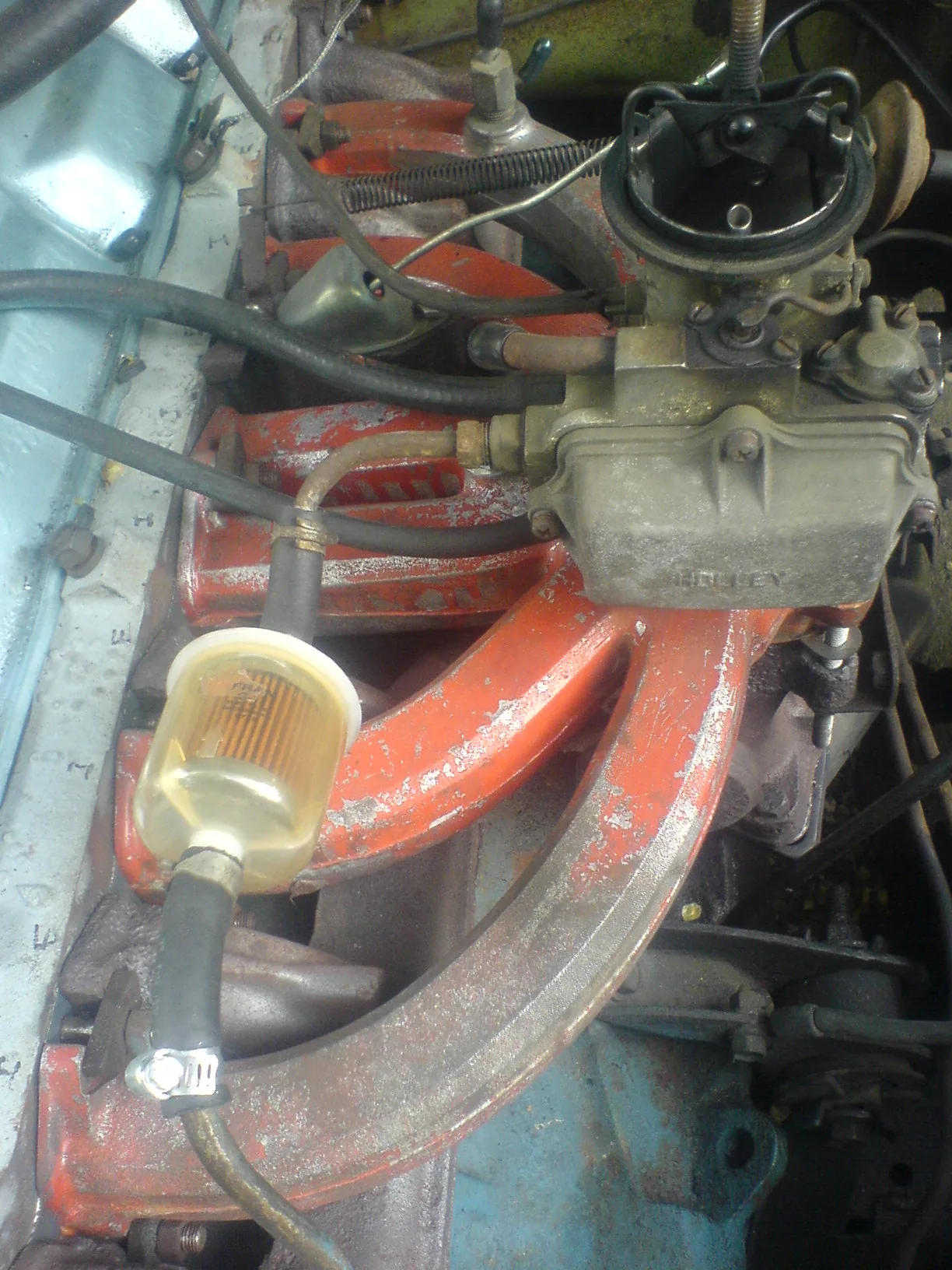


The file identifies this as a sand-cast aluminium manifold from a 1960 Valiant. On this carbureted engine the carburetor sits on top, and the manifold carries the air-fuel mixture. That is the wet manifold in the StarTuned account.
Off the engine, the runners and the long chamber come apart as two shapes.
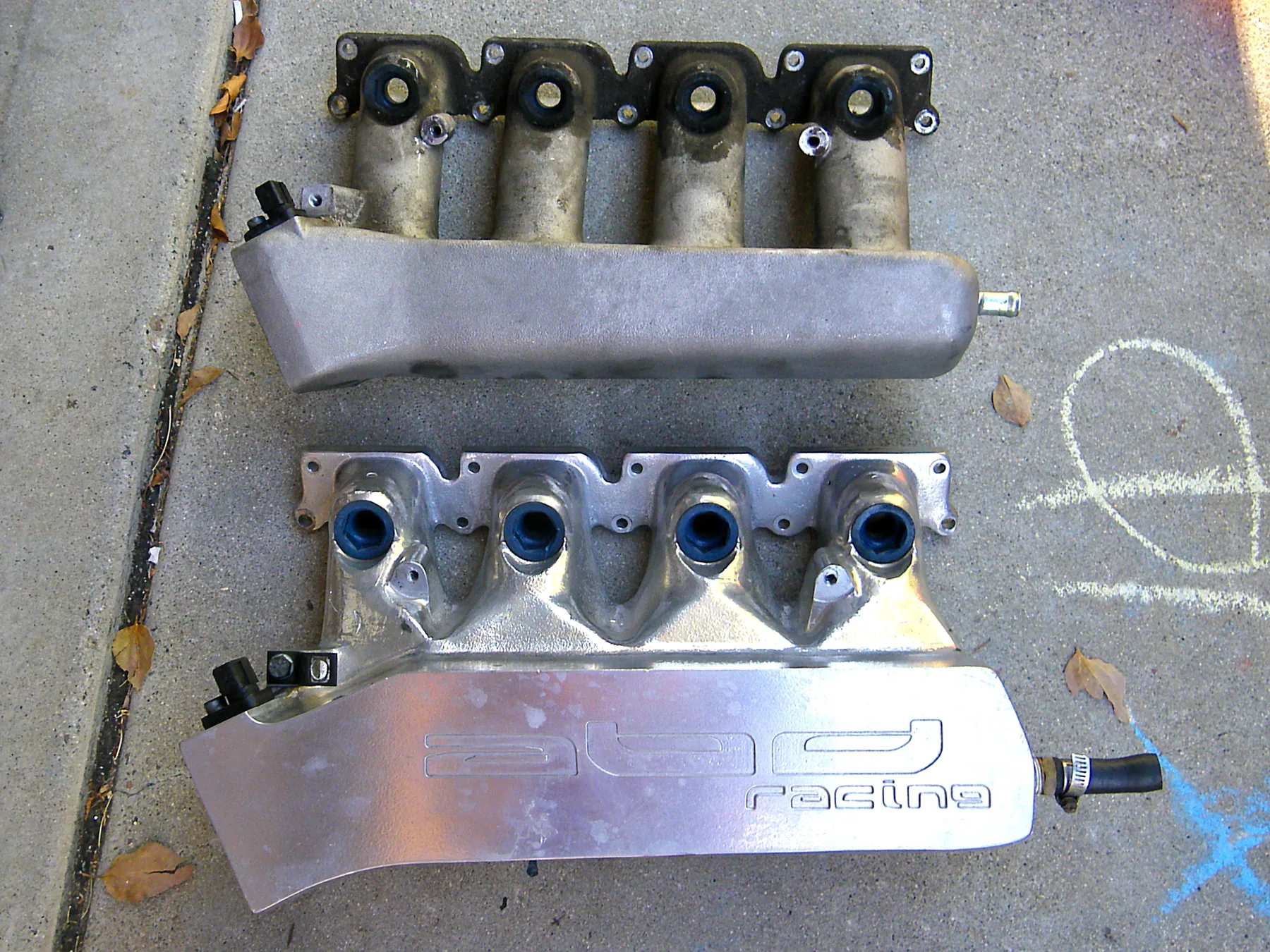

The file identifies the upper piece as a stock intake manifold from a fuel-injected VW 1.8T, and the lower piece as a custom manifold. The tubes are the runners. The long chamber is the plenum.
A mold can make the same split in one piece. StarTuned says composite plastic manifolds were developed because a mold can make shapes that sand-cast aluminum does not, and because the plastic runs cooler than aluminum, which the article ties to a denser air charge that can be matched with more fuel. Magnesium, from high-pressure casting, is the other material it names, for light weight, strength, and rigidity, and for the thermal and acoustic properties it lists. Both composite plastic and magnesium, it says, are used on Mercedes-Benz vehicles.
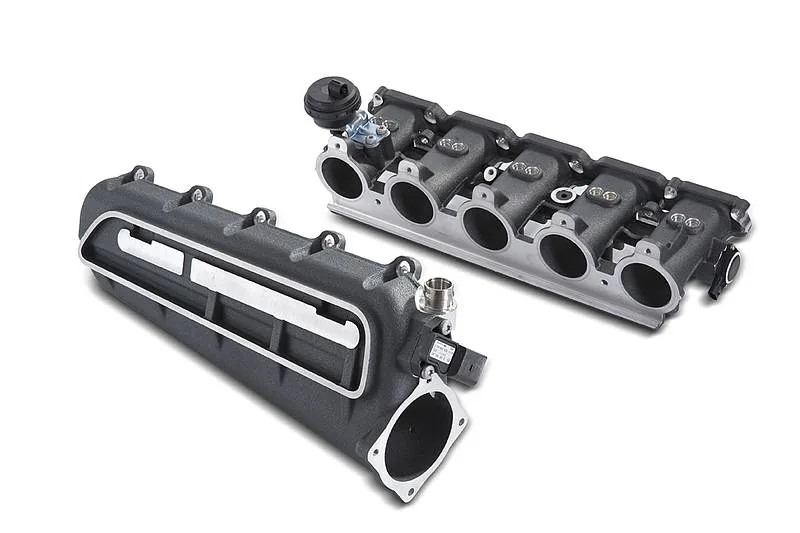

The file calls these a Saugrohr made by Handtmann Systemtechnik. The near housing is the single opening. The far housing opens into five ports.
The length of the runner, and the volume it leaves
Plenum size, runner length, and shape are the three factors StarTuned names for how a manifold performs. A fixed shape, the article says, is a compromise. It can be reasonable across the speed range and excellent at none. Mercedes-Benz introduced a two-stage manifold in 1994, a variable-length intake manifold in the article’s wording. An internal flap opens and shuts, so one housing holds two runner lengths.
The article splits the reason for that change into three bands. At low speed, with high vacuum, shorter and slightly tapered runners speed the air, which the article calls the venturi effect, and the chamber fills more completely. As the throttle opens and speed and load rise, vacuum falls, and the article turns to pressure waves it names Helmholtz resonance. An intake valve shuts while the incoming air still has momentum. The air stops, and a pressure wave builds in the runner behind the valve. A longer runner is how that wave is used. Stacking it raises the pressure and the amount of air for the next charge, and the article puts that effect in a narrow mid-rpm band. At higher rpm the time available to fill the cylinder is shorter, so the article wants the short runner, and it adds the dynamic pressure of outside air being pushed into the inlets as road speed rises.
MIT’s lecture 8 for 2.61, Internal Combustion Engines, spring 2017, models the tuned runner as a Helmholtz resonator. The frequency depends on the speed of sound, the runner’s length and area, and a volume, so length and volume set the engine speed where that ram effect helps.
The variable-length hardware in the StarTuned article is a spiral. The runners form around a central plenum, which is how a runner typically about 800 mm long fits the space. Individual runners give each cylinder its own airflow, so that cylinder is not driven by the pressure waves of the others. Resonance flaps sit about halfway along the runners. Open, they are the normal position, and the air takes a shortcut from the plenum to the cylinder, the short path. Closing the opening at mid-runner forces the air along the full length. Each runner has a flap, and shafts tie the flaps so they move together. A vacuum actuator on the manifold moves them. At idle and low rpm a spring in the actuator holds the flaps open. From about 1,700 to 3,900 rpm, with load above 50 percent, vacuum pulls the flaps closed. The vacuum is stored in a reservoir inside the manifold, about five actuations before a check valve lets the reservoir refill, so the flaps can still move when manifold vacuum is low. An electric solenoid on the manifold, triggered by the engine computer when the conditions are met, controls that vacuum.
A flap in the runner, and a flap at the port
The resonance flap chooses the length. On the engines in the next papers, a second flap sits at the port and changes the motion of the air as it enters.
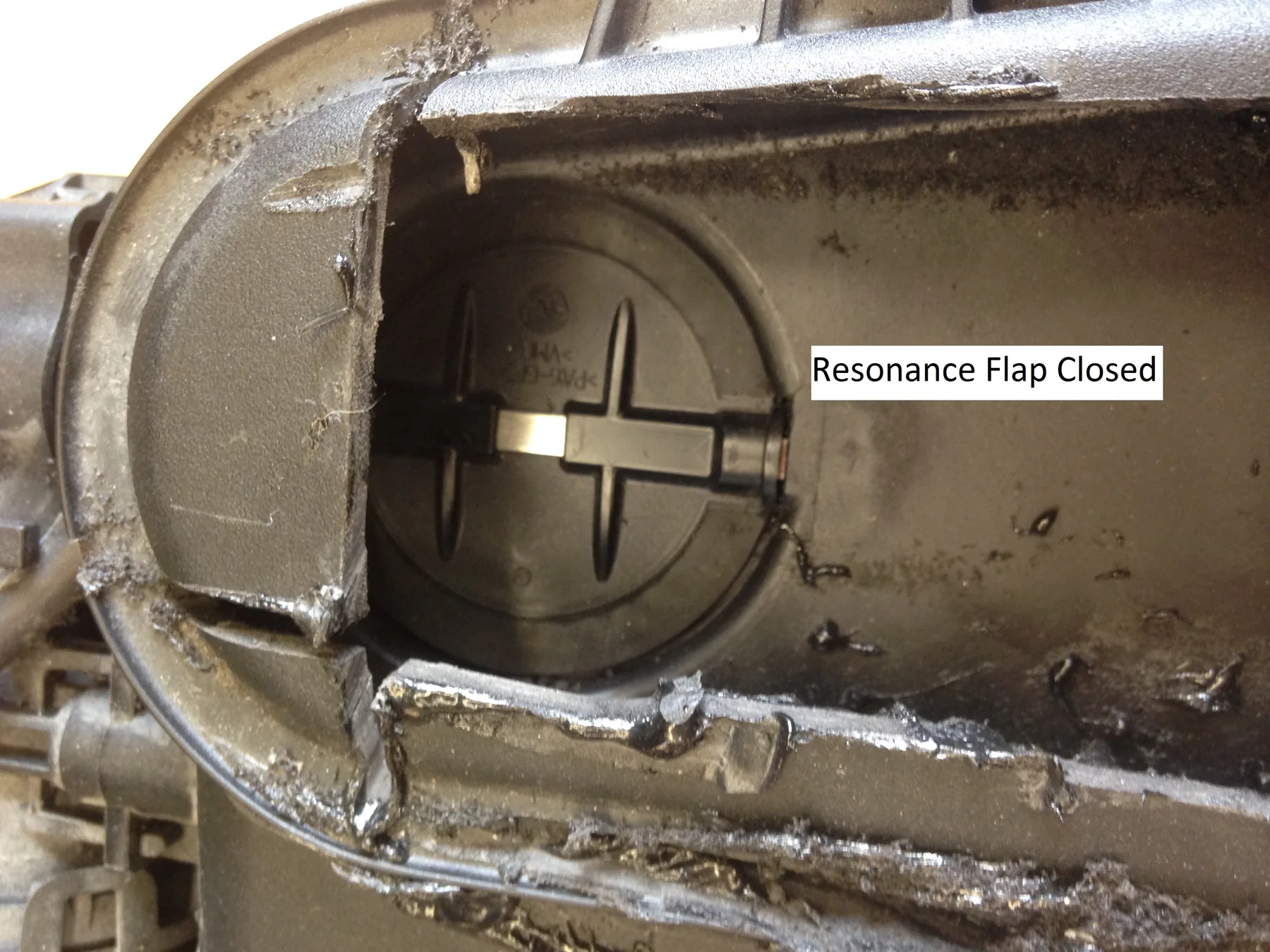

The file identifies the plate across that passage as a resonance flap on an M276, labeled closed. The speed and load window above is the one StarTuned gives for the variable-length system it describes, and that article does not attach the window to an M276.
On the M272 and the M273, the same article adds tumble flaps at the manifold outlets, swung into the intake ports just ahead of the fuel injectors. Closing part of the port, the curved flap speeds the charge and makes it swirl, which the article says blends the mixture into a more even charge. A vacuum actuator of the same kind moves them. A spring holds them back in the recess until engine management applies vacuum at 50 percent load. Sensors at the end of the shaft report where the flaps are. If a flap does not open fully, or does not open, the article says a fault code is set. On the M272 manifold in the article’s photograph, the actuator for those flaps sits between the actuators for the variable-runner flaps.
Audi self-study 920273, the 2.5 TFSI in the EA855 Evo series, gives the port flap a different rest position. The manifold is two sand-cast aluminum pieces. The top is a header, and the throttle valve control unit bolts to it. A pneumatic flap system in the bottom works with the tumble inlet duct. Intake manifold runner control valve N316 switches the vacuum unit. When the engine control leaves N316 off, the valve is de-energized and a spring in the vacuum unit closes the flaps. Fresh air then enters through the tumble intake ports. The program calls that path a halved intake manifold. At idle, and in low partial throttle during normal driving, the flap is closed. During catalytic-converter heating the flaps stay closed up to a medium engine speed. In both of those cases the program treats air mass as a lesser factor in calculating flap position. Intake manifold runner position sensor G336 reads where the flaps are. On this engine the motion flap is shut at idle. In the Mercedes variable-length account, the resonance flap is open at idle. The papers are describing different flaps, and they give them different positions.
Self-study 920243 is the four-cylinder. Pan-shaped flaps in the intake duct direct the air, on one angled stainless-steel shaft. N316 drives a vacuum motor from signals the engine control sends, and G336 reads the position. The flaps are tensioned in the manifold so the airflow itself is less able to excite them. The intake ports are tumble ducts. The 1.8 uses a tumble flap. The 2.0 uses the flap Audi calls a drumble flap: the tumble duct closes on one side more than the other, and the charge picks up swirl and tumble together. The program says the motion with the flap closed differs by displacement, which is the reason the flaps are not the same part. It does not give the idle position that the 2.5 program gives.
The pressure in the volume, and the gas that joins it
On the EA888 diagram, intake air temperature sensor G42 is combined with manifold absolute pressure sensor G71, and the diagram places that pair with the intake manifold. On the 2.5, two pairs measure the air. One is upstream of the throttle, working with charge-air pressure sensor G31. One is downstream of the throttle, working with G42 and G71. Both send their signals by SENT. The program says those two measurements are how this engine’s air mass is taken. The MAP sensor in the downstream pair is the pressure on the manifold side of the plate. The upstream sensor is the pressure before the plate.
Crankcase gas uses the manifold on the engines these papers describe, and the route changes with boost. In 920243, naturally aspirated running opens a non-return valve by the vacuum in the intake manifold, and the cleaned blow-by is admitted through the manifold. In charging mode that valve closes, because pressure fills the charge-air tract, and a second non-return valve opens so the compressor draws the cleaned gas in. The PCV path on this engine is that pair of valves, with the fine oil separator and a pressure control valve ahead of them. StarTuned’s note is what that stream can leave behind. Crankcase pressure is routed through the intake manifold, and the carbon arrives as oil vapor.
Exhaust gas is a separate stream, and the two papers do not send it the same way. StarTuned says exhaust-gas recirculation returns a little spent exhaust to the intake manifold, and that under a light load the dilution keeps oxides of nitrogen from forming. The EGR valve is the external path that sentence describes. The EA888 features table lists exhaust-gas recirculation as internal, done by camshaft adjustment. That sheet describes no external stream into the manifold.
A torn hose, a seam, and one corner
A lamp that mentions the intake, or a crack someone can point to, still has to match the paper that describes that car.
On some 2017–2019 F-Super Duty trucks with the 6.2-liter, Ford special service message 48869 says the malfunction lamp with P2004, P2005, or both may be a tear or a crack in the intake-manifold vacuum hoses, and that the damaged hose is a vacuum leak. The step before the normal diagnosis is to inspect those hoses. If a hose is torn or cracked, the intake manifold assembly is not replaced. The hose assemblies are their own part, base 9E498. On those trucks, those two codes can be the hose. They do not establish that the manifold casting has failed.
Volkswagen technical tip 24-09-02, October 19, 2018, draws the same kind of line, and it says on its face that it is a tip rather than a warranty bulletin. The cars are the 2008–2013 Jetta, Passat, CC, Beetle, Beetle convertible, Golf, GTI, and Tiguan with the 2.0 TSI, engine code CCTA or CBFA. A vacuum tee off the brake vacuum pump feeds the leak-detection pump and the intake-manifold runner-control solenoid, through small orifices drilled in the plastic connection. Debris in an orifice may set P2014 or P2015 on the runner-control line. With engine speed brought above 3,000 rpm, measuring value 143, field 3, should change at once from 0 percent to 100 percent. If the hose is restricted, that value rises slowly or does not rise. On these cars, those codes can be the orifice or the hose. The tip does not treat them as a cracked manifold.
The vacuum leak in the StarTuned article is older, and it is the joint. Warpage of aluminum manifolds on inline engines opened a leak at the seam where the manifold meets the cylinder head. When the article turns to flaps that collect coke, a vacuum leak is one of the things that could follow, together with a misfire, a loss of power, and, in the case it calls the worst, pieces that come free and are drawn into the cylinders. The engine it shows for that case is an M272 neglected until the flaps stuck and broke, the actuator rods broke, and plastic from the flaps bent the valves. A vacuum leak on that list does not say which of those happened, and it does not say the housing itself is fractured.
Chrysler technical service bulletin 09-025-23, November 30, 2023, also issued as rapid service update 23-329, is the paper that does name a fracture, and it names one place. The vehicles are 2022 and 2023 Dodge Charger models, code LD, built on or after December 9, 2022, MDH 1209XX, and on or before January 20, 2023, MDH 0120XX, with the 5.7-liter Hemi, sales code EZH. A customer may have the lamp on, the technician may find P0301, a cylinder 1 misfire, and the customer may report a rough idle and shaking while driving. Any other code is written down and repaired before this bulletin continues. The inspection is the left-front corner of the intake manifold. If P0301 is stored, active, or pending, or if a crack is found at that corner, the manifold is replaced, together with the gasket kit and the seal between the throttle body and the intake. If the code is absent and that corner is not cracked, the bulletin does not apply, and ordinary diagnosis continues. The bulletin says the rapid service update expires 18 months after November 30, 2023. What it establishes is a fracture at that corner, on those cars, inside that build range. A rough idle without the code, or a crack somewhere else, is outside it.
On the EA888, self-study 920243 describes a different opening. If the vent line on the crankcase breather module is missing or poorly installed, an installation-detection contact opens on the air-intake side of the cylinder head, the engine inducts unmetered air, and the oxygen sensors detect it. That is the breather line left off or left loose. It does not establish a crack in the manifold.
StarTuned does say Mercedes-Benz uses composite plastic for manifolds, because a mold can make shapes sand-cast aluminum cannot and because the plastic runs cooler than aluminum. The Chrysler bulletin names a fracture and does not name a material. A cracked plastic manifold, offered on its own as the diagnosis, is not a finding either paper makes.
Sources
- Bosch: Electronic throttle valve DV-E/RKL-E, product datasheet 292000P1GO, 2019 — The electronic throttle regulates air supply in the combustion chamber by reducing or enlarging the intake manifold cross-section; an electrically driven throttle valve and an angular-position sensor; the engine control triggers the valve from accelerator-pedal position and from torque requests including cruise control, adaptive cruise control, and the electronic stability program
- Mercedes-Benz StarTuned, October 2014: Variable length intake manifold operation and maintenance — A traditional manifold as a flange for a carburetor or throttle valve, a plenum, runners, and a flange to the head; vacuum on the intake stroke depending on atmospheric pressure; a wet manifold carrying mixture on a carbureted or throttle-body-injected engine, and a dry manifold flowing only air with port injection; composite plastic molded into shapes sand-cast aluminum does not allow, running cooler than aluminum, and magnesium from high-pressure casting, with both plastic and magnesium used on Mercedes-Benz vehicles; plenum size, runner length, and shape as the defining factors, and a fixed shape as a compromise; the 1994 variable-length manifold and an internal flap; short tapered runners at low speed, Helmholtz resonance and a longer runner in a narrow mid-rpm band, and a short runner at higher rpm; spiral runners around a central plenum, typically about 800 mm, individual runners so one cylinder is not affected by another's pressure waves; resonance flaps about halfway along, normally open for the short path, closed for the full length, linked by shafts; spring-open at idle and low rpm, closed from about 1,700 to 3,900 rpm above 50 percent load by a vacuum actuator fed from an internal reservoir good for about five cycles; tumble flaps on the M272 and M273 at the outlets just ahead of the injectors, curved to speed and swirl the charge, spring-held in the recess until vacuum at 50 percent load, with position sensors and a fault code if a flap does not open; warpage of aluminum manifolds on inline engines causing vacuum leaks at the head seam; crankcase ventilation routed through the manifold as oil vapor; EGR returning exhaust to the manifold under light load to limit nitrogen oxides; coked flaps that could stick or break, with symptoms that could include misfires, vacuum leaks, and loss of power, and a neglected M272 whose broken flap plastic was ingested and bent valves
- MIT OpenCourseWare, 2.61 Internal Combustion Engines, Spring 2017, lecture 8 — The tuned runner modeled as a Helmholtz resonator whose frequency depends on the speed of sound, runner length, runner area, and a volume, which is how length and volume set the engine speed where the ram effect helps
- Audi of America self-study 920243: The Audi 1.8L and 2.0L third-generation EA888 engines — Transverse air routing naming the air filter, turbocharger, charge-air cooler, throttle valve control module J338, and the intake manifold; charge-air pressure sensor G31 between the cooler and the throttle; intake air temperature sensor G42 combined with manifold absolute pressure sensor G71; pan-shaped intake-manifold flaps on a stainless shaft, moved by runner control valve N316 through a vacuum motor from the engine control, position read by G336, and tensioned against airflow excitation; tumble intake ports; a tumble flap on the 1.8 and a drumble flap on the 2.0 that closes the tumble duct asymmetrically for combined swirl and tumble; charge motion with the flap closed differing by displacement; in naturally aspirated running, intake-manifold vacuum opening a non-return valve so cleaned blow-by enters through the intake manifold, and in charging mode that valve closing while the compressor inducts the gas; a missing or poorly installed crankcase-breather vent line opening a detection contact so the engine inducts unmetered air, detected by the oxygen sensors; exhaust-gas recirculation listed as internal, by camshaft adjustment
- Audi of America self-study 920273: The Audi 2.5l TFSI engine, EA855 Evo — A two-part sand-cast aluminum intake manifold, the top a header the throttle bolts to, and a pneumatic flap system in the bottom working with the tumble inlet duct; N316 de-energized so a spring closes the flaps and air enters through the tumble ports, called a halved intake manifold; flaps closed at idle and low partial throttle in normal driving, and closed up to medium engine speed during catalytic-converter heating; air mass a lesser factor in the flap-position calculation; position sensor G336; one pressure and temperature measurement upstream of the throttle with charge-air pressure sensor G31, and one downstream with G42 and manifold absolute pressure sensor G71, both on SENT, as the air-mass measurement
- Ford SSM 48869: 2017–2019 F-Super Duty 6.2L, illuminated MIL with P2004 and/or P2005 — Some 2017–2019 F-Super Duty trucks with the 6.2L may show a lamp with P2004, P2005, or both, which may be a tear or crack in the intake-manifold vacuum hoses and a vacuum leak; inspect the hoses before normal diagnosis; if a tear or crack is found, intake-manifold assembly replacement is not required; the hose assemblies are service part base 9E498
- Volkswagen of America technical tip 24-09-02, October 19, 2018: vacuum lines and fittings for EVAP or IMRC faults — A technical tip, not a warranty bulletin, for 2008–2013 Jetta, Passat, CC, Beetle, Beetle convertible, Golf, GTI, and Tiguan with the 2.0 TSI, codes CCTA or CBFA; a vacuum tee off the brake vacuum pump feeding the leak-detection pump and the intake-manifold runner-control solenoid, with small orifices in the plastic connection; debris in an orifice may set P2014 or P2015 on the runner-control line; above 3,000 rpm, measuring block 143 field 3 should change at once from 0 percent to 100 percent, and a restricted hose makes that value rise slowly or not at all
- FCA US TSB 09-025-23, November 30, 2023: engine misfire from an intake manifold crack — Also rapid service update 23-329, expiring 18 months after the issue date; 2022–2023 Dodge Charger LD built on or after December 9, 2022 (MDH 1209XX) and on or before January 20, 2023 (MDH 0120XX) with the 5.7L Hemi, sales code EZH; a fracture crack at the left front of the intake manifold; a lamp, P0301 cylinder 1 misfire, rough idle, and shaking while driving; other codes repaired before the bulletin proceeds; inspect that corner; replace the manifold, gasket kit, and throttle-body-to-intake seal if the code is present or a crack is found there; if the code is absent and that corner is not cracked, the bulletin does not apply and normal diagnosis follows
References checked .