Published by HALOX Co.
What an NMVTIS report actually is
What the federal NMVTIS vehicle history report shows from states, insurers, and junk and salvage yards, what a clean report still leaves out, and how that report differs from a commercial history report and from a title record at the current state's DMV.
A buyer who asks for a vehicle history report can be handed any of three records. One is an NMVTIS vehicle history report, sold by a provider approved to carry the federal data. One is a commercial history report that can add accident and repair history the federal system is not built to hold. The third is the title record at the state that currently titles the car. The FTC’s used-car page sends the buyer to the National Motor Vehicle Title Information System, which that page calls vehiclehistory.gov, for title, insurance-loss, and salvage information. The same page says reports from other providers sometimes have additional information, such as accident and repair history, and that the FTC does not endorse specific services. A vehicle history report, on that page, is not a substitute for an independent inspection.
NMVTIS is the National Motor Vehicle Title Information System. The Bureau of Justice Assistance says it was created under the Anti Car Theft Act of 1992, and that in 1996 responsibility for it moved from the Department of Transportation to the Department of Justice. The system overview says the American Association of Motor Vehicle Administrators operates it, and that BJA oversees the operation. The consumer site is the Department of Justice page for that system.
The five lines the report is built to carry
The page that explains the report says an NMVTIS vehicle history report is intentionally concise. It is built to carry five indicators, the ones tied to fraud and theft. The glossary says an approved data provider is a company under contract with the operator to sell the public a report that contains this information. Those providers are listed on the AAMVA and Department of Justice sites. This article does not pick one.
The first line is the current state of title and the last title date. The understanding page says that line is there so a buyer can check that the title being offered is a real one.
The second is brand history. A brand is a label a state titling agency puts on a vehicle for a current or prior condition. The consumer page names junk, salvage, and flood, and it says a state may use some other designation. The glossary says state brands are mapped into NMVTIS brands so the system can keep them in one record. Once a state has reported a brand, the consumer page says that brand stays in the NMVTIS record. A later state can issue a paper title that does not print it. The earlier brand is still in the national record, which is the point of the system. That kept history is what a branded title leaves behind when the next state’s certificate is quiet.
The third is the odometer reading. The glossary says the reading is reported when a state titles the vehicle. The consumer-access disclaimer, revised September 2022, calls it the most recent odometer reading in the state’s title record. The FAQ calls it the latest odometer data. The understanding page says checking that reading is how a buyer spots a discrepancy in the history. The states page says the operator makes available the reading disclosed when the title was issued, and any later mileage the state has. That is a number from a title record. It is a different paper from the odometer disclosure signed when the car changes hands.
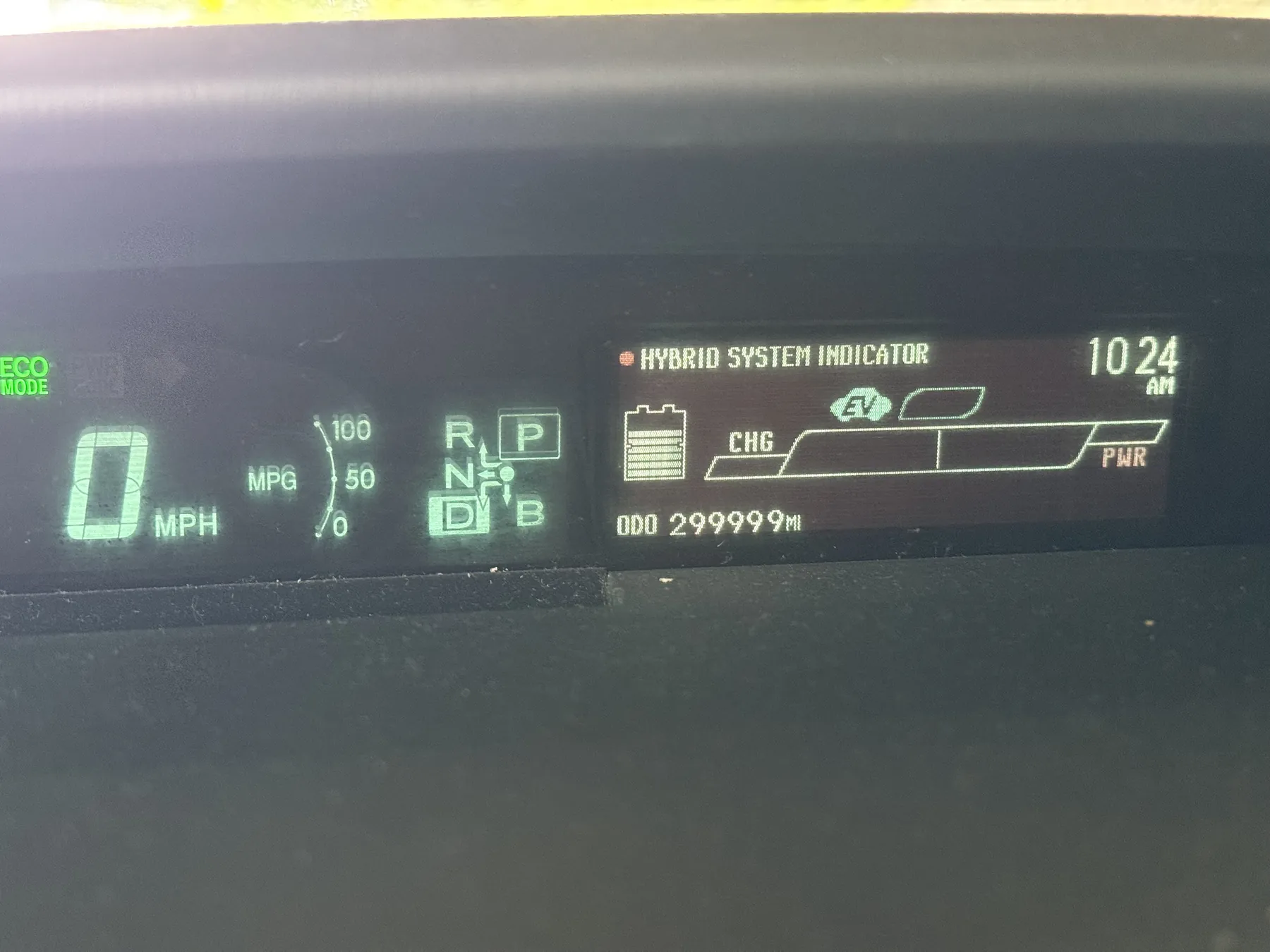

A dark instrument cluster. A large green 0 sits beside MPH. A gauge marked MPG runs from 0 through 50 to 100. The shifter display boxes P and D, with R, N, and B beside them. The screen is headed HYBRID SYSTEM INDICATOR. It shows a battery icon, the letters CHG, a car icon, the letters PWR, and the time 10:24 AM. The mileage line reads ODO 299999 mi. The file page identifies the cluster as the one in a 2014 Toyota Prius II and dates the photograph to September 10, 2025. The display is the mileage that car was showing that morning. The odometer line on an NMVTIS report is the reading a state reported when it titled a vehicle.
The fourth line is total-loss history. The understanding page says a total loss generally means severe damage, and that the line is there so a buyer can avoid a car that may be unsafe. The insurance page covers more than a car that was crushed. On that page a salvage automobile is one damaged by collision, fire, flood, accident, trespass, or another event, to the point that its fair salvage value plus the cost of repairing it for legal operation would be more than its fair market value immediately before the event. The Department of Justice also counts every automobile an insurer finds to be a total loss under the law of the applicable state, or designates as a total loss under its own policy. That count includes a car the insurer retitles into its own name and a car the owner keeps. The consumer page adds the stolen car that is not recovered within 30 days. An insurer may label that car a total loss. If the car is later recovered in perfect condition, the page says the total-loss determination is not removed.
The fifth line is salvage history. The understanding page puts it next to a total loss: a vehicle with a salvage history has had severe damage. The consumer page describes the line a buyer is searching for as any report that the vehicle was transferred or sold to an auto recycler, a junk yard, or a salvage yard, and it includes a salvage determination by an insurance company or a self-insuring organization. A yard’s possession is not, by itself, a brand. The same page says a state does not have to brand a car junk or salvage merely because a yard had it.
The FAQ also lists current and previous state-of-title data, so the record reaches past the latest state, and theft history data if any. Theft data, when a reporter sent it, is a reported theft. A report that does not show one does not establish that the car was never stolen. The consumer page’s opening says historical theft data appears in some cases.
The identifier under all of this is the vehicle identification number. The states page says a state reports the VIN, and any description on the certificate of title, including every brand.
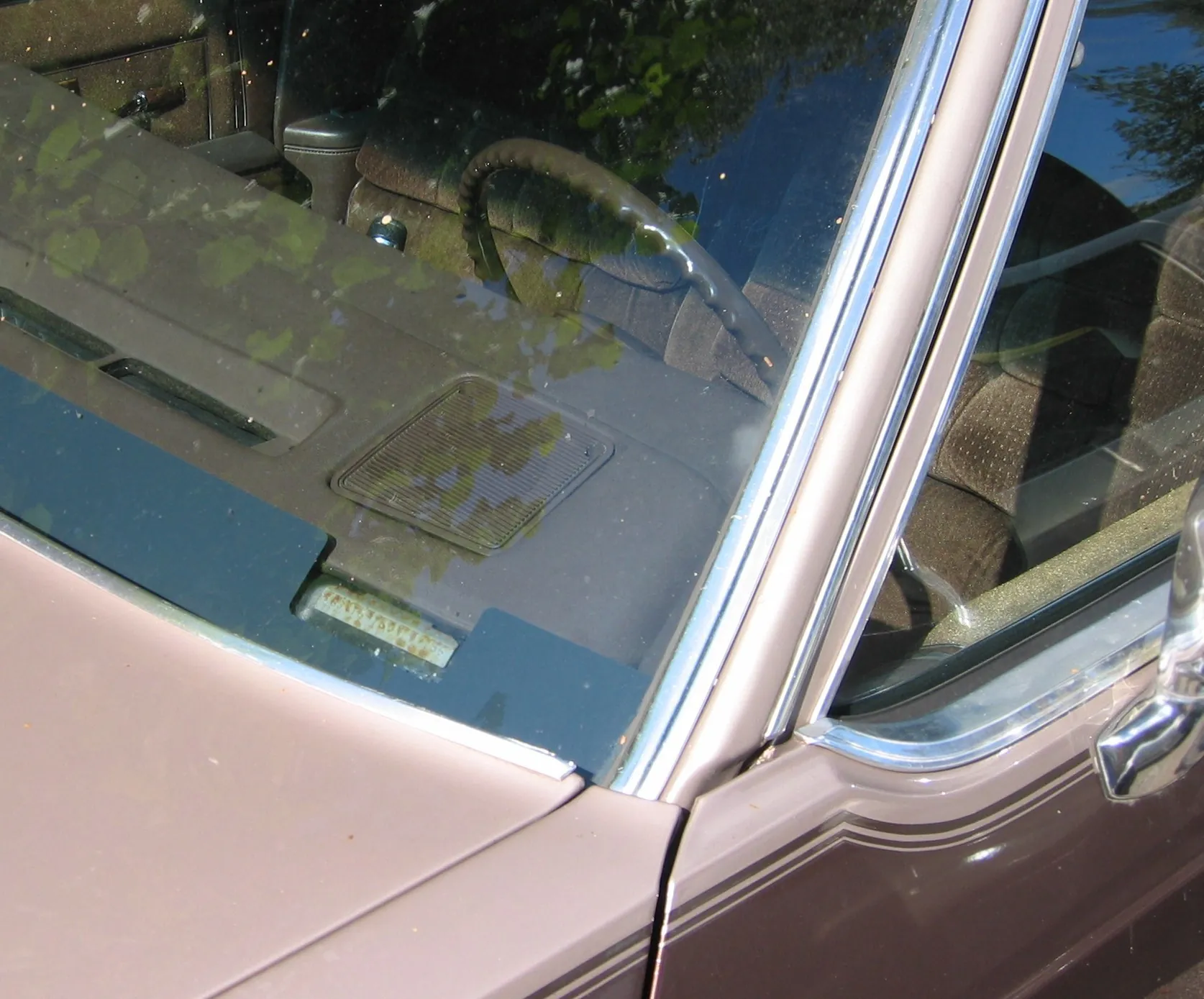

Seen from outside, through the windshield. The hood is pale, the lower body is darker, and a thin stripe runs along the side. Chrome trim frames the glass, and a side mirror sits at the right. Reflections of trees lie across the glass. A steering wheel and the front seats show inside. A small rectangular plate sits on the dash at the base of the windshield. The characters on that plate are not clear. The file page identifies the plate as the vehicle identification number behind the windshield of a GM vehicle, and it dates the photograph to August 11, 2012. The photograph shows where the plate sits. It does not show a readable number, and it does not show a report.
Three reporters, and they do not share one rule
The understanding page names the sources federal law requires to report on a regular basis: state motor vehicle titling agencies, junk yards, salvage yards, auto recyclers, and insurance carriers. It says NMVTIS is the only publicly available system in the United States to which all of those insurers, recyclers, junk yards, and salvage yards must report.
States come first. The states page, using Federal Highway Administration data it dates to 2026, says 100 percent of U.S. DMV data is represented in the system. It counts 51 participating jurisdictions, the District of Columbia included, that provide data and inquire into the system before issuing a new title, and one state still in development. What a state must send is the VIN, any description on the title including all brand information, the name of the person or entity the title was issued to, and junk or salvage information the state is already collecting from yards or insurers. That name is for law enforcement and state motor vehicle agencies. It is not one of the lines the consumer pages list. The state also supplies the odometer reading disclosed when the title was issued, and any later mileage on the title record. New title information and updates go in at least once every 24 hours. A state with integrated access sends the update as the transaction happens. A state on the batch method uploads on a daily cycle. The September 2022 disclaimer describes the same spread from the buyer’s side: some states report as the title transaction happens, and others send updates less often, once every 24 hours or within a period of days.
Before a state issues a title on a vehicle someone is bringing in from elsewhere, the states page says the state has to check the system. The check is there to judge the title document, to see whether the car has been junk or salvage or reported as such, to compare the odometer with what was reported before, and to judge other information presented, which the page illustrates with lien-holder status. In a state that prints the permanent title at a central office after the application, the page says that check can fall at any point before the permanent title. The consumer pages do not list a lien among the lines a buyer receives. Lien-holder status, for that incoming-title check, is the state’s use of the system.
The system does not make the states use one brand. The consumer page says NMVTIS collects what states report and does not change their names or their standards. One state may brand a damaged car salvage because the damage meets that state’s threshold. The page’s example of a threshold is a damage estimate set against fair market value. Another state may leave the same car unbranded. A car that came out of a flood may be branded flood where that designation exists, and carry no such word in a state that has none, and the second state does not have to adopt the first state’s label. The value of the system, that page says, is that it keeps every reported brand, so taking the car across a state line does not wash the brand out of the national record. The paper title from the new state can still omit it. A flood title is the brand a state prints. The NMVTIS line is the brand some state reported, kept after the car moved.
States are required to report automobiles. The system overview says participating states have also been sending other vehicles that carry a VIN, including motorcycles, buses, trucks, motor homes, and truck tractors, and that they are encouraged to keep sending them. The same page leaves out trailers, mobile homes, special machinery, vessels, mopeds, semi-trailers, golf carts, and boats. The FAQ says a commercial vehicle can be missing when a separate agency, rather than the titling agency’s main file, holds that record.
Insurers file a different set of facts. The insurance page requires a monthly report on the junk and salvage automobiles the carrier obtained. So that the reporting is comprehensive, the Department of Justice includes every total loss under state law or under the carrier’s own policy, whether or not the carrier put the title in its name. The required report covers automobiles of the current model year and the four model years before it. The page encourages a carrier to report older vehicles, and to include the primary reason for the salvage or total-loss designation. An older car can be absent from the insurance line because that required window did not cover it. The disclaimer states the mismatch from the other direction: an insurer may have to report a total loss even when the titling state has not branded the car salvage or junk.
Yards file a third set. The page for auto recyclers, junk yards, and salvage yards requires a monthly report on each vehicle taken into inventory. The filing carries the VIN, the date the vehicle was obtained, whether it was crushed or disposed of or offered for sale or for some other purpose, and whether it is intended for export. The name of the person or business it came from is for law enforcement and government agencies, as are the name fields on the insurance report. A yard that already gives the required information to its state, and whose state sends that information on, does not also file with NMVTIS. The glossary says that through fiscal year 2022, Georgia and Tennessee are the only states reporting on behalf of their junk, salvage, and insurance entities. The same glossary puts the reporting duty on an entity that handles five or more junk or salvage automobiles a year. The yard page says a yard that handles fewer than five such vehicles a year is not required to report. A vehicle does not have to be reported when qualified appraisal personnel, working independently of anyone else, decide in good faith that it is neither junk nor salvage. When the yard does not yet know whether the car will be crushed, sold, or rebuilt, the yard page says a further report follows at the disposition, or within 30 days of it.
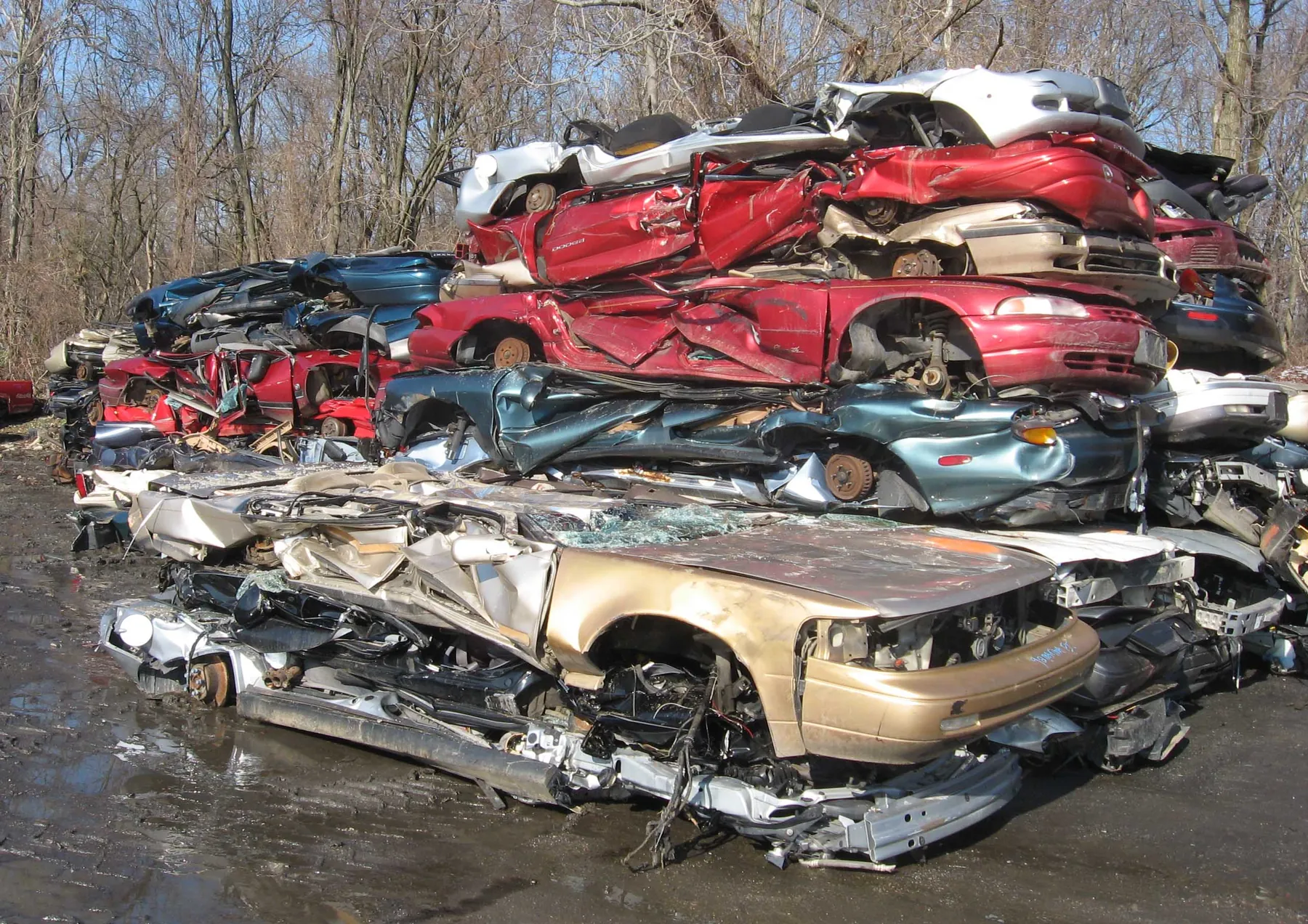


A stack of crushed cars on wet pavement, bare trees behind them under a blue sky. A gold sedan in front has a flattened hood, and its bumper cover and grille are gone, leaving the engine bay open at the nose. A teal car and a red car sit above it, and more crushed bodies are piled higher, some still carrying a wheel. The file page calls this an auto scrapyard in Fort Washington, Maryland, and dates the photograph to January 18, 2008. The yard page asks a reporting yard to say whether a vehicle was crushed or disposed of, or offered for sale. The photograph shows crushed cars in a stack. It does not show a report, and it does not show a brand on a title.
The states page says a state is not required to change how it brands a car, or how it titles one, because insurer, junk, and salvage data are in the system. A state that finds an insurer or a yard in the history is not required to take any particular action. The Department of Justice recommends that the state verify the title document and the history before it issues a new title. A junk or salvage report, and an insurance total loss, can sit in the NMVTIS record while the current title, from a state that did not apply a brand, stays quiet. A salvage title is the document that state issues when it does brand the car. Junk status is that state’s or that reporter’s status. The report is where those reports are collected. It does not issue the title.
A clean report is a short one
The consumer page says a clean NMVTIS report is a good thing, and it says the report is short on purpose. The same page says that until every required entity is reporting, a search can come back with a false negative. The example it gives is a result of no junk or salvage history. The disclaimer says the system does not contain detailed information on a vehicle’s repair history, and that information on previous significant damage may be absent when no insurer determined a total loss and no state titling agency applied a brand. The FAQ uses the repair history as its example of vehicle-history data NMVTIS does not contain.
The understanding page says private vehicle history providers offer information the system is not intended to include: vehicle repair histories, recall information, and other care and maintenance data. The FTC page draws the same line from the buyer’s side. The NMVTIS site is where that page sends someone for title, insurance-loss, and salvage information. Reports from other providers sometimes add accident and repair history. An accident that never became a brand, a total loss, or a junk or salvage report is not one of the lines this system stores. A shop’s invoice is a different paper. A repair order is that shop’s account of one job. It does not post itself into this record.
The disclaimer adds a warning about the printout. An approved provider can include vehicle-condition data from sources other than NMVTIS. The federal lines, and any extra pages that provider attaches, are two bodies of information in one product. A long printout from an approved provider can be more than the five lines.
The disclaimer, the understanding page, and the FTC page each say the report does not stand in for an independent inspection. The understanding page tells a buyer to get the inspection, the NMVTIS report, and the other vehicle information that is available, before deciding.
The title record at the current state is a different request
The consumer page says the information in NMVTIS is not all of the information a state may keep in its title records, and it tells a buyer to look at the actual state title record before a purchase. Each consumer report, that page says, includes a link to the current state’s full vehicle title record. The directory that link uses is the Department of Justice list of how to request the record from that state. The FAQ says a complete copy is requested from the current state motor vehicle titling agency.
That request is one state’s file. It holds what that state keeps on a title, which is more than the five lines, and it is the file of the state that currently titles the car. A brand a previous state reported, which this state left off the paper, can be missing from that file. An insurer’s total loss or a yard’s report from somewhere else is in that file only if this state took the information into its own record. A title and a registration are already two records inside one state. An NMVTIS report is a third record: the national extract of title state, brand, odometer-at-title, junk, salvage, and total-loss reporting, with previous title states and any theft history when a reporter sent them.
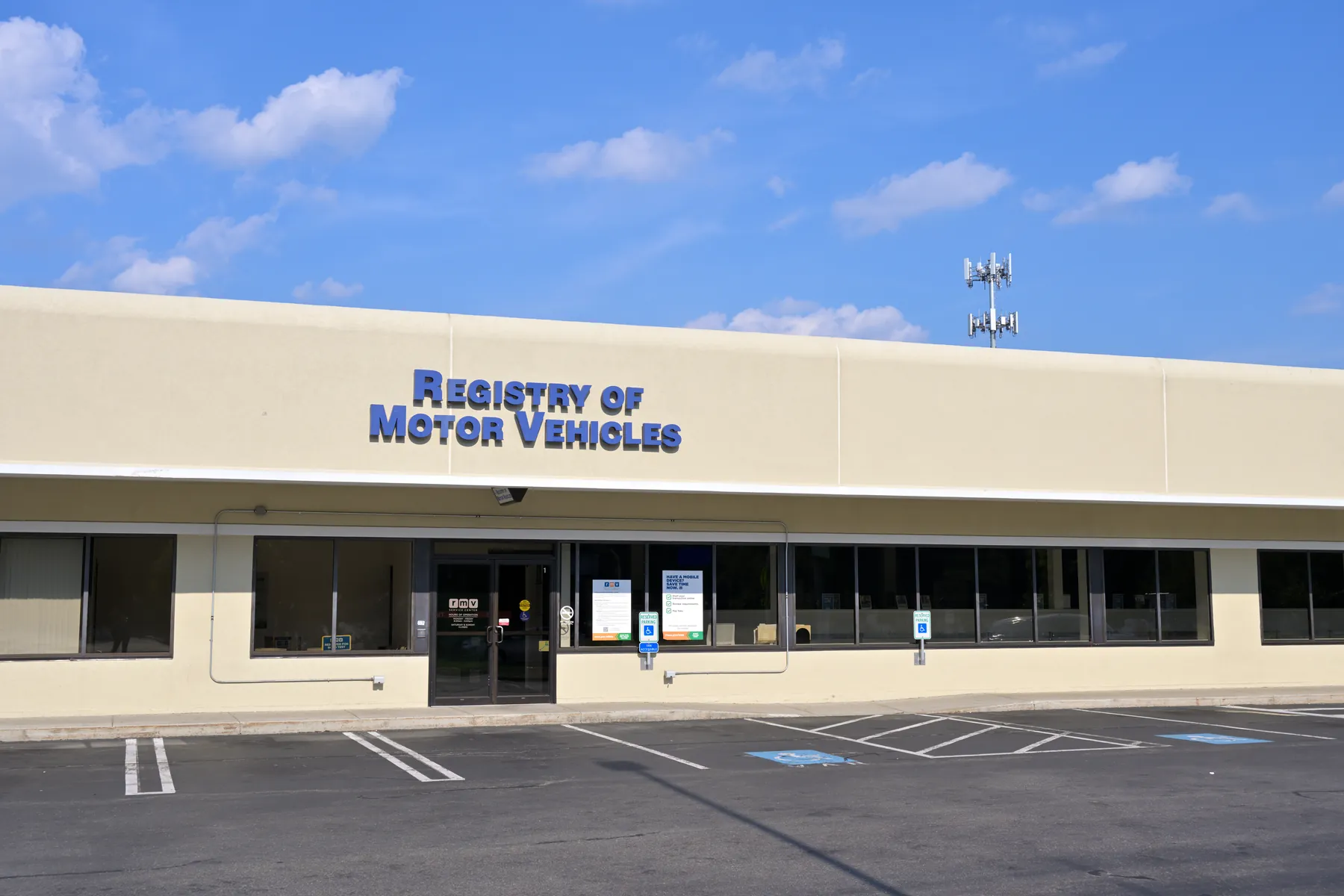

A beige one-story building under a blue sky with scattered clouds. Large blue letters on the facade read REGISTRY OF MOTOR VEHICLES. A glass door sits under the letters, with dark windows along the front. The lot in front has white parking lines and blue accessible-parking markings. A cell tower rises behind the roof. The file page identifies the building as the Wilmington branch of the Massachusetts Registry of Motor Vehicles and dates the photograph to July 6, 2025. The photograph shows the sign. It does not show a title record, and it does not show how that registry takes a request. The consumer report’s link is the Department of Justice directory for the current state’s own record.
A buyer holding an NMVTIS report is holding the lines the required reporters sent. The current title state and the last title date. The brands states applied, kept after a later title went quiet. The latest odometer reading in a title record. Junk and salvage reports, and insurance total losses, including a total loss the titling state never branded. Previous title states, and theft history, when those were reported. The report establishes that those reporters sent those lines. It does not establish that the car was never damaged, never repaired, or never in a crash that nobody branded and nobody totaled. The certificate on the desk is the current state’s title. That state’s own title record is the longer file the certificate comes from. A commercial history report, when a buyer gets one, is the product that may add the accident and repair history these pages leave out.
Sources
- Bureau of Justice Assistance: National Motor Vehicle Title Information System overview — The system was created under the Anti Car Theft Act of 1992. In 1996 responsibility moved from the Department of Transportation to the Department of Justice. The system is an electronic means of verifying and exchanging title, brand, theft, and related data among state titling agencies, law enforcement, consumers, and other authorized users. The overview's telephone number is not repeated here.
- Department of Justice, Vehicle History: For consumers — What the system is, who reports into it, and what a consumer can search before a purchase: current title information and brand history, the latest reported odometer readings, an insurer or self-insurer salvage determination including total loss, and a report that the vehicle was transferred or sold to an auto recycler, junk yard, or salvage yard. A brand stays in the record once a state reports it. State brand names and thresholds are not nationalized. A junk-yard possession does not by itself require a state brand. An unrecovered stolen vehicle can be labeled a total loss and that label is not removed if the vehicle is later recovered. A clean report can still be a false negative while required reporting is incomplete. NMVTIS is not the whole of a state's title record, and each consumer report links to that state's full record. The page's older participation percentages are not used here; the states page supplies the 2026 count. Company names and case counts on the page are not repeated.
- Department of Justice, Vehicle History: Understanding an NMVTIS vehicle history report — The consumer report is limited to five indicators: current state of title and last title date, brand history, odometer reading, total-loss history, and salvage history. A clean report is short on purpose. State titling agencies, junk yards, salvage yards, auto recyclers, and insurance carriers are the sources, and the page calls this the only publicly available U.S. system to which all insurers, auto recyclers, junk yards, and salvage yards must report regularly. Private history reports offer repair histories, recall information, and other care and maintenance data the system is not intended to include. The buyer is told to get an independent inspection, this report, and other available vehicle information.
- Department of Justice, Vehicle History: Frequently asked questions — What a consumer record provides: current and previous state-of-title data, title issue date, latest odometer data, theft history data if any, any brand and the date it was applied, and salvage history including a total-loss designation. The report does not contain a repair history. Vehicle types in the system, and the gap for a commercial vehicle held by a separate agency. A complete state title record is requested from the current state titling agency. The page's price range for a report is not repeated here.
- Department of Justice: NMVTIS consumer access product disclaimer, revised September 2022 — The system is a source of title and brand history and does not contain a detailed repair history. Significant prior damage may be absent if no insurer determined a total loss and no state applied a brand. An insurer may have to report a total loss even when the titling state has not branded the vehicle salvage or junk. State updates arrive in real time, about every 24 hours, or within a period of days. The included data, as available from required reporters, cover participating states' title information, the brand types those states apply, the most recent odometer reading in the state's title record, and insurance and recycler reporting that includes a carrier's total-loss determination. An approved provider can add vehicle-condition data from sources other than NMVTIS. The report is not a substitute for an independent inspection.
- Department of Justice, Vehicle History: For states — Using Federal Highway Administration data the page dates to 2026, 100 percent of U.S. DMV data is represented. Fifty-one participating jurisdictions, including the District of Columbia, provide data and inquire before issuing a new title, and one state is in development. States report the VIN, the description on the title including every brand, the name of the person or entity the title was issued to for law enforcement and state agencies only, junk or salvage information the state already collects, and the odometer reading disclosed when the title was issued plus any later mileage. Updates at least every 24 hours, in real time for integrated states and by daily batch otherwise. The American Association of Motor Vehicle Administrators is the system operator. A state is not required to change its branding because insurer, junk, or salvage data is present. The state's pre-title check of a vehicle brought in from elsewhere covers the title document, junk or salvage status, the odometer, and other information including lien-holder status. Fee figures and the 2007 transaction count are not repeated here.
- Department of Justice, Vehicle History: System overview — AAMVA operates the system and the Bureau of Justice Assistance oversees it. States are required to report automobiles and are encouraged to report other vehicles that have a VIN, including motorcycles, buses, trucks, motor homes, and truck tractors. Trailers, mobile homes, special machinery, vessels, mopeds, semi-trailers, golf carts, and boats are excluded. The page is dated March 24, 2025. Grant totals and statute section numbers on the page are not repeated here.
- Department of Justice, Vehicle History: Glossary — A brand is a designation on the ownership document, including the electronic record, for an event that affects value or safety, such as junk, salvage, or flood, and state brands are mapped into the system. The odometer reading is reported when a state titles a vehicle. Approved data providers are companies under contract with the operator to sell reports that contain NMVTIS information, and they are listed on the AAMVA and DOJ sites. A junk, salvage, or insurance entity that handles five or more junk or salvage automobiles a year has the reporting duty. Through fiscal year 2022, Georgia and Tennessee are the only states the page names as reporting on behalf of those entities. The page is dated March 24, 2025.
- Department of Justice, Vehicle History: For auto recyclers, salvage yards, and junk yards — A monthly report on each vehicle received: the reporting entity, the VIN, the date obtained, whether the vehicle was crushed or disposed of or offered for sale or another purpose, and whether export is intended. The name of the person or entity it was obtained from is for law enforcement and government agencies only. A yard that already reports the required information to its state, and whose state sends that information on, does not also file with the system. A good-faith appraisal that the vehicle is neither junk nor salvage is outside the requirement, as is a yard below the yearly count the page states. A further report follows when a disposition that was unknown becomes known. State definitions are not replaced, and a later state is not required to use the yard's report when it titles the vehicle. Consolidator names and telephone numbers are not repeated here.
- Department of Justice, Vehicle History: For insurance carriers — Carriers report monthly on junk and salvage automobiles they obtain, including every automobile found to be a total loss under the applicable state's law or designated a total loss under the carrier's policy, whether the carrier retitles the vehicle or the owner keeps it. The required monthly report covers automobiles of the current model year and the four prior model years. Reporting on older vehicles, and the primary reason for the designation, is encouraged and not required. The name fields are for law enforcement and government agencies only. A later state is not required to use the carrier's report when it titles the vehicle. Consolidator names and telephone numbers are not repeated here.
- Department of Justice, Vehicle History: State vehicle record request information, 2024 — The directory the consumer report uses for the current state's full vehicle title record. This article does not list the state-by-state request steps.
- Federal Trade Commission: Used cars — The page sends a buyer to the NMVTIS website, which it names vehiclehistory.gov, for a vehicle history report with title, insurance-loss, and salvage information, from a provider that site lists. Reports from other providers sometimes add information such as accident and repair history. The FTC does not endorse specific services. A vehicle history report is not a substitute for an independent inspection. Provider names printed on the page are not repeated here.
References checked .